


The morning air carried the sharp, damp scent of the redwoods and the unmistakable, earthy musk of the primate enclosures. It was feeding time. Seventeen Japanese macaques shrieked, tumbled, and vaulted across their climbing structures, a chaotic blur of gray fur and kinetic energy against the backdrop of the waking sanctuary. But amidst the frenzy, one remained perfectly, unnervingly still.
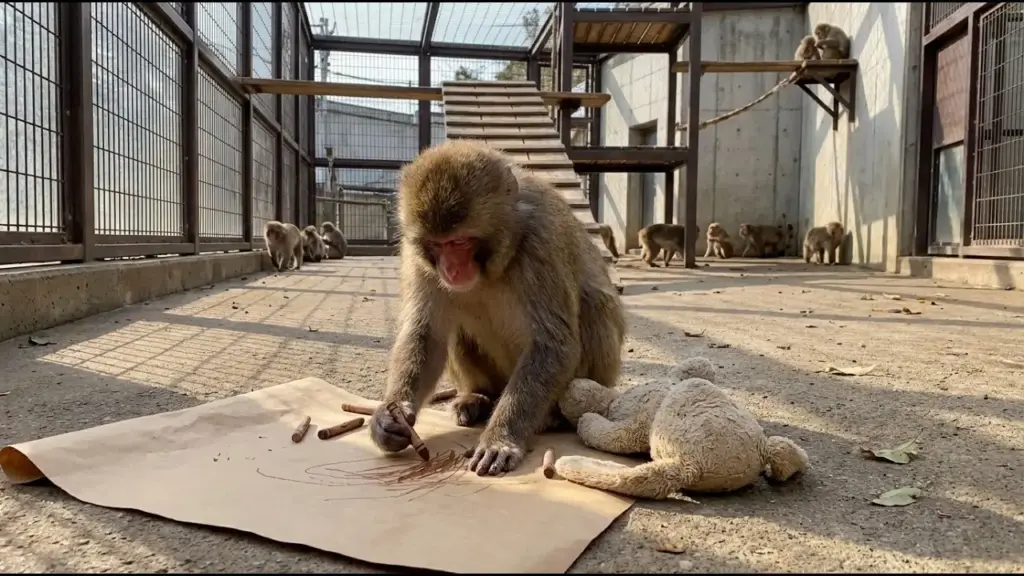
She sat anchored in the far corner of her enclosure, her small spine curved against the chain-link mesh. Clutched tightly against her chest was a stuffed rabbit, its gray fabric threadbare from years of desperate handling, a single floppy ear remaining. In her right hand, she gripped a blue crayon that had been worn down to a blunt, uneven nub. Nathan Cole paused, lowering his heavy feed bucket to the cold concrete floor. He had only been on the job for three weeks, still struggling to match the myriad of faces to the names in the intake files, but something about the profound isolation of this particular macaque rooted him to the spot.
On the concrete directly in front of her lay a piece of paper bearing three distinct shapes. One was blue, one was brown, and one was green. Nathan would only later come to realize the staggering gravity of those shapes—that she had sat in this exact spot, rendering this exact configuration, every single day for one hundred and twenty-seven days. She did not look up at the raucous activity of her troop. Her small, leathery hand moved across the paper with a slow, deliberate cadence.
This was not the erratic scribbling of an animal at play. This was labor. This was an animal working with an absolute, consuming purpose. Nathan reached into his pocket, pulled out his phone, and captured a photograph of her through the mesh. He did not fully understand what compelled him to document the moment, only that the silence radiating from her demanded to be witnessed.
Later, sitting in the harsh, humming glow of the staff break room, Nathan enlarged the image on his laptop screen. The room smelled perpetually of scorched coffee and astringent industrial floor cleaner, a sterile contrast to the raw life outside. He zoomed in on the crayon marks. Blue, brown, green. At a passing glance, it resembled a toddler’s idle scratching. Yet, the longer Nathan allowed his eyes to trace the lines, the more the shapes seemed to hold an intentional ground. They were consistent. They were anchored. It was as if she knew precisely the story she was trying to force onto the page.
He toggled over to the sanctuary’s staff database, pulling up the intake notes. Her name was Aki. She was a four-year-old female, born right here on the sanctuary grounds. The clinical notes betrayed a quiet tragedy: rejected by her mother within twelve hours of birth, cause of rejection unknown. The next line made Nathan lean back in his chair. Aki had been hand-raised by a senior caretaker named Daniel Mitchell. It was the same name printed on the faded label of the desk Nathan now used, a name that seemed to carry an invisible weight, one the rest of the staff conspicuously avoided speaking aloud.
Nathan read further into the enrichment protocols. The notes indicated cognitive stimulation through mark-making, noting the subject’s preference for repetitive patterns. It also documented her intense attachment to a comfort object, the stuffed rabbit, provided by that same caretaker. Nathan’s eyes drifted back to the photograph on his screen. The rabbit pressed to her heart, the crayon in her fist, the deliberate shapes on the floor. For four formative years, she had carried that fabric toy. For four years, she had anchored her entire existence to one man. And then, he had simply vanished.
Nathan closed the laptop. He walked to the break room window, watching the coastal fog drift through the towering redwoods, thick and pale like the smoke of a dying fire. He had taken this low-paying, invisible job specifically for the quiet. He had come here because nobody knew his face, because he could spend his days shoveling enclosures, portioning fruit, and sweeping concrete without ever having to explain why a once-renowned photojournalist had suddenly put down his camera.
For eight years, Nathan had lived in the sweltering heat of Southeast Asia, tracking trafficking routes and exposing underground primate markets. His memories were permanently stained with the sights of cages stacked from the floor to the ceiling in rotting warehouses, spaces thick with the suffocating stench of ammonia and pure, vibrating terror. He had managed to get twelve macaques out of a compound in Laos before the entire sting operation catastrophically collapsed. Twelve saved, out of fifty-five.
The brutal footage he captured had aired across three major television networks. A prominent senator had given an impassioned speech. Heartbroken donations had flooded the wildlife charities for exactly two weeks. And then, as it always does, the relentless news cycle had churned forward, leaving the remaining forty-three animals to slip into the dark. Nathan had stopped shooting the very next day. He packed his expensive lenses into a canvas duffel bag, convincing himself they were nothing more than dead weight. Yet, a phantom weight remained; he carried the ghosts of Laos in his chest every single day.
Turning his back to the fogged glass, Nathan reopened the staff directory. Daniel Mitchell, senior caretaker. Twelve years of dedicated service. The final entry read: Emergency departure, December 26th. No forwarding contact information provided. The day after Christmas.
Nathan immediately cross-referenced the dates with Aki’s behavioral logs. December 29th: Subject accepted a small portion of fruit, began repetitive mark-making with enrichment crayons. It was the exact same week Daniel Mitchell had stopped answering his phone.
The following morning, the coastal air bit at Nathan’s cheeks as he dropped fresh apple slices through the metal feeding slot of the enclosure. The troop of seventeen macaques rushed the pile, a chaotic chorus of hooting and grabbing. Aki did not move. She remained in her corner, sitting cross-legged, the frayed rabbit wedged securely between her knees. Her right hand swept across a pristine sheet of paper. Blue crayon. Slow, heavy, deliberate strokes.
Nathan crouched down, the cold concrete seeping through his denim jeans, his joints popping in the quiet air. He watched her work. The other monkeys wrestled and shrieked mere feet away, but Aki never flinched. She didn’t look up at the fruit or the commotion. Her focus was a fortress. Slowly, Nathan retrieved his phone and took a second photograph. The digital click of the shutter made her tufted ears twitch, pivoting slightly toward the sound, but her hand never broke its rhythm.
By noon, Nathan had commandeered the small table in the break room, spreading the photographs out under the buzzing fluorescent lights. Yesterday’s drawing on the left. Today’s drawing on the right. Side by side, the reality of it sent a cold prickle down his arms. The shapes matched perfectly. The placement on the page, the strange, distinct proportions, the exact use of the three colors.
Linda Kowalski, the sanctuary’s lead veterinary technician, pushed through the door. She cradled a steaming ceramic mug of coffee, pausing to glance at the scattered printouts.
“Still obsessing over that?” she asked, her voice carrying the weary edge of someone who had seen too many caretakers project their own emotions onto the animals.
Nathan didn’t lift his eyes from the images. “Has anyone actually taken the time to analyze what she’s drawing?”
Linda sighed, her shoulders lifting in a dismissive shrug. “It’s basic enrichment behavior, Cole. Daniel used to give her those crayons to keep her grounded when he was cleaning the habitat. She liked the colors. It became a habit. End of story.”
“This doesn’t look like a habit,” Nathan countered, tapping his index finger against the rightmost photo. “Look at the fierce consistency. The repetition. This doesn’t look like an animal just soothing itself. This looks like she is actively trying to finish something.”
Linda walked over to the counter, topping off her mug from the carafe. A curtain of steam rose between them, momentarily blurring her features. “She’s been doing it for months. If it actually meant anything profound, one of the seniors would have flagged it by now.”
“Maybe nobody was brave enough to really look,” Nathan said quietly.
Linda froze, the rim of the mug hovering inches from her lips. A complicated flicker of guilt and defensiveness passed over her eyes, there and gone in a fraction of a second. “I’ve got afternoon rounds,” she muttered, turning on her heel and letting the heavy door swing shut behind her. Nathan was left sitting alone in the humming light, staring down at the blue, brown, and green marks, entirely certain that Aki was speaking into a void that no one had bothered to measure…To read the rest of the story – CLICK the NEXT button 👇👇👇