


“What exactly is going on out here?” Dr. Thomas Vance’s voice cut through the clamor of the maternity ward hallway, sharp and heavy with authority.
He stopped in the middle of the corridor. The second floor of Oakhaven County General always smelled the same: a stale mix of industrial bleach, worn vinyl flooring, and sheer exhaustion. Slumped against the peeling plaster wall, curled into a tight, trembling knot on a cracked waiting-room bench, was a young woman. Her knuckles were bone-white where she gripped the hem of a frayed wool coat, her breathing shallow and ragged. Around her, the nursing staff buzzed in a chaotic orbit, creating plenty of motion but delivering zero actual medical care.
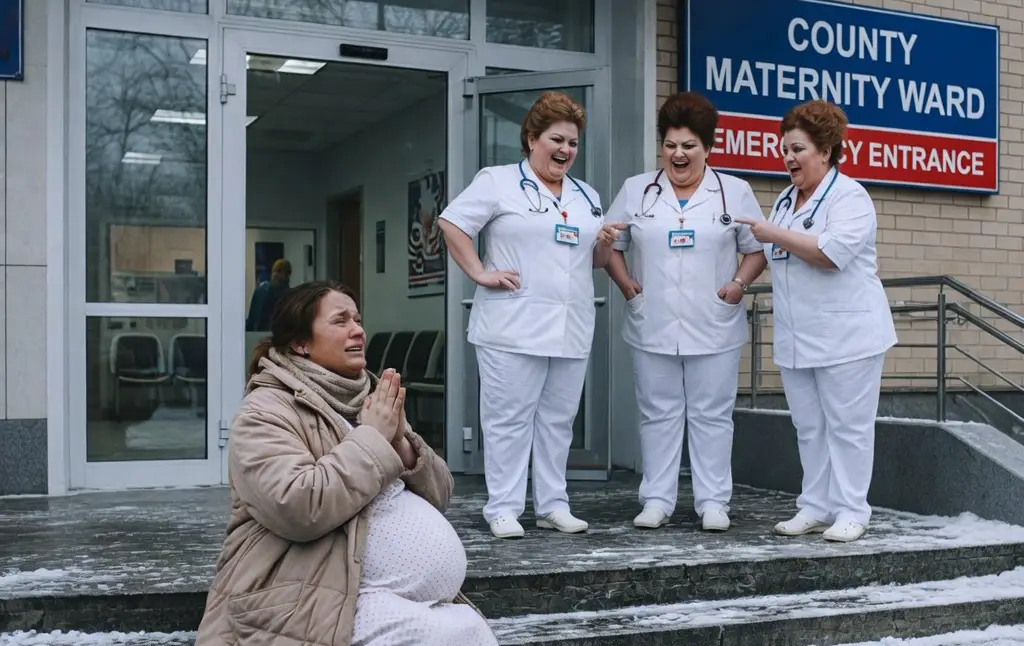
“I asked a question,” Thomas said, fixing the staff with a stare that had been known to make third-year residents suddenly forget their own names. “Why is a patient in active labor sitting in a drafty hallway?”
Maya—though no one in the hospital yet knew the exhausted woman’s name—had been huddled on that unforgiving bench for the better part of an hour. Each minute had dragged over her like broken glass. She had prayed, silently and desperately, for someone in scrubs to stop, to look at her, to offer even a fraction of relief. Instead, the floor nurses hurried past, throwing her quick, glassy-eyed glances. They had their own fires to put out. Who had the bandwidth for a nameless walk-in? A county EMS rig had picked her up off the sidewalk outside a strip mall three towns over. She had no ID, no insurance card, and no cash. To the hospital’s administrative system, she was a ghost.
Bystanders had called 911 when she collapsed on the concrete, clutching her swollen stomach through a sudden, crushing contraction. But upon arrival at Oakhaven, the reception had been clinically cold. The charge nurse had quickly assessed her status: no paperwork, no prenatal records. By law, they couldn’t turn her away, but they could certainly park her in the corridor while they scrambled to figure out what to do with a financial and medical liability.
“Where are we supposed to put her?” Chloe, a young nurse barely six months out of her clinical rotations, kept her voice low. She hadn’t yet grown the thick armor of cynicism required to survive this ward. “She needs a bed now. Let’s just get her into triage and worry about the billing later.”
“Triage is full. Every room is full of women who actually made appointments,” Brenda snapped. She didn’t look up from the towering stack of patient charts at the central desk. A twenty-year veteran of the maternity ward, Brenda had seen enough life, death, and administrative failure to learn exactly how to ration her empathy.
“If we bump a scheduled induction for every walk-in off the street, we’ll lose our licenses,” the older nurse muttered, aggressively flipping a page. “We’re already drowning. We’ve been pulling double shifts all week because half the staff is out with the flu. You want to deliver a baby in the supply closet? Because that’s what’s left.”
Brenda rubbed her temples, the lines around her eyes deep and gray.
“There are no beds. Period. When someone discharges, we’ll move her. Until then, grab some vitals and stop hovering.”
Chloe dropped her gaze. Arguing with Brenda was like trying to stop a freight train with bare hands. The senior nurse was forged from decades of underfunded budgets, screaming monitors, and bureaucratic red tape. To her, the endless line of patients had become a logistical equation that needed solving, not a series of human tragedies.
It was Brenda who had briskly guided Maya to the hallway bench, handed her a paper cup of water, and immediately pivoted to a delivery room where three other women were already progressing. The workload at the rural county hospital was, quite frankly, a disaster. Somewhere beneath the harshness, the staff’s sheer fatigue was understandable. They were keeping the place running on fumes and caffeine.
Thomas, as the Chief of Staff, fought a losing battle every quarter to recruit fresh talent. But reality was stubborn: no ambitious young doctor wanted to settle in a decaying Rust Belt town for a fraction of the salary they could make in Chicago or Cleveland. The good ones left. The ones who stayed inherited the burnout.
“Get her into Exam Four immediately,” Thomas ordered, his tone leaving zero room for debate. He had already read the situation. “I don’t care if you have to move the ultrasound machine into the hall. I’ll be in there in two minutes. Prep a tray.”
He adjusted the collar of his coat, feeling the sudden spike of adrenaline. It had been years since Thomas had personally delivered a baby. With his administrative load, he usually only stepped in during catastrophic emergencies when the floor was completely overrun. But this qualified. When he saw the sheer, hollow terror in the girl’s eyes, his professional detachment fractured. He couldn’t just walk away. Something about the way she stared at the floor, expecting absolutely nothing from the world, twisted a cold knot just under his ribs.
Ten minutes later, scrubbed in and gloved, Thomas pushed through the heavy door of Exam Four.
“Who was supposed to be monitoring her?” he asked quietly.
“Brenda,” Chloe whispered, nervously adjusting the edge of her gown. “Dr. Vance, please don’t come down too hard on her. It’s a war zone out there today. Brenda’s on hour eighteen of a double. She slept for maybe forty minutes on a breakroom chair.”
“Save the excuses for the mortality review,” Thomas cut her off, moving to the foot of the bed. “Right now, we have a patient.”
The next two hours collapsed into a blur of tense, measured action. The strained silence of the exam room was finally shattered by a sharp, furious cry. Maya, pale and shivering with exhaustion, weakly reached out. Thomas gently laid a warm, towel-wrapped weight on her chest. A boy, red-faced and furious, with a shock of dark hair, squinting against the harsh fluorescent lights.
“Well, congratulations, mom,” Thomas said, his voice dropping its clinical edge, replaced by a warm, genuine smile as he stripped off his bloody gloves. He was profoundly relieved it had gone smoothly.
“What’s there to congratulate?” Maya replied, her voice completely hollow.
Her large, exhausted eyes pooled with tears she fought to hold back. She bit her cracked lower lip, trembling. For a second, the veteran doctor thought she was going to completely break down from the sheer weight of her reality. He froze, his hand resting on the metal edge of the instrument tray. He couldn’t look away.
Something in the exact shape of those eyes—the subtle, unmistakable angle of her jawline—made his heart physically stumble in his chest. A missed beat. A sudden rush of cold air in his lungs.
It can’t be, a wild, completely irrational thought flared in his mind.
He had noticed something vaguely familiar when he first looked at her in the hallway, but there had been no time for ghosts. The contractions had been stacking up; the fetal heart rate needed tracking. Now, in the quiet aftermath, the resemblance slammed into him. Maya curled inward, pulling the blanket tight around her shoulders, instinctively walling herself off from the strange doctor staring at her.
“What do you mean?” Thomas asked, recovering his composure, though his pulse hammered against his throat. “Look at him. He’s perfect. Have you picked out a name?”…
To read the rest of the story – CLICK the NEXT button 👇👇👇