


The red dog collar hanging from a low branch of the white pine told Mara Bennett she had found the right tree. Its leather had darkened with age, and the brass tag had been rubbed nearly smooth. A girl in a yellow rain jacket stood on the lowest root, polishing the tag with her mittened thumb while a tall man steadied her by the elbow. At his feet rested a green forestry pack with a red rescue throw bag clipped to one side.
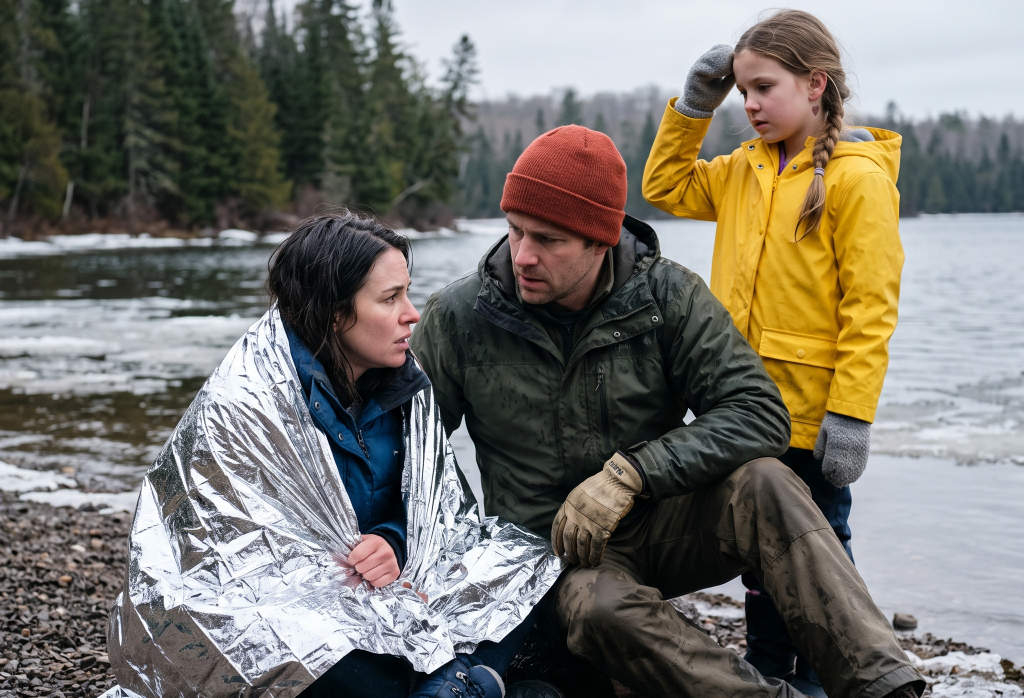
Beyond them, snowmelt ticked through Pine Hollow Forest in northern Minnesota.
“Juniper,” the girl read. “Dad, do you think she knew it was my birthday?”
“She knew somebody needed finding,” the man said. “Dogs don’t care much about calendars.”
Mara pressed herself against the rough trunk of a spruce thirty yards away. The folded newspaper clipping inside her coat crackled against her ribs.
NEWBORN FOUND ALIVE NEAR SENTINEL PINE, the ten-year-old headline said. A later feature showed the same man kneeling beside a redbone hound, with a brown-haired child named Nora between them. It identified him as Eli Rowan, a Birch County forester and volunteer EMT. The infant, it said, had survived and later been adopted by a local family.
For ten years Mara had believed the paw prints in the snow belonged to something that had carried her baby away. For six days she had known there might be another answer. She had come to the pine wanting proof and dreading it with the same breath.
The girl unclipped the collar and tucked it carefully into a canvas field bag. She was narrow-shouldered and long-legged, with a brown braid slipping loose beneath her knit cap. When she bent to retrieve a pencil, the braid fell forward and exposed the skin below her left ear.
There, small and unmistakable, lay a rust-colored mark shaped like a crooked heart.
Mara’s knees softened.
Ten years vanished, and she was seventeen again in a drafty packing shed, holding a child no bigger than a barn cat against her bare chest. She remembered touching that mark with one shaking finger, terrified by how perfect it was.
The girl straightened. For one impossible second, her clear gray eyes looked directly through the trees toward Mara.
“Someone’s over there,” she said.
Mara turned before the man could answer. A branch caught her sleeve as she pushed through the undergrowth, and the small blue fabric square she carried everywhere slipped halfway out of her pocket. She shoved it back in without stopping.
She had left Cal that morning while he was loading feed at the co-op. Her sister Sophie had driven her to a domestic-violence center two counties south, but after an hour in its safe room, the clipping began to feel like a hand around her throat.
Mara had taken bus fare from the emergency cash she had hidden for months and come north. She had told herself she only wanted to see the tree.
Now she had seen the child.
The trail dropped toward Blackwater Lake, a spring-fed iron quarry that never froze completely. In March the water was the color of a shovel blade, open near the middle and crusted with rotten ice along the shaded bank.
Mara stepped past the warning sign and the waist-high steel safety post beside it. Her boots sank into mud at the edge.
Behind her, a man called, “Ma’am?”
She walked into the water.
Cold locked around her ankles, then her knees. It did not feel peaceful. It hurt with an animal sharpness that emptied her lungs and made her stumble.
Still she kept moving, because the girl had been alive for ten years without her, and Mara could not imagine carrying both that mercy and what she had done.
“Ma’am, stop where you are.” The man’s voice had changed. It was closer now, clipped by training. “Turn around and look at my red cap.”
Mara saw the reflection of his jacket shivering across the water. She took another step.
The quarry floor ended beneath her.
Water closed over her mouth before she could draw a breath. She clawed at weeds, found nothing solid, and surfaced once to the sound of the girl shouting into a phone. A bright loop of rescue line struck the water beside her.
Mara watched it drift past.
Then the man was there. A tether ran from his waist to the steel post onshore, and he caught the back of her coat with one hand. He said something she could not understand. The cold had turned every sound into metal.
He did not let go.
Mara came back to herself on gravel with her cheek against a wool glove. She coughed lake water until her ribs cramped. The girl in the yellow coat knelt several feet away, still holding the phone, her face pale but composed.
“She’s breathing,” the girl told the dispatcher. “Yes. Dad says she’s breathing.”
Mara stared at her.
“Nora,” she whispered.
The girl’s gaze sharpened.
Eli Rowan covered Mara with a silver emergency blanket from his field pack. He was soaked to the waist and breathing hard, but his hands remained steady as he checked her pulse.
“Help is coming,” he said. “Don’t try to stand.”
Mara looked toward Nora again. Up close, she could see the faint spray of freckles across her nose and a graphite smudge on one mitten. The child watched her with worry, not recognition.
Why would there be recognition? Mara had held her for less than an hour.
“Nora,” Eli said, “go wait by the trail marker. Keep the dispatcher with you.”
“Can I see you from there?”
“The whole time.”
Nora backed away without taking her eyes off Mara. At the marker she turned, pressed the phone to her ear, and began giving directions in the careful tone of a child determined not to get anything wrong.
Eli crouched beside Mara again. His red cap lay near the water, dark and flattened.
“What’s your name?”
Her teeth struck together. “Mara.”
“Mara what?”
She almost gave him her married name. Cal’s name had been on her paychecks, the truck title she was never allowed to touch, and the bank card he kept in his wallet. It had never sounded like hers.
“Bennett,” she said.
“All right, Mara Bennett. Stay on your side. I’m going to sit right here until the ambulance comes.”
His tone held no bargain and no sermon. That kindness was harder to bear than anger.
Mara began to shake so violently that the emergency blanket whispered around her. The blue square fell from her coat and landed on the gravel between them.
Eli reached toward it, then stopped. “Is that yours?”
It had once been part of a pinwheel quilt, faded navy cotton printed with tiny yellow stars. One edge was finished by hand; the other three were ragged.
Mara picked it up before the meltwater reached it.
“Your daughter,” she said. The words scraped her throat. “Does she know where she came from?”
Every trace of reassurance left his face.
“She knows she was adopted. She knows Juniper found her near that pine.”
“And the blanket?”
He did not answer.
Mara looked past him. Nora had removed her cap and was trying to retie her braid one-handed while she spoke to the dispatcher. The movement revealed the heart beneath her ear again.
“Does the mark have a pale notch through the left side?” Mara asked.
Eli rose halfway, placing his body between Mara and the child. “How do you know about that?”
“The blue quilt was missing one square when you found her.” Mara opened her fist. “This square.”
Sirens sounded faintly beyond the trees. Eli stared at the torn cloth, then at the woman he had just pulled from the lake. “Were you the one who left my daughter under that tree…”
To read the rest of the story – CLICK the NEXT button 👇👇👇