


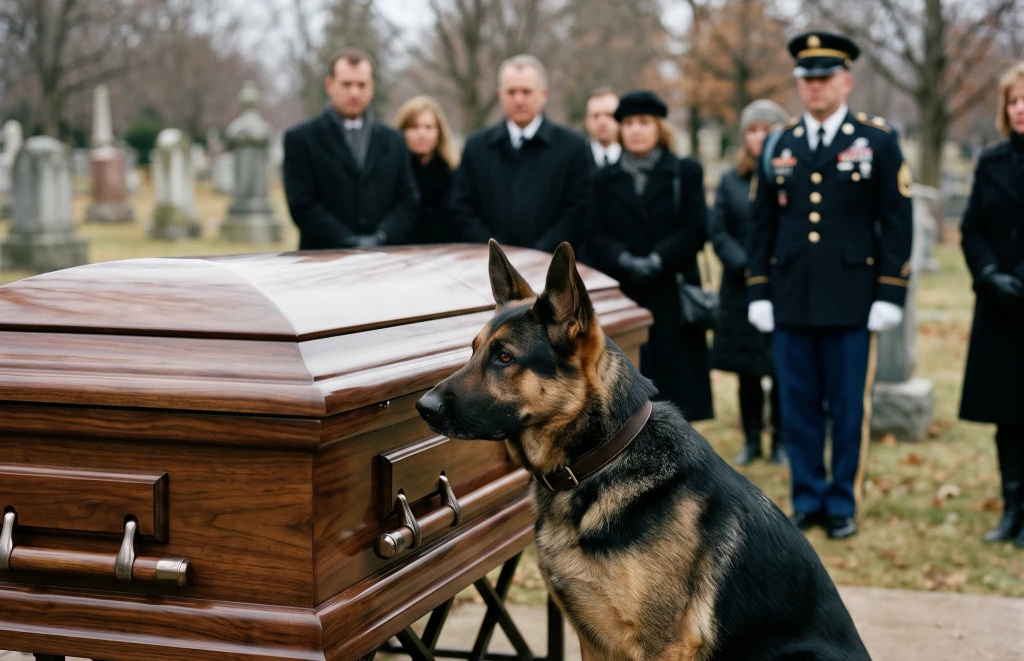
Ranger began to whine before the chaplain said Ben’s name. Mara Whitaker felt the sound travel up the leash and into her wrist, a small vibration that seemed indecently alive beside the child-size casket. She shortened the lead and pressed her knee against the German Shepherd’s shoulder. He had lain through ambulance sirens, infusion alarms, and the worst nights of Ben’s illness without breaking a command. Now his ears were pitched toward the blue blanket visible beneath the raised viewing panel, and he would not look at her.
“Easy,” she whispered. The word scraped her throat.
Around them, folding chairs sank into the damp November grass of the state veterans cemetery. Ben was entitled to a place there as the dependent of a service member, a rule Mara had once regarded as paperwork and now hated for knowing. Daniel stood at her right in his Army dress uniform. His face held the blank concentration he used when something hurt too much to touch. The tremor in two fingers against his trouser seam was the only part of him that had escaped command.
The chaplain spoke of Ben’s curiosity, his terrible jokes, his devotion to Ranger. Mara heard none of it cleanly. She heard the rattle of the pill organizer in her purse, though it was no longer there. She heard Ben at eight asking if clouds got tired. She heard the oncologist saying the N-17 study was his best remaining option. Beneath all of it came Ranger’s thin, rising complaint.
Daniel bent toward her. “I can take him to the truck.”
Before she could answer, Ranger surged. The leash burned across her palm and slipped free. He crossed the narrow strip of grass in three strides, planted his forepaws against the casket stand, and drove his nose toward its lower left corner. His nails raked the polished walnut. A bark burst from him, then another, each followed by the sharp sit he used when he had found the scent Ben had taught him to find.
People turned. Someone in the second row gasped. Mara saw the funeral director start forward, his concern already arranged into professional lines.
“Ranger, back,” Daniel commanded.
The dog looked at him and struck the wood again.
Mara remembered the service trainer teaching Ben that an alert had to be boringly exact. One odor, one behavior, the same reward every time. Ben had practiced until Ranger stopped pawing or barking and simply sat. Today the dog could not hold to that quiet finish, yet he kept returning to it after every frantic scrape. His distress did not make the signal meaningless. It made careful checking more important.
She also remembered fastening the blue rocket blanket beneath Ben’s hands at the funeral home. The corner Ranger worked lay near his feet, beyond the panel opened for viewing. If something had shifted there, no mourner could see it.
Mara’s embarrassment lasted less than a second. She had spent twelve years as an Army medic, long enough to distrust panic and to respect repeatable behavior. Ranger was not offering an explanation. A dog could not tell them what was in a sealed casket, or why. But he was working one point, returning to it after two handlers called him off, and finishing with the same trained sit. That was an observation. Observations were checked.
She caught his collar. Under her hand, his whole body shook. “Pause the service.”
“Mrs. Whitaker,” the funeral director said quietly, “grief can affect animals in unpredictable ways. Perhaps if we—”
“He may be grieving. I am too. Pause it anyway.”
Daniel came beside her. He did not invoke his rank or threaten anyone. He looked at the scored corner, then at the dog who had slept outside Ben’s bedroom for three years. “Call your supervisor,” he told the director. “We’re the parents. We’re asking you not to lower the casket until we inspect the bedding.”
The two soldiers from Daniel’s unit remained still while the service came apart around them. The cemetery supervisor arrived in a green utility cart, listened, and called the funeral home. Ten minutes passed in low voices and blowing leaves. Mara stood with one hand hooked beneath Ranger’s collar. Every time the wind shifted, his nose pulled toward the casket.
The supervisor finally nodded. “We can reopen the viewing panel with your written consent. If there’s an unknown substance, nobody touches it barehanded. We photograph where it was found and call county dispatch.”
That was enough. The mourners were led toward the reception shelter, though several lingered beyond the rope. The chaplain stayed. So did Ben’s teacher, crying into both hands. A funeral-home employee put on nitrile gloves and released the latches. The small metallic clicks carried farther than the chaplain’s last words had.
When the lid lifted, Mara saw her son’s dark hair, the soft line of his cheek, the blue rocket blanket she had packed around him at the funeral home. Her body tried to move toward him. Daniel’s hand closed around her elbow, and she understood that if he let go, both of them might fall.
Ranger did not jump.
He pulled toward the blanket’s bottom corner and sat again.
There was a ridge beneath the fleece. Mara knew every frayed edge of that blanket, every place Ben had worried with his thumbnail during treatments. This seam was new—not factory stitching but a crooked line of blue thread tucked into the binding. At the supervisor’s direction, the employee photographed it, then opened three inches with sterile scissors.
A folded sheet of notebook paper slid out first. Behind it lay a glass vial no longer than Mara’s little finger, cushioned inside a zippered coin pouch. A hairline crack silvered one side, and a bead of cloudy liquid had dampened the pouch lining. Ranger’s nostrils fluttered. He sat so hard his tags clicked.
“Bag it,” Mara said automatically.
The employee placed pouch and vial in a rigid specimen container, sealed it, and wrote the time across the tape. The supervisor photographed the note before handing it to Mara in a clear sleeve. No one called it proof of anything. County dispatch sent a deputy to take a report, and the funeral director checked his inventory sheet twice. Neither item appeared on it.
Mara recognized Ben’s handwriting before she read a word. He made the upright strokes too dark and dotted every i like he was driving a nail.
Mom and Dad,
Ranger knows where I hid this. I practiced until he could bring you here. Please have a real lab check the vial. The medicine at Lakeshore wasn’t what they told us. Dr. Vale and Mr. Shaw spoke beside my bed while I kept my eyes shut. Other N-17 kids don’t know. My desk has the dates. Don’t let them say you agreed to this. Please finish what I started. I love you. I’m sorry I got scared.
Ben
The page lowered in Mara’s hand. For one strange second, she noticed mud on Daniel’s immaculate shoe and the chaplain’s thumb pressed between the pages of his prayer book. Ordinary things remained where they had been while the world changed shape.
Daniel read the note through the plastic. “He was scared,” he said.
The deputy asked them not to speculate until the vial had been analyzed. Mara agreed because he was right. Ranger had found an odor. Ben had left an allegation. Between those facts and the truth stood records, chemistry, and living people who might still be responsible for children.
She looked into the open casket. They had spent six months asking Ben to be brave for one more needle, one more scan, one more awful night. He had been frightened, and instead of bringing that fear to them, he had hidden it beside his own body where he believed only his dog could lead them.
Mara turned to Daniel, the sleeve shaking between her fingers. “Before they lower our son,” she said, “someone is going to tell us what was in that vial.”
To read the rest of the story – CLICK the NEXT button 👇👇👇