


Nora James held the knife sideways and dragged it around the bottom of the peanut-butter jar. The blade made a dry little scrape against plastic. By the time she had gathered enough for both heels of bread, the kitchen clock said 6:12 and her grandmother’s bedroom door had begun to creak.
She worked faster. Peanut butter went on both pieces, thin enough that the brown showed through in places. She pressed them together, wrapped the sandwich in a paper towel, and slid it into the front pocket of her backpack before Ruth reached the kitchen.
“Morning, baby.”
“Morning, Grandma.”
Ruth James was sixty-five, though on damp mornings her knees made her move like somebody older. She paused with one hand against the doorframe, waiting for the first ache to loosen, then crossed to the refrigerator. Cold light fell over a carton with one egg, half a stick of butter, a squeeze bottle of ketchup, and a bowl of rice left from Sunday.
“You eat?” she asked without turning.
Nora zipped the backpack. “At school.”
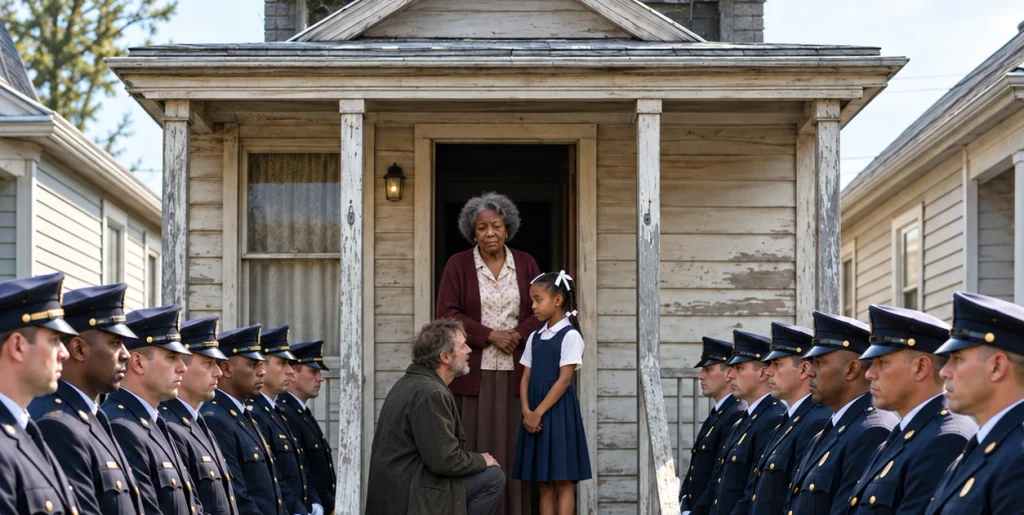
Ruth closed the refrigerator and studied her granddaughter. Nora wore the navy jumper required at Douglass Elementary, a white blouse, and the braids Ruth had redone the night before. The white ribbons were beginning to fray at the ends. Ruth reached out and tucked one beneath Nora’s collar.
“There’s cereal in the top cabinet.”
“I’m not hungry yet.”
Ruth glanced toward the cabinet. The box inside was empty; neither of them had thrown it away.
On the wall above the table, Leah James smiled from a photograph taken the summer before she died. She wore a yellow dress and had one arm raised against the sun. Nora had been six when a truck ran a red light on a wet road and left Ruth to raise a child while still learning how to live without her own.
Nora glanced at the picture, as she did every morning. Then she bent to tie the lace on her left shoe. The sole had started separating at the toe, and Ruth had sealed it with a narrow line of glue that shone when the light caught it.
“Sit down a minute,” Ruth said. “I’ll make you that egg.”
“Save it for supper. I have my sandwich.” Nora patted the backpack and made her voice bright. “And Tuesdays are pizza days.”
Pizza cost two dollars and twenty-five cents unless a child qualified for the meal program. Ruth had submitted the form, but the school office was still waiting on a document she had misplaced during the week the landlord taped the first warning to their door. Nora knew none of the details. She only knew how to look busy while her classmates joined the lunch line.
Ruth did not challenge her. She sat at the kitchen table instead and drew a pile of envelopes toward her. The electric bill had a red stripe across the top. The gas notice was printed on yellow paper. Beneath both lay a court-stamped sheet she kept facedown.
Nora had seen enough of it the night before to read the words possession hearing.
Ruth picked up the phone and dialed Dennis Carver, their landlord. She squared her shoulders before he answered, as if he could see her through the receiver.
“Mr. Carver, it’s Ruth James. I’ll have part of it Friday, and the rest after my next check.” She listened. “No, sir, I understand what the paper says. I’m asking if you can hold it one more week.”
Nora went to the hall for her coat. Ruth’s voice followed her, careful and low, the voice she used with people who had the power to say no.
When Nora returned, the call was over. Ruth slipped the court paper under the chipped blue fruit bowl. There had not been fruit in it since the end of August.
“The science-museum slip is due Friday,” Nora said.
Ruth’s hand stopped on the bowl. “How much?”
“I don’t want to go.”
“That wasn’t what I asked.”
Nora lifted one shoulder. “Twenty-five. But Kiara said it’s mostly rocks.”
Ruth looked at her for a long second, then reached into the pocket of her robe as if money might have appeared there overnight. “Let me see what I can do.”
“It’s okay, Grandma.”
Ruth had heard that answer about birthday parties, new shoes, and the ache in Nora’s stomach before bed. Each time, the child sounded a little older.
Ruth pulled her close. Nora’s cheek pressed against the soft cotton at her grandmother’s shoulder, and for a moment they stood beneath Leah’s yellow dress in the photograph.
“You don’t have to make things easier for me,” Ruth murmured.
Nora nodded, though both of them knew she would keep trying.
Outside, the East Ward of Mason Creek, Virginia, was waking in pieces. A delivery truck rattled behind the discount pharmacy. The laundromat sign flickered though the sky was already pale. At the storefront church, two women arranged donated coats on a folding table while men outside the barbershop argued cheerfully about last night’s game.
The Route 14 stop was six blocks away. Nora walked with her backpack high between her shoulders, humming the part of a song her mother used to sing. She no longer remembered the verses. The melody had survived without them.
At Linden Avenue, the bus shelter had one clear panel, one clouded with scratches, and a metal bench cold enough to sting through her uniform. Nora sat near the center and watched a pigeon work at a crushed cracker beside the curb.
Only then did she notice the man at the far end.
His coat might once have been green. Now it was the color of wet pavement, split at one cuff and dark at the collar. Gray threaded his beard, and his face had narrowed until the bones seemed too large for it. One hand lay open on his knee. The other trembled against his ribs.
Nora looked toward the avenue. The bus was not in sight.
The man’s eyes opened briefly, unfocused, then shut. His lips moved as if he were counting, but no sound came out. People passed behind the shelter without slowing. One woman guided a small boy to the outer edge of the sidewalk.
Nora unzipped her backpack.
She took out the paper-wrapped sandwich and rested it in her lap. Hunger had sharpened the smell of peanut butter; she could taste it before she opened the paper. For three quiet seconds she considered eating fast and pretending she had never seen him.
Then his stomach made a hollow sound.
Nora peeled back the paper. She put her thumbs into the soft center of the bread and pulled. The sandwich tore unevenly, one side broad and square, the other narrow with a ragged corner.
She kept the small piece.
The man did not react when she placed the larger half on the cleanest part of his knee. Nora sat back, took one bite of her own portion, and looked straight ahead so he would not feel watched.
His fingers closed slowly around the bread. “Is this yours?”
Nora chewed and nodded.
“Did somebody tell you to give it to me?”
She shook her head.
The man looked from the half in his hand to the smaller one she was holding. His eyes were pale, the whites veined red. Whatever he had expected from the morning, it had not been this.
“Why’d you give me the bigger half?”
To read the rest of the story – CLICK the NEXT button 👇👇👇