


The cap of the pill bottle clicked against the flat stone and rolled into a patch of wet leaves. Daniel Mercer watched it settle beside his boot. His right hand still held the bottle. His left lay curled against his jacket, a hand in name only, two years after the stroke had taken most of its strength and all of his faith in it.
He had come far enough into the woods that no one would hear him. That had been the point. Then, from beyond a wall of alder, something cried.
It was too rough for a child and too frightened for any bird Daniel knew. The sound rose again—thin, hoarse, urgent—and broke apart among the bare October branches.
He put the cap back on the bottle without deciding to. In the kitchen at home, a note waited beneath the sugar bowl: Went walking. Don’t wait for lunch. Laura would read it in the same room where they had spent months speaking through lists. Milk. Prescriptions. The furnace filter. She had been awake when he dressed before dawn; he knew by the careful rhythm of her breathing. Neither of them had disturbed the other’s pretense.
The cry came a third time.
Daniel slipped the bottle into his coat and reached for his cane. The sensible thing was to turn back. A man who dragged his left foot on level ground had no business following an animal into a ravine. But the noise had the one quality he could not ignore: it expected an answer.
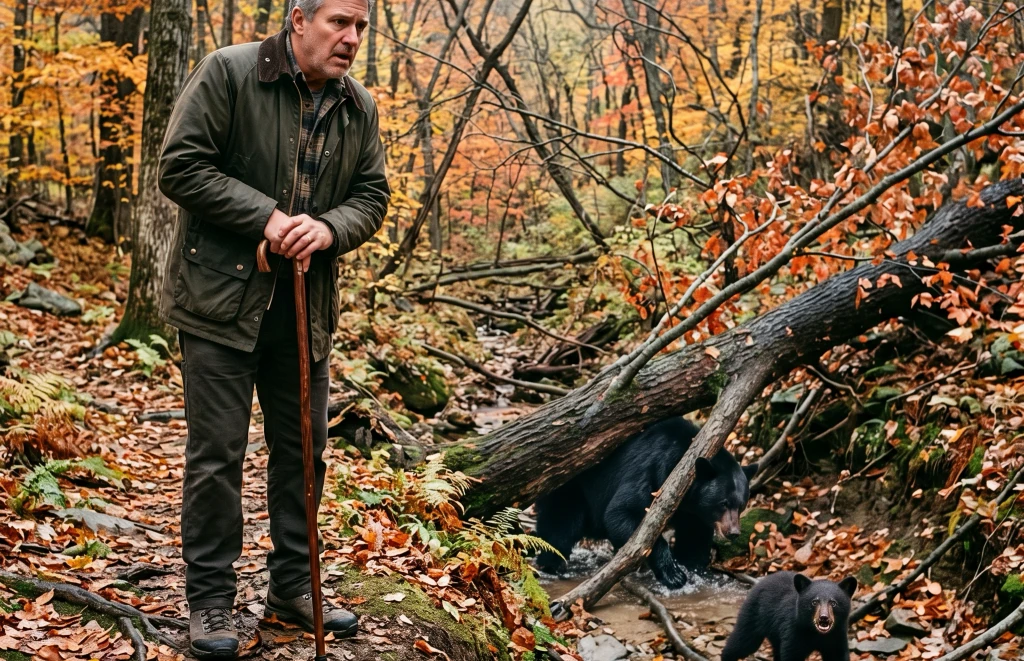
He pushed through the alder with his cane held crosswise. Thirty yards downslope, the earth opened into a shallow wash where a red maple had come down in the previous week’s storm. Its roots stood higher than a truck, clotted with stones and black soil. The main trunk bridged from that root mass to a granite shelf; a forked limb as thick as Daniel’s thigh angled down from it. A black bear cub paced beside the trunk, bawling toward a pocket beneath the fork.
Daniel stopped so hard his weak knee buckled.
The cub was not the tiny, harmless thing the sound had suggested. It was perhaps sixty pounds, all oversized ears and long feet. It swung its head toward him, startled, then scrambled back to the tree. Only then did Daniel see the sow.
The forked limb lay across her hindquarters. The root cradle and granite shelf carried the tree’s main weight, but the limb had flexed low enough to pin her against the ground. Her muzzle was gray with dirt. Each breath came in a shallow, visible pull. She lifted her head at Daniel’s scent and showed her teeth without sound.
Every old hunting lesson told him to retreat. An injured mother bear was still a mother bear. The cub could bring her up in a violence no damaged leg could outrun.
Daniel backed one step. The cub circled wide, keeping the trunk between them. It struck at the ground, cried again, then darted close enough to catch Daniel’s cuff in its teeth and tug once toward the tree. Daniel jerked away; the cub sprang back. Whatever the cub meant, Daniel could read only fear in it.
“I can’t,” Daniel said.
His voice sounded unused.
Before the stroke, he had spent twenty-six years designing and inspecting small bridges across northern Maine. He knew what loads did when they found a weak point. He knew how force traveled through a beam, how a few inches of bad bearing could turn weight into leverage. He had stood in sleet beneath rusting spans and told crews exactly where to place a jack.
Now he needed both hands to button a shirt.
The cub cried again. Daniel looked at the bottle-shaped weight in his pocket, then at the maple. He had walked into the woods believing that the people he loved would be freer without him. The animal in front of him knew nothing about dignity, marriage, disability, or shame. It knew only that the body under the tree was the center of its world.
He set his cane down.
The first branch he chose was rotten at the heart. It broke before he could wedge it beneath the fork, pitching him onto one knee. Pain flashed through his hip. The sow snapped her jaws, and Daniel froze with his face close enough to smell wet fur and crushed fern.
“Easy,” he whispered, though he was speaking to himself.
He crawled backward and studied the fall. The tree weighed tons, but he did not need to lift it. He needed to flex the loaded fork between its two supports. The root cradle had left a narrow gap beneath the uphill side. With enough leverage, he might raise the limb a fraction at a time and give the bear room to pull free. Might. The word had once belonged to calculations. Here it meant a damaged man trying to borrow an inch from a fallen maple.
Daniel found a straight storm-thrown sapling nearly ten feet long, sound beneath the bark, and dragged it through the leaves. He rolled a broad granite slab close to the trapped point, padded it with bark so the lever would not skate, and fed the narrow end beneath the fork. His weak foot kept sliding. He braced it against a root and leaned on the long end.
Nothing moved.
He changed the angle. His shoulder burned. The sapling bowed, and the loaded fork gave a low wooden groan but did not rise. Sweat cooled under his shirt. He tried again until his right arm trembled too badly to hold pressure.
The cub stayed ten feet away, rocking from paw to paw. Once it approached its mother and touched its nose to her ear. The sow’s eyes opened, fixed briefly on the cub, then closed.
Daniel sat in the leaves, breathing through the hammering in his chest. He had not taken his prescribed walks in three months. He had quit occupational therapy the previous winter after telling Laura the roads were too icy, then kept finding reasons after the thaw. Every failed exercise had seemed like proof that the doctors’ optimism was only a polite form of pity.
Laura had stopped arguing. That had been worse.
He could picture her at the kitchen sink, shoulders set, doing the work of two people while insisting she was fine. He could picture the half-second pause before she helped with a zipper or cut his meat. He had read exhaustion as contempt because contempt hurt less than admitting she might be drowning too.
The thought made him angry—at her, at himself, at the useless hand resting in his lap. Anger, at least, had heat in it.
Daniel pushed himself upright. He gathered stones, selecting them the way he once chose cribbing: flat faces, no shale, nothing likely to split under pressure. He built a low stack beside the first rock. Then he worked the branch deeper beneath the fork and pressed down with his shoulder.
This time the limb flexed. Not an inch. Barely the thickness of a coin. But Daniel saw daylight open under the bark.
He kicked a stone into the gap before his strength failed. The fork settled on it.
The sow released a long, ragged breath.
Daniel laughed once, a sound with no humor in it. “That’s all I’ve got?”
He looked at the line of the trunk. One fraction would not free her. He would need dozens. The work would take hours, and he had no phone signal in the wash. His hip was already swelling. His heart had begun to skip in a way his doctor had told him not to ignore.
He picked up his cane and considered using it to hold each wedge while the long pole carried the load. The laminated hickory was stronger than any loose stick within reach but also his only reliable way home. If it broke, he would have to crawl out or fashion another.
The bottle pressed against his ribs when he bent.
Daniel took it out. For a moment he held it over the dark pocket beneath the roots. Then he shoved it into the bottom of his pack, beneath the water and the spare gloves, where reaching it would require a deliberate act.
He placed the cane beside the first wedge and tested the two points of pressure. His left arm would have to help steady the long pole. The hand could not grip, but the forearm could bear against the wood if he trapped it carefully. He eased it into position. Pins and needles raced from his wrist to his shoulder—painful, startling, unmistakably alive.
The cub edged forward, stopped beside his boot, and bawled toward the sow. Daniel looked down at its bright, frightened eyes, then at the sow’s flanks moving under the maple.
“All right,” he said. He set his bad hand against the lever. “Once more.”
To read the rest of the story – CLICK the NEXT button 👇👇👇