


The old dog was sitting behind a livestock shed with a feed sack tied around his neck. On the sack, somebody had written in black marker: FORTY DOLLARS OR HE GETS A BULLET. He watched people pass through the Saturday market in Alder Creek without begging any of them to stop.
I had come down from my place for chicken feed and a used well pump, not another mouth to support. At sixty-eight, four winters into being a widower, I had learned to walk past most things I could not fix. Then the man holding the dog’s rope gave it a jerk, and the dog rose on shaking legs without lowering his head.
“He’s too old to work,” the man said. “Eats like he remembers being young.”
The shepherd was large beneath the neglect, sable-backed and broad through the chest. One ear had a pale notch along its rim. His coat was matted, his ribs showed, and there were raw places under the rope. What held me was not misery. It was the steady way he studied the man’s hands, as though he had survived by learning exactly what hands might do.
“Where’d you get him?” I asked.
“Came out of a logging camp after they cleared the kennels. You buying or writing his life story?”
I paid forty dollars from the envelope meant for the pump. The man folded the bills, laughed at my judgment, and left before I could ask which camp. The dog stepped into my truck only after I tapped the passenger floor twice. He turned once in the cramped cab, settled with his chin on the seat, and stared west toward the wet folds of the Bitterroots.
My wife, Ellen, would have said I had finally let loneliness make a decision for me. She had been dead long enough that I no longer heard her voice every day, only when I did something she would have understood too quickly. I drove home with the heater rattling and the dog breathing beside me, and for the first time in months I spoke without first checking whether anyone was there to listen.
“You look like a Bear,” I told him.
His good ear moved.
That was all the approval I got.
My place sat nine miles beyond Alder Creek where county gravel narrowed to two ruts through lodgepole pine. I kept hens, a vegetable patch, and an International tractor old enough to qualify for sympathy. The house had two coffee cups in the cabinet because I had never found a sensible reason to put Ellen’s away.
Bear stopped at the threshold that evening. He would not enter until I took off the rotten rope and laid my palm against the side of his neck. Even then he crossed the kitchen cautiously, testing the linoleum with each paw. I fed him half a bowl of rice, broth, and venison scraps so an empty stomach would not be overwhelmed. He ate with careful bites, drank, then stationed himself between my chair and the back door.
There were behaviors you did not get from wandering. When I dropped a spoon, he did not startle; he looked toward the windows. When I opened the mudroom closet, he found the gap beside my left knee and held there. Before lying down, he made one silent circuit of the house. I had never trained a working dog, but I knew workmanship when I saw it.
Rain moved in after midnight, tapping the metal roof with the loose, uneven rhythm that used to keep Ellen awake. I slept better than I had any right to. Near dawn I woke because the house had gone wrong in some small way I could not name.
Bear was gone.
The back door stood open three inches. I had failed to latch it fully, a mistake Ellen would have marked with one lifted eyebrow. Muddy prints crossed the porch, cut behind the chicken run, and disappeared through a break in the fence toward the timber.
I called until my throat hurt. Nothing answered except a raven somewhere above the creek. The sensible thing was to let an animal that had known me less than a day make its own choice, but the blanket where he had slept still held the shape of him. I pulled on rain gear, took my walking stick, and followed.
His tracks did not wander. They ran northwest along an overgrown skid trail, crossed a shallow drainage, and climbed through blowdown toward Black Hollow. People around Alder Creek avoided that country, partly because of old mine cuts and partly because Clayton Rusk’s logging crews had leased most of the accessible ground around it. My boundary was three-quarters of a mile behind me when I heard claws striking dirt.
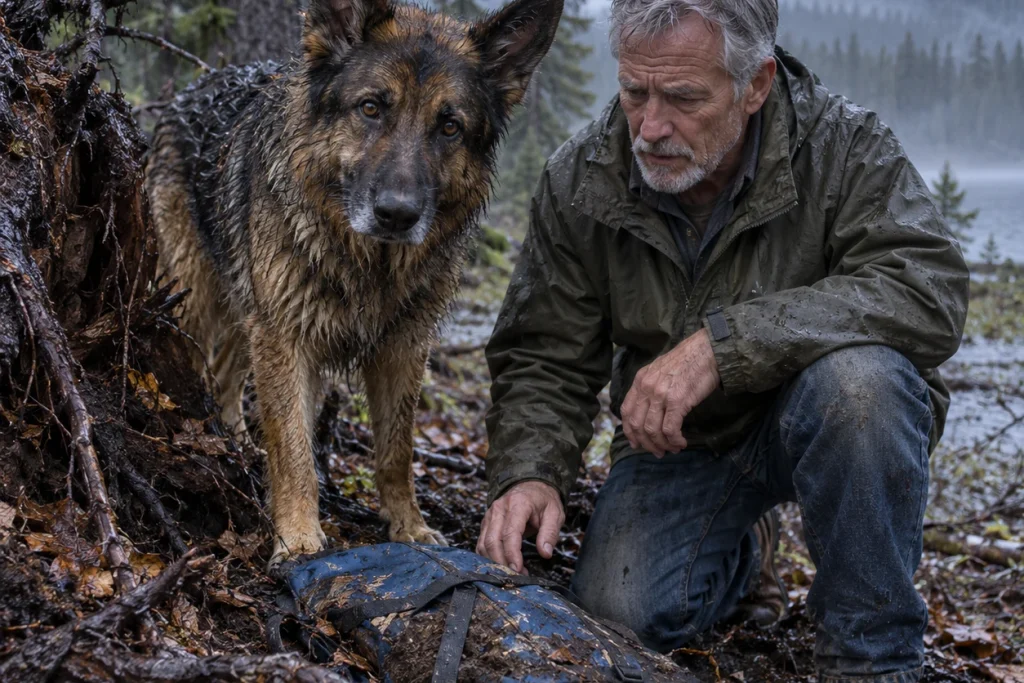
Bear stood beneath the root plate of a windthrown cottonwood, digging with a force his tired body should not have possessed. Wet soil flew between his hind legs. He paused only to press his nose into the hole, then dug again, whining low in his throat.
“Easy,” I said. “You’ll tear yourself open.”
He ignored me. When I caught his collar, he twisted free, plunged his muzzle into the earth, and pulled out a strap. Blue nylon followed, then a small mud-packed backpack with the faded face of a cartoon mouse on its front pocket. Bear carried it two steps, set it at my boots, and sat.
The pack had not washed there. Somebody had tucked it beneath the roots and covered it with stones and sod. Rain had exposed one corner, but the ground around it held the flat, deliberate layering of a place once filled by hand. I used the end of my stick to lift the pack, expecting bone or some other thing a man cannot unsee. Instead, a yellow child’s jacket came loose from the dirt.
Bear turned toward the deeper hollow. His nose lifted, working the damp air. Then he looked back at me with a demand so plain I felt foolish for thinking it belonged only to a dog.
The zipper had rusted shut, but a clear plastic sleeve was stitched into one shoulder strap. I wiped mud from it with my thumb. Inside was a school-bus tag, the ink blurred at the edges but still readable.
Caleb Reed.
I knew the name. Seven-year-old Caleb had vanished from a school nature walk in Black Hollow seven years earlier. Searchers covered the county until Sheriff Owen Pike declared that the boy had probably fallen into flooded mine workings. Bear had uncovered the one piece of Caleb that official maps said should not be there.
The dog pulled toward a western game trail, returned to touch the pack, and pulled again. I wanted to follow, but an old man without phone service was no rescue team. I photographed the site, wrapped the pack and jacket in my rain shell, and drove to the only person who had fought the decision to stop searching.
Walt Kincaid lived in a leaning trailer behind an abandoned mill. “Grant Harlan,” he said when he opened the door, as if my name were another chore. Whiskey had swollen his face, but the sight of Caleb’s repaired backpack sobered his eyes. When I mentioned the dog, Walt followed me outside without taking time to find a coat.
He stood ten feet from my truck and gave two short whistles followed by one rising note. Bear came upright so quickly his shoulder struck the dashboard. At the repeated signal, he pushed past me, crossed the yard, and sat against Walt’s left boot.
Walt found the notch in his ear, then a small hard scar beneath his jaw.
His hand began to shake.
“His name was Ranger.”
To read the rest of the story – CLICK the NEXT button 👇👇👇