


By the time Mara Ellison reached the infant room at Juniper House, the late-November windows had gone mirror-dark. Paper turkeys covered the walls. Everything looked warm, orderly, safe. Ranger walked at her left knee. His respiratory-alert training was documented, so the daycare allowed him inside for pickup; Evan had trained him after a warehouse fire damaged his lungs.
“There are my two favorite gentlemen,” Mara said as she turned toward Noah’s crib.
Abby Flores, the young aide assigned to the infant room, smiled too quickly. “He had a wonderful nap. Almost three hours.”
Three hours was not wonderful for Noah. At eight months, he fought sleep like an insult and woke hungry after forty minutes. Mara was about to ask when his last bottle had been offered when Ranger stopped so abruptly that the leash tightened across her palm.
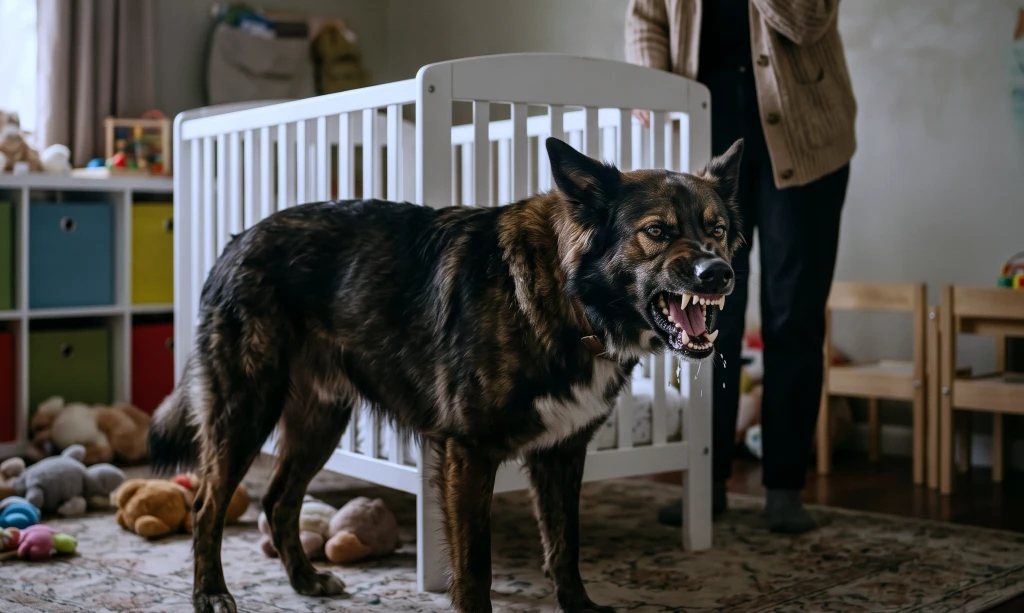
His ears came forward. He stared at the row of cribs, drew one measured breath, and went straight to Noah. Then he planted his body between the crib and the room and struck the vinyl floor once with his right paw.
Mara’s fatigue vanished. “Ranger, show me.”
He touched his nose near Noah’s chest, returned to Mara, and pawed her shin—Evan’s sequence for breathing trouble.
An older aide reached past the dog. “Ma’am, get him under control.”
Ranger blocked her with his shoulder and let out a low warning sound. He did not bare his teeth or snap, but the aide recoiled and shouted that the dog was growling at her. Chairs scraped in the adjoining toddler room as staff members hurried toward the noise.
Mara unclipped the leash so she would not trip over it, then leaned across the crib. Noah lay on his back beneath a cotton sleep sack, his arms loose at his sides. His lips had a gray-blue cast, and when she put two fingers against his chest, she felt shallow breaths separated by frightening pauses.
Her old EMT training came back without permission. “Call 911. Tell them an eight-month-old is in respiratory distress. Abby, bring me the emergency oxygen if you have pediatric equipment, but don’t put anything in his mouth.”
She lifted Noah, supporting his airway against her shoulder. Ranger moved with her, close enough to watch but careful not to touch the baby. His growl stopped the moment no one tried to interfere.
Celeste Ward entered in a fitted cream suit, every blond hair in place. The Juniper House owner looked first at Ranger, then at the open door, as though calculating how many parents might have heard.
“That dog has to leave,” she said. “He’s frightening the children.”
“My son can barely breathe.”
“Noah was fine five minutes ago. Abby, wasn’t he fine?”
The aide opened her mouth, but no answer came. Mara heard the faint catch in Noah’s breathing and lowered him onto the padded changing station, keeping his neck in a neutral position. Ranger pressed one paw against the cabinet and looked at her.
“He’s getting worse,” Mara said. “Where is the oxygen?”
Celeste folded her arms. “We can’t have an animal interfering with emergency care.”
“Then stop interfering and bring the kit.”
Abby ran for it. Celeste’s face went still, but the siren outside spared Mara whatever came next. Paramedics entered with a pediatric bag and monitor, and Mara recognized the lead clinician, Ben Russo, from the ambulance service where she had worked before Noah was born.
She gave him a concise report while his partner fitted a small mask over Noah’s nose and mouth. His oxygen saturation was dangerously low, his pulse slower than it should have been, and he responded only weakly to stimulation. Ben asked whether Noah had a fever, a fall, an allergy, or access to medication.
“None,” Mara said. “Ranger alerted when we came in. He’s trained for changes in breathing.”
Ben glanced at the dog, who had settled at the end of the table without taking his eyes off Noah. “I remember Evan working with him. Let’s move.”
Celeste followed the stretcher into the lobby. “For our incident report, I need it noted that the dog became aggressive in the infant room.”
Mara stopped just long enough to face her. “For your incident report, note that your staff told me my baby slept for three hours and nobody noticed he was turning blue.”
Outside, cold air cut through Mara’s cardigan. The ambulance supervisor approved Ranger riding secured in the front footwell with the driver. He had not bitten or lunged, and separating him from Mara would delay transport.
Mara sat beside Noah as the ambulance crossed Bellwether. Oxygen improved his color, but his breaths remained slow. She held his socked foot and watched the monitor.
Through the partition she could hear Ranger shift whenever Noah’s breathing faltered. Evan used to say the dog noticed the body before the person living in it did. After Evan died in a highway pileup eighteen months earlier, Mara had put those words away with his turnout coat and wedding ring because they hurt too much to touch.
At Carrow Regional, Dr. Lena Patel took Noah into a pediatric bay. Ranger was permitted to remain against the far wall while nurses started an IV, drew blood, and attached monitors.
Forty minutes later, Noah’s breathing strengthened. Mara was allowing herself one careful breath when Celeste arrived with a Bellwether police officer and an animal-control investigator. She held up her phone and said she had video of Ranger “charging a caregiver” and endangering children.
The investigator asked whether anyone had been bitten and whether Ranger was contained. When Celeste admitted there was no contact injury, he explained that there was no basis for emergency seizure or quarantine. He could document the complaint and require a prompt behavior assessment.
Celeste’s displeasure lasted only a second. “I’ve also made a mandated report. Mrs. Ellison brought a dangerous animal into a room full of babies and refused repeated instructions to remove it.”
Mara stared at her. “You called child welfare on me while my son was being transported?”
“I reported a safety concern. It’s what responsible directors do.”
Dr. Patel stepped between the bed and the gathering argument. “This child needs quiet, and I have observed no dangerous behavior from the dog. Everyone who is not family, staff, or law enforcement will wait outside.”
Celeste left with a look that made the room colder. The officer took short statements and told Mara the complaint would be reviewed, not presumed true. Still, when the door closed, she felt as if the institutions around her had begun moving before she understood where they meant to take her.
Ranger crossed the room and rested his chin on her knee. His steadiness carried the shape of Evan’s hands: patient, warm, insistent when it mattered. Mara stroked the white fleck beneath the dog’s jaw and watched Noah’s chest rise under the hospital blanket.
Near midnight, Dr. Patel returned with a toxicology report and a pediatrician Mara knew from Noah’s regular visits, Dr. Owen Mercer. Neither physician sat down.
“The lab repeated the test,” Dr. Mercer said. “Noah has a prescription sedative in his blood. It was not given by the ambulance or this hospital.”
Mara’s fingers tightened in Ranger’s fur. “We’ve never had that drug in our house.”
Dr. Patel looked toward the sleeping baby. “At this concentration, it can suppress an infant’s breathing. Noah did not simply become ill at daycare, Mrs. Ellison. Someone gave him medication.”
To read the rest of the story – CLICK the NEXT button 👇👇👇