


The skid marks appeared where no one had any business driving fast. Two black arcs crossed the abandoned mine road, climbed the plowed berm, and vanished into the white that had swallowed the Blackglass Range before dusk. Grant Mercer eased his truck to a stop. Something dark lay below the shoulder, half covered by windblown snow.
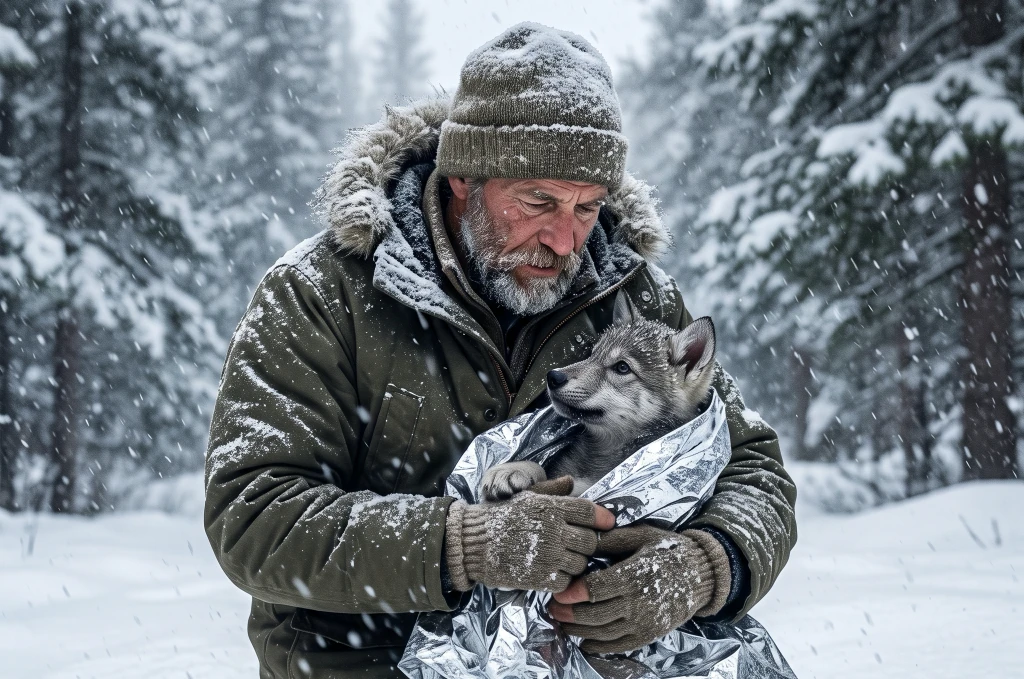
He had enough feed in the bed to get Timberline Wildlife Recovery through three days of storm, and the county radio had warned everyone off the upper roads. A sensible man would mark the location, call it in, and keep moving. Grant had been sensible about distance for most of his fifty-two years, and it had left him alone in a converted survey cabin with six injured dogs and a stove that smoked when the wind turned east.
He shut off the engine.
Cold struck through his coat as soon as he opened the door. His right knee, stiff from the piece of metal an Army surgeon had left beside the joint, buckled when he stepped over the berm. Grant caught a lodgepole trunk, waited for the pain to settle, then went down with a flashlight, trauma kit, and silver emergency blanket tucked under his arm.
The animal in the ditch was a gray wolf. A female, full grown, with a dark ridge along her back and frozen blood at one shoulder. Tire tracks told the rest. She had made it off the road after the impact and curled herself around the roots of a fallen pine.
Grant knelt, already knowing there would be no pulse. Her body had formed a wall against the wind. Inside that wall, the ground was bare.
He took off his cap. In Afghanistan, good-byes had happened under rotor wash, if they happened at all. He had learned how quickly a body could become cargo and how long the mind could refuse that fact. The wolf had received no ceremony, only weather, but she had spent the last of herself on shelter.
A low, rusty complaint came from beneath her chest.
Grant aimed the light between the roots. Two yellow eyes stared back. The pup was perhaps five months old, young of that spring but starved down to a much smaller shape. Snow clotted his silver-gray coat, his belly was almost white, and one ear sagged around a swollen crease at its base. A shallow tear crossed his right forepaw.
He was shaking hard enough for his teeth to click, but he bared them at Grant anyway.
“Fair,” Grant said. “I wouldn’t trust me either.”
The pup did not retreat. He gave another grave little rumble, outraged by the cold, the light, and perhaps the whole arrangement of the world. Grant felt something move under the scar tissue he had mistaken for peace.
Protocol was clear. He should call Montana Fish, Wildlife & Parks, keep his distance, and wait for an officer or the veterinarian authorized to work with his station. Protocol also assumed a passable road and enough body heat in the animal to survive the wait.
Grant reached in slowly. The pup snapped once at the leather glove, missed, and sagged against the roots. Grant wrapped him in the emergency blanket and lifted him against his chest. The bundle fought the zipper on his coat with surprising conviction, then shoved a cold nose under Grant’s collar.
“Your mother bought you time,” Grant said. “Don’t waste it arguing with me.”
He tied a strip of red survey tape above the ditch so the recovery crew could find the mother when the weather broke. By the time he climbed back to the truck, his knee was trembling. The pup pushed harder against him each time he slipped, as if annoyance alone could keep a grown man upright.
In the cab, Grant radioed the county dispatcher and left the location, his wildlife-rehabilitation permit number, and the pup’s condition. The wildlife officer on duty approved emergency stabilization and told him not to mistake that for permission to keep a wolf. Grant said he understood. He did not say the words already forming in him sounded less like ownership than an order: keep this one breathing.
The old truck crawled the final four miles to the recovery station. Wind erased the road behind them. On the passenger seat, the pup watched the direction of the ditch until snow covered the windows, then collapsed with his muzzle on Grant’s glove.
The station had once housed a mining survey crew. Now one room held kennels, another held medical supplies, and the largest room served as kitchen, infirmary, radio shack, and whatever passed for Grant’s life. He laid the pup on felt beside the woodstove, warmed veterinary rehydration broth, and clipped ice-matted fur from the injured paw.
The pup growled at the tin bowl, the antiseptic, the bandage, and the iron poker when it rolled against the hearth.
“You’ve got a complaint for everything.” Grant watched snow hammer the windows. “Gale. That’s what you are.”
The name earned him a suspicious yellow stare.
The dispatcher caught Dr. Nora Hale returning from a ranch call above the lower switchback. At forty-six, with silver beginning in her dark hair, she had treated Grant’s animals for six years and handled county avalanche dogs. She reached the station just ahead of the plow.
Nora examined the paw, listened to the pup’s lungs, and checked his gums. “Cold-stressed, dehydrated, no fracture I can feel. The cut is ugly but clean.”
“So he makes it.”
“If the night is kind.” She sat back on her heels. “And if he does, Grant, he’s still a wolf. The state will decide whether release is possible. You can’t keep him because you hate how quiet this place is.”
He closed the medical kit harder than necessary. “I’m trying to get him to morning.”
“Then get him to morning.” Nora met his eyes without flinching. “We’ll tell the truth after that.”
Eli Ross was already stranded. He had come that afternoon to repair the radio mast, then lost the road. A thirty-four-year-old former Army bomb technician, he still shook when metal struck metal. Grant had given him dry socks and a task, the two forms of help he accepted.
The storm trapped the three of them around the stove. Nora monitored Gale’s breathing. Eli rebuilt a cracked radio connector at the table. Grant kept the recovery broth warm and pretended he had not noticed how the room had changed.
For years he had arranged his nights to leave no openings. Wood stacked. Latches checked. Reports filed. Words kept short enough that no one could use them to come closer. Gale ignored the defenses. He grumbled when Grant looked too long out the window, nosed Eli’s sleeve when the man’s fingers froze above a screw, and made a tiny impatient sound each time Nora’s thoughts drifted somewhere beyond the room.
When a slab of roof snow crashed outside, Nora’s hand stopped over the bowl. Grant saw the four-year-old memory move through her face. She whispered that her husband, Daniel, had left for a routine search on a clear morning and never reached the second beacon marker.
Grant had no useful sentence for that. Gale did. He opened his mouth and produced a demanding squeak so undignified that Nora laughed before she could stop herself.
Eli smiled down at the radio. “He’s got timing.”
“He’s got opinions,” Grant said.
Near three in the morning, they slept where they sat: Nora in the wooden chair, Eli folded beside the radio, Grant against the wall with one hand near Gale’s blanket. The stove settled into a low red glow while the storm sanded ice across the glass.
Grant woke to a bark too deep for so young a wolf.
Gale stood between the sleepers and the portable electric heater. His wounded paw shook under him, the fur along his spine was raised, and every bark landed at the same spot behind the stove. Grant started to tell him enough.
Then the smell reached him—hot rubber and melting insulation. Behind the stove, orange light pulsed once inside the wall.
To read the rest of the story – CLICK the NEXT button 👇👇👇