


The cuff had ridden past Owen Mercer’s shirtsleeve, the steel on bare wrist where the gallery could see. He pulled the sleeve down once. The fabric caught in the hinge and stayed, and he left it, because Dutch would have worried a snag like that with his teeth until Owen told him to quit. Behind him the benches creaked under people he had winched out of the barrow pit in four years with a county star. Not one of them used his name.
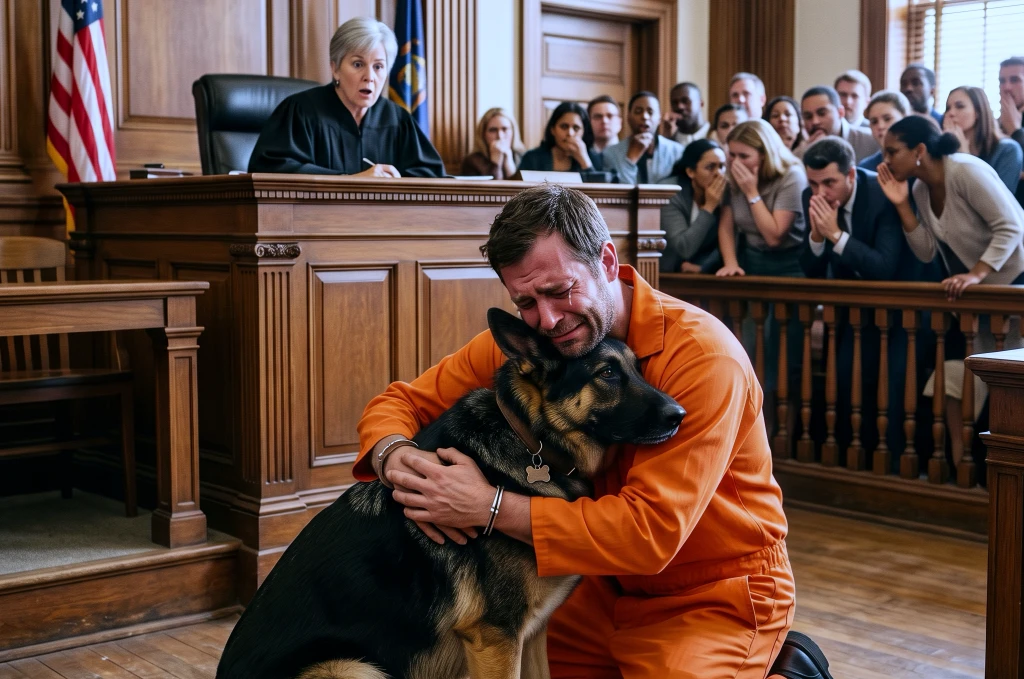
Judge Alan Renner read the sentence at the speed he read everything. The jury had found Owen guilty of abducting and killing Callie Boyd, a capital count under state law; after a separate penalty phase, Renner imposed a sentence of death. Janine Boyd made a sound that did not get out of her. Her husband kept folding his work cap and opening it again.
Paul Lindahl got close enough that his sleeve came down over the cuff and named two courts above this one. Then he waited to be told he had been heard.
The room would not hold still long enough to look at. Owen nodded anyway. Renner asked whether he wished to say anything; Lindahl’s fingers closed on his elbow. One more sentence about being innocent would land where all the others had. He had one turn and nothing this room would take. So he spent it on the dog.
“There’s a dog of mine,” Owen said. “I want somebody to bring him where I can see him.”
Renner looked up. A neighbor had kept him since the arrest, Owen said, and he wanted a few minutes before the transfer. Back in the room a breath went out through somebody’s nose.
“Put it through your counsel,” Renner said. “I’ll consider it.”
Owen thanked him. Going to the side door between two deputies he kept his eyes on the tile, Dale Boyd tracking him the whole way, because the one thing he could not look at twice was the gap on the bench between her parents.
Owen’s second February in uniform there was a shepherd pup behind the feed store on Ash Street, wedged between a dumpster and pallets, black and tan, maybe four months, one ear ending in a ragged notch. He spent half a lunch break on his heels in dirty snow, working pieces of a sandwich nearer his boots, until it let a hand under it. That night the thermometer read twelve below, and by morning the quilt beside the bed was against the frame.
Grown, he was broad through the shoulders and yellow-eyed, and on walks brought Owen things. A stick. A ball out of a yard. A frozen glove. He would carry it a few yards, set it down, take it up when Owen reached, and back away ears forward until Owen followed to where it came from. Then he traded it for a biscuit.
After the wreck at the Blackpine grade and two calls one winter involving children, he turned the star in and bought a place four miles out of Harlow, timber to the back fence, a creek along the bottom. He walked that creek with the dog most evenings.
What came next was Callie Boyd, out at the house.
The second time he saw her she was eighteen, kneeling in gravel on the Ketter road beside a rolled pickup, holding a man’s phone at his ear so he could tell his wife he was all right; the first time she had been a kid who waved at patrol cars, and he had known her father then. Diner wages were going toward somewhere that had never heard of her. He asked if she had eaten.
She fed Dutch off her own plate and told him she wasn’t. One night she stayed and washed up, so long over one plate that he understood she was holding the room open for him to finish something about a call in his second year. He got out another sentence, and then could not. She shelved the plate herself, asked which cupboard the bowls lived in, left a water glass by the sink. Her watch and a thin silver bracelet sat on the sill until she was done.
He was thirty, she was eighteen, and no hour went by without his knowing it. It came out as questions about money and work and who she would call at night. She heard a man adding up her chances and finding them short. He heard leaving in sentences she had not meant that way, and was frightened by how much of him wanted her to stay. The last evening she took her keys off the counter mid-sentence.
None of what I say is what you hear, she wrote.
He typed that she should sleep on it and call in the morning. Then he typed the other thing. You drive those roads tonight and you’re going to get hurt.
He meant the sleet, ticking the window since dark, the grade glass by midnight. He was also angry, and the anger is in the sentence, so a stranger reading it aloud in a courtroom a year later could not find the weather in it. He watched until it said delivered and put the phone facedown.
By seven her number rang through to a recording. He drove two days with Dutch beside him: timber edge, gravel pit, every turnout on the skid road. On the third morning he called it in and heard his own voice get away from him over her plate number. A deputy told the jury it had not sounded like a man reporting somebody missing.
Two hunters found her that afternoon in the Blackpine, and fire had taken enough that identification came through DNA. The medical examiner recovered a deformed bullet from what the fire had left. Then a deputy turned wet leaves forty feet from where she had lain and came up with Owen’s pistol, and the state firearms examiner identified it as the weapon that had fired the bullet.
It had been gone out of the truck since March, unreported, because he kept deciding it would turn up under the seat. He knew it in the dark by the bite out of the checkering on the left panel. After that everything he had done to look for her worked the other way: boot prints in the grid, fingerprints on old shell casings at the pit, the messages on a screen. Sutter took each loose end as one more thing he used to get them off the obvious.
Lindahl spent eleven months on the one joint in the case with any play in it, ownership of the pistol against use; Whitcomb assembled it in an order a jury could follow. Before the arrest, Dutch had walked the porch at night and whined toward the timber; at the neighbor’s he walked the barn and would not eat.
Dale Boyd told investigators his daughter had wanted out and had been frightened of him. The first half Owen could not argue with; there were evenings it had been true. The second he had no way to weigh — how much Callie had said, and how much her father had put there afterward, knowing how it ended.
The room they walked him to two evenings after the sentencing was off the service corridor, a ring under the table; a deputy ran a short chain from it to the cuffs. Renner had signed off. Animal control had the dog at the back door, and a second deputy went down for the lead.
The claws reached him first, out on the concrete.
Dutch came through hard enough to take the deputy on the lead a step with him. The clip came off, his weight went against Owen’s knees, his head driving up under the joined hands. The coat was rougher than memory had it, a ridge of backbone under it never findable before. Owen leaned as far as the chain gave and got a thumb on the notch.
“Here,” he said. “Here now. Get in where I can reach you.”
A tongue went along the inside of his wrist. Then the slack chain swung into his nose, and when Owen moved it Dutch followed, shoving at the links. He said into the fur that he had not touched her. None of it would come apart into words for a dog. He said it anyway.
The deputy read the time off his clipboard and gave him five minutes.
Still working a hand through the loose skin of Dutch’s neck, Owen told him about the first morning of the search. Dutch had leaned into the collar and gone north up the old cutting, and Owen had followed half a mile before deputies came for a statement about the messages. The dog had been trying to show him something out there; Owen had gone back down to answer questions.
“The chain goes through the floor,” Owen said. “That is the whole of why I am not up that hill.”
The deputy put a hand down for the lead and the dog went out from under it. Behind them the door stood off the latch where a guard had gone through with both arms full of paper. Dutch was past him before anybody shifted, and Owen came up hard enough to move the table.
“Nobody shoot that dog!”
Claws were going on concrete out past the doorway. Down in the service bay, where a county van stood with its doors open, a man yelled. Owen had the wire glass and that was all: the dog cutting between a worker’s legs, the dog out under the gate while it was still going up, the gate coming down with him on the far side of it…
To read the rest of the story – CLICK the NEXT button 👇👇👇