


The sound at Caleb Mercer’s door was too soft to be a knock and too steady to be the wind. He set down the split birch he had been carrying to the stove and listened. There it was again: a low whine under the hard scrape of February snow.
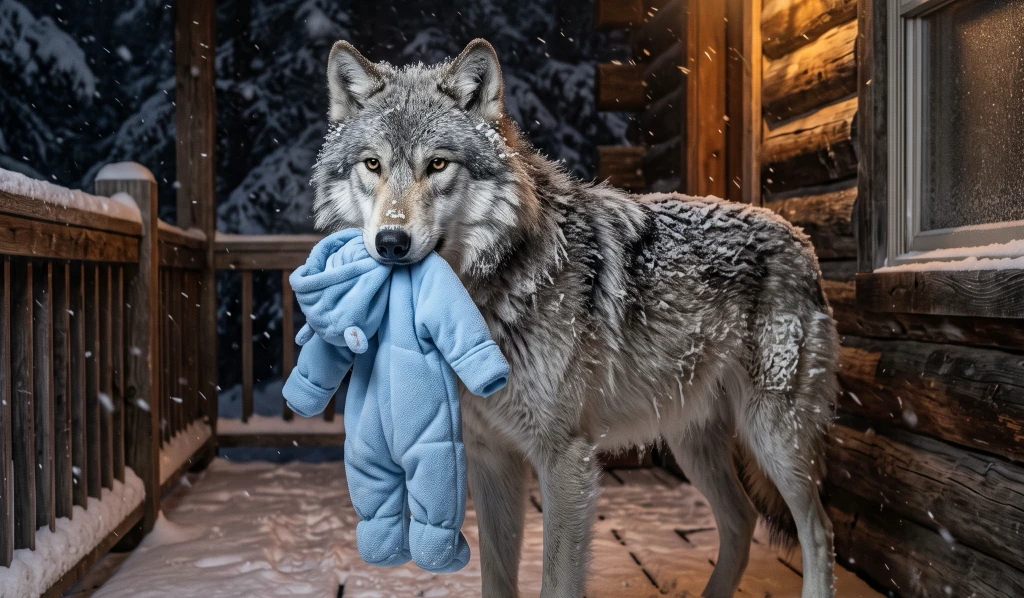
At 2:17 in the morning, no one came six miles up an unplowed Forest Service road by accident. Caleb took the flashlight from its hook, opened the inner door, and kept the storm door latched while he swept the porch with the beam.
A gray wolf stood beyond the drift.
Ice silvered the guard hairs along her shoulders. Her ribs moved fast beneath her winter coat, and something pale blue hung from her jaws—not limp, as Caleb first thought, but bundled. Then the bundle gave a thin, furious cry.
Caleb forgot the latch. He pushed through the storm door in shirtsleeves, stopped himself after one step, and lowered his body without looking away from the wolf. She was close enough that he could see snow crusted between her toes.
“Easy,” he said, though he had not used his voice for company in a long while. “Just set it down.”
The wolf’s ears tipped back. She shifted her grip from the padded hood of the bunting to a fold of the outer blanket and moved forward once, careful and silent. The zipped fleece supported the child’s weight. When Caleb extended both hands, she released what she carried.
The weight landed against his palms with startling warmth. A baby boy, no more than three months old, stared up at him from a blue snowsuit. His lips had a dusky cast, but he was breathing, and his cry strengthened as Caleb pulled him against his chest.
Caleb backed through the doorway. The wolf did not follow. She sat at the edge of the porch light, muzzle lifted, watching until he kicked the storm door shut.
His cabin had held only practical things for the past two years: one plate by the sink, one mug near the coffeemaker, one chair angled toward the woodstove. Now Caleb cleared the kitchen table with his forearm and laid the baby on a folded quilt. The child’s hands opened and closed as if searching for something to hold.
Caleb called 911, gave his coordinates, and answered the dispatcher’s questions twice because the first account sounded impossible even to him. The county road was buried, the dispatcher warned; an ambulance and a sheriff’s rig were coming, but the plow would have to cut a path ahead of them.
“Keep him warm and dry,” she said. “Don’t give him anything by mouth yet. Watch his breathing. If it changes, tell me immediately.”
Caleb stripped off the damp outer blanket, left the child in the dry layers beneath it, and tucked him inside his flannel shirt against bare skin. He had done something like this once before, twenty years earlier, when a nurse had placed his newborn son against his chest and his wife, Laurel, had laughed at how afraid he looked.
The memory arrived whole, followed by the one he usually managed to stop: Owen at eighteen, found after six days in the Boundary Waters, his body carried out beneath an orange rescue tarp. Caleb turned toward the stove and counted the baby’s breaths instead.
“Stay with me,” he murmured. “That’s all you have to do.”
Small fingers caught in the hair on his chest. The grip was weak, then firmer. Caleb sat in the chair nearest the stove, wrapped another quilt around them both, and kept one hand over the child’s back while the dispatcher remained on the line.
Beyond the window, the wolf had curled beside the bottom step. Every few minutes she raised her head toward the glass.
Caleb knew enough about wolves to distrust the story his grief wanted to tell. He had spent twenty-six years maintaining remote wildlife stations and surveying winter habitat for the state. A wild animal did not make promises, choose a human family, or understand what waited inside a house. Yet this one had carried a living child through a blizzard and had not left.
The baby’s color improved slowly. His crying softened into exhausted hiccups, and then he slept with his cheek against Caleb’s shirt. Caleb did not move, even when his left foot went numb.
Nearly two hours passed before amber lights moved between the trees. The wolf rose before Caleb heard the engines, slipped behind the woodshed, and disappeared into the dark.
Paramedic Tessa Moran entered first, stamping snow from her boots while Deputy Ben Alvarez held the door. Tessa took the baby without wasting a question, set him on the warmed pad of her equipment case, and checked him from scalp to toes.
“Mild hypothermia and dehydration,” she said. “Breathing’s clear. Heart rate is coming up.”
Only then did she look at Caleb. “You said a wolf brought him?”
“By the bunting’s padded hood and the blanket. Never touched skin that I saw.”
Ben gave him the expression he used when hunters described a ten-point buck that had left no tracks. Then he went outside with a flashlight. He returned five minutes later, the skepticism gone from his face.
“Wolf prints come up from the south trail,” he said. “They stop at your porch. There’s another set under the snow, but the wind has worked them over.”
Tessa zipped the child into an insulated transport wrap. The boy woke and began to cry as she lifted him, reaching one bare hand toward Caleb.
The gesture struck somewhere below thought. Caleb offered a finger, and the baby closed his fist around it as if he had been waiting to find the same hand again.
“We need to go,” Tessa said gently.
Caleb freed his finger. “Does he have a name?”
Ben was already speaking into his radio. A young woman named Maria Hart had failed to reach her mother’s home in the neighboring county the previous evening. She had been driving with her three-month-old son, Daniel.
“Danny,” Caleb repeated, testing the ordinary warmth of it.
The ambulance crawled away behind the plow. Its taillights faded between banks of snow, leaving the cabin quieter than it had been before. On the table lay one damp blue mitten no bigger than Caleb’s palm.
He picked it up and stood there until a whine sounded from the porch. The wolf had returned. She remained beyond the light this time, her body barely distinguishable from the trees, but her eyes fixed on the window where the child had been.
“They took him somewhere warm,” Caleb told her. “You did what you could.”
The wolf watched a moment longer, then turned toward the south trail. Caleb expected her to vanish. Instead, she stopped at the first spruce and looked back.
At dawn, Ben returned alone. Snow clung to the shoulders of his uniform, and he did not come inside when Caleb opened the door.
“We found Maria’s car,” he said. “It went through the rail at Miller’s Cut. She didn’t survive.”
Caleb closed his hand around the little mitten in his pocket.
Ben glanced toward the trail the wolf had taken. “The impact tore the rear door off its latch. The carrier is still on its base, but the harness is open. Maria’s blood is on the buckle, and the wolf tracks start beside it.”
To read the rest of the story – CLICK the NEXT button 👇👇👇