


Caleb Raines saw the young rider’s mistake before the boy had finished wrapping the rope around his glove. The kid had buried his hand too deep, as if more rope could bargain with a bull that had thrown eighteen challengers across three seasons.
From behind the service fence, Caleb curled two fingers through the wire. “Son. Keep that wrap shallow.”
The rider turned. He was twenty-two at most, narrow through the shoulders, with a new vest and the fixed stare of someone trying not to be sick. His eyes moved over Caleb’s sun-faded coat, split right boot, and sweat-softened hat before settling on the paper cup at his feet.
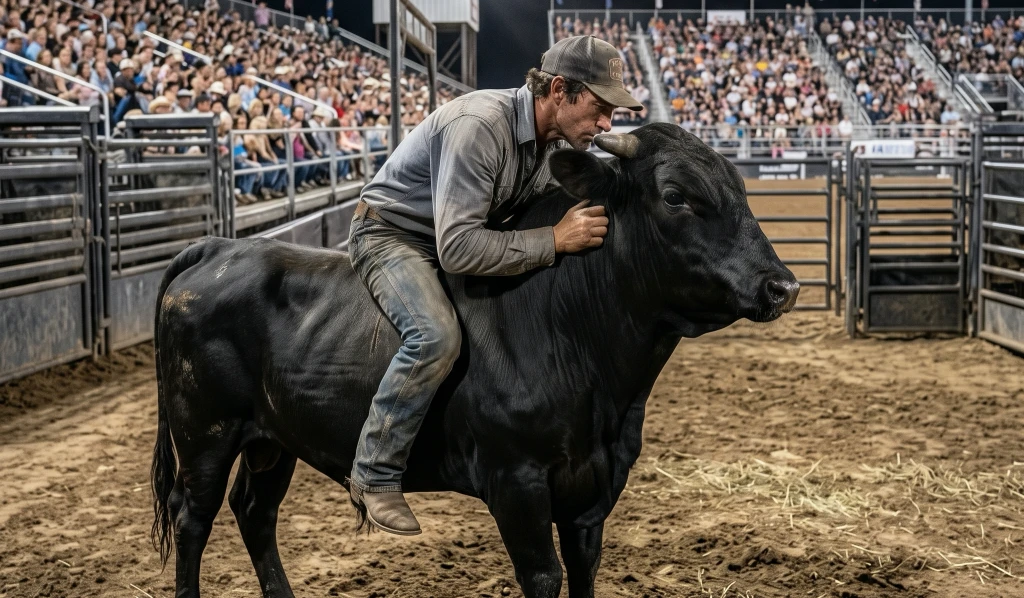
“You talking to me?”
“Hard Mercy drops his left shoulder before he reverses. If your hand’s locked when he does it, your elbow pays.” Caleb nodded toward the chute. “Take the first spin. When the shoulder goes, open your hand.”
The kid glanced toward the handlers. None of them had heard. Above the bucking chutes, twelve thousand people shifted in the August heat, impatient for the next failure in the Red River Million-Dollar Minute. A national sports feed had turned the afternoon into spectacle: stay on Hard Mercy for sixty seconds and leave the Lone Star Pavilion with one million dollars.
The kid looked back at Caleb. “What makes you think I’ll get the first spin?”
Caleb’s left hand tightened on the wire. “Because he loads his right hind leg before the gate opens. Sit left until you feel daylight.”
The kid looked once more at Caleb’s split boot, then gave one small nod.
His name, according to the screen, was Eli Turner of Abilene. The gate cracked open. Hard Mercy came out like nearly nineteen hundred pounds of black muscle thrown from a machine, his left horn cutting a level line through the glare. Eli survived the first jump, then the second. When the bull’s shoulder fell and the spin reversed, Eli released exactly when Caleb had told him to.
He struck the dirt rolling and reached the rail on his own feet. Four seconds flashed on the clock—the best time of the finals. Eli flexed both hands, found Caleb beyond the fence, and touched two fingers to the brim of his hat.
Caleb looked away first.
He had kept quiet. For years Caleb had treated silence as something the association could no longer take; if he offered no opinion, nobody could twist it into another charge. He watched Eli bury the wrap, counted two breaths, and told himself the handlers were paid to notice. Then he saw the leather, the boy’s white knuckles, and all the experience that was not there. The warning came only when Caleb understood that his privacy was about to cost a stranger an elbow. Eli’s nod did not feel like gratitude. It felt like a debt Caleb had refused to pay.
Above the north grandstand, sunlight lay flat across a steel record board. It had room for the names of riders who had completed a full minute on championship stock. One dark rectangle interrupted the brushed metal, a scar beneath several coats of paint where letters had once been cut away.
Caleb had spent two summers sleeping on a folded tarp behind the stock pens. He knew which concession workers left unsold sandwiches beside the Dumpster instead of inside it, which guards woke him with a boot, and which ones pretended not to see him wash at the livestock spigot before dawn. He also knew where to stand so that the record board stayed outside his direct line of sight.
That afternoon, he had failed at it.
The twentieth scheduled challenger entered through the tunnel to music loud enough to vibrate the wire against Caleb’s knuckles. Landon Voss raised both arms before the crowd had decided how loudly to welcome him. At thirty-four, he had three world titles and a vest crowded with sponsor patches.
He took the announcer’s microphone. “Nineteen men showed you what Hard Mercy does to ordinary riders. You didn’t buy a ticket to watch ordinary.”
The crowd answered on command. In the timing booth, promoter Mara Bellamy leaned toward the glass, pleased to see the camera find every logo. She had mortgaged her family’s feed business to launch the event three years earlier. The million-dollar purse had made her famous, but a prize nobody could win had begun to make sponsors suspicious. Landon was supposed to restore the bargain: danger, swagger, and a respectable defeat.
Hard Mercy had other plans.
The bull left chute four low, snapped back over his own hip, and separated Landon’s shoulders from the direction of the rest of his body. Two seconds later the champion lay on his back, his hat beyond the painted sponsor line. Silence held for one stunned breath. Then laughter began in the upper rows and poured down the grandstand until the whole pavilion seemed to shake with it.
Landon rose with dirt pasted along one side of his face. Caleb recognized the look even before the champion found the cameras. He had seen riders hide cracked ribs without blinking; Landon flinched at the laughter. The champion needed the crowd to turn on someone else.
Mara reached for her microphone to announce that the purse would carry over to the following year.
“Ma’am,” Caleb called. “Entry’s still open.”
Her live microphone caught him. Heads turned toward the service fence, followed by the cameras. Caleb stepped through the gate before an attendant could close it. His left leg dragged slightly, a twelve-year-old hitch that worsened on hard ground.
The clerk at the entry table lifted a hand. “Sir, contestants need to be registered.”
“The sheet says registration closes when the last rider clears the arena.” Caleb pointed toward Landon, who was still retrieving his hat. “He hasn’t cleared it.”
The clerk, Tess Grant, read the rule twice. It had been written to accommodate late-arriving champions, not a man who smelled of hay dust and slept beyond the loading dock. Still, the sentence said what Caleb said it did.
High in the officials’ booth, Commissioner Wesley Carver set down his coffee. He had judged bulls before half the current field had been born, and he watched Caleb move past the chutes without once staring into them.
“Tourists always look at the animals,” the chute director said beside him.
“He’s not looking at the animals,” Wesley replied. “He’s checking where the riders landed.”
Landon reached the table before Tess could offer Caleb the pen. “What do you think you’re signing?”
“An entry form.”
“You don’t have a card. You don’t have a rope or a vest. Those boots barely qualify as boots.” Landon turned toward the nearest camera. “Maybe he plans to ask the bull for spare change.”
The laughter came quickly, grateful for a new target. Caleb kept one palm on the table. “I asked the clerk for a turn. I didn’t ask you for anything.”
Landon’s smile sharpened. He pushed Caleb with one hand, lightly enough to make the insult look casual. Caleb’s bad leg folded in the churned dirt, and he caught himself on his fingertips.
Mara could have ended it then. One sentence from the booth would have brought security and a commercial break. Instead she watched the broadcast monitor, where the audience number had begun climbing, and kept her channel closed.
Caleb stood, wiped his hand against his coat, and returned to the table.
One person clapped from the north stand. The sound lasted less than a second, but Landon heard it. He knocked Caleb’s hat into a muddy track left by the water truck, set his boot on the crown, and slowly ground the felt beneath his heel.
The hat had cost Caleb part of his first professional check. It had crossed four states in the cab of his old pickup, lain beside him during a disciplinary hearing, and served as his pillow for more nights than he cared to count. He watched Landon destroy it without bending to save it.
“You wanted a turn,” Landon said into the microphone. “Last five seconds and I’ll apologize on my knees. Fall before that, and you crawl back to your fence.”
Eli Turner shoved past an official near the alley. “He kept me from losing an arm. He knows that bull.”
Security caught Eli by both elbows, but his words had already reached the crowd. Landon’s face changed.
“Then no rope,” he said. “No glove. No protective gear. Let’s see what the old expert can do.”
Caleb looked past him to the timing booth. “Your program says sixty seconds earns the million. Does that rule still belong to you?”
Every camera turned toward Mara. She could void the entry, but she could also see the sponsor representatives standing inside their suites, phones lifted, waiting to hear whether the promise on their banners meant anything. She opened her microphone.
“The rule applies to every accepted rider,” she said. “Sixty seconds on Hard Mercy, and the million is his—even him.”
To read the rest of the story – CLICK the NEXT button 👇👇👇