


When the carrier door opened, the white cat did not bolt. He pressed himself into the molded plastic until his spine had nowhere else to go, staring past the gloved hands and into the bright intake room. Wind worried the loading-bay door behind him.
He gave no sign that he heard it.
It was the second week of January, eight below zero in Duluth, and a delivery driver had found him wedged behind a dumpster near the rail yards in West Duluth. At North Harbor Animal Rescue, a private nonprofit housed in a converted plumbing-supply warehouse, winter strays arrived with frost-stiff whiskers and road salt between their toes. This one was thin but uninjured. His coat was pure white, his eyes an improbable clear blue, and terror had made him rigid.
Ruth Bell, the cat-care coordinator, waited while the veterinarian examined him, scanned for a microchip, and found none. The cat tracked every hand and shadow. Yet he did not turn when a cabinet clicked shut behind him, or when keys struck the stainless counter outside his line of sight. The next morning, a partner clinic confirmed profound deafness in both ears with a BAER test. His ear canals were healthy, his balance normal, and there was no sign of injury; the veterinarian believed he had been deaf from birth.
Ruth wrote SNOW on his intake card and placed him in a lower stainless-steel condo in the quietest end of the cat wing. She covered half the door with a towel and put a box inside so he could hide without disappearing from view. He ignored warmed wet food until the building emptied that night. By morning the dish had been licked clean, but Snow was back in the box, watching through its doorway with both pupils wide.
Staff approached only from the front and tapped the fixed shelf before opening the door, giving him a vibration he could learn to expect. Even so, a sleeve passing beyond the towel made him flinch. He slept in scraps, one eye opening whenever fluorescent light shifted across the wall.
The quietest room in the building was not quiet to him; it was simply a place where change arrived without warning.
On his fourth day, a college volunteer named Eli carried a stack of washed feeding pans down the aisle. Ruth had shown him the yellow notice on Snow’s door: DEAF—LET HIM SEE YOU. Eli remembered until two pans began sliding from the stack. He caught one. The others hit the concrete beside Snow’s condo.
Snow heard nothing, but the impact came through the floor, the steel bank, and all four of his feet at once. He hurled himself against the side wall, rebounded, and struck the door. Eli, frightened by what he had caused, opened it and reached in.
“Easy, buddy. Easy.”
The hand filled Snow’s vision. He slashed once, opening three lines across Eli’s wrist, then flattened himself behind the litter box as if waiting for the blow that would answer his own. Ruth closed the door, sent Eli to wash the scratches and complete the shelter’s exposure report, and knelt several feet away. The cat’s flanks pumped. A bead of blood on one white claw belonged to the boy, not to him.
Eli came back with a bandaged wrist and tears of embarrassment in his eyes. Ruth did not scold him in front of the other volunteers. She changed Snow’s handling note, moved loose metal pans off that section of shelving, and explained that the scratch was an escape response, not proof of a vicious cat. Snow watched their mouths move and their hands point.
None of the explanation reached the place where he had been frightened.
David Mercer saw the aftermath from the utility-room doorway. At fifty-six, he had the heavy shoulders and careful hands of a man who had spent thirty years repairing city buses. He had started volunteering three mornings a week because his house in Piedmont had become unbearable after his wife, Ellen, died seven months earlier. At the shelter there were drifts to shovel, loose latches to fix, forty-pound bags of litter to move. A job could occupy the exact amount of thought he was willing to give it.
Snow occupied more. David recognized the animal’s refusal before Ruth explained the deafness: the way he made himself small, yet never truly rested; the way every kindness became another thing he had to defend against. After Ellen’s funeral, David had stopped answering the door even when he saw friends’ cars at the curb. He did not pretend that grief and deafness were the same. He simply knew what it was to regard the next arrival as a demand you could not meet.
At home he had learned which floorboards could be crossed without passing Ellen’s chair and which cupboard held only one coffee mug now. At North Harbor, Snow had made a smaller map: box, litter pan, dish, rear wall.
David understood the usefulness of a map that protected you by shrinking your life.
“Don’t put your hands in there,” Ruth told him. “Not yet.”
“Wasn’t planning to.” David set his toolbox down where Snow could see it. He repaired the latch on the neighboring condo in long, deliberate movements, keeping his body turned sideways. When he finished, he sat on an overturned bucket and studied the floor. Snow watched him for twenty minutes. The cat did not soften, but he did not throw himself at the wall either.
Pepper found them the following week, after both cats had completed their intake holds and medical clearance. She was a small black cat with a green gaze, a crooked tip to her tail, and the social confidence of someone certain that every lap had been placed in the building for her use. Staff let her roam the closed cat corridor under supervision. She greeted volunteers, inspected carts, and stole David’s shop rag whenever he left it within reach.
She sprang onto the roof of Snow’s condo. The thin panel flexed under her landing, and Snow came upright so violently that his shoulder struck the box. Pepper glanced down, then began washing one front paw. Her tail hung through the narrow gap between condos, swaying inches from his face. Snow held his crouch. Nothing attacked him. After a minute, his back lowered by a fraction.
A dog barked beyond the fire door. Pepper’s head lifted; both black ears turned toward it. Snow saw the change and looked the same way. When the barking stopped, Pepper resumed washing.
Snow continued to watch her ears.
The next day Pepper slept on the condo roof while David sat six feet away with a clothbound book about Lake Superior wrecks. He read three pages and retained none of them. Whenever a cart rattled in the hall, Pepper opened one eye. Snow’s muscles tightened only until she closed it again. Soon he was no longer searching every doorway. He was reading the black cat instead.
David made the arrangement a routine. He finished his chores, washed the machine oil from his hands, put the same wooden chair in the same place, and opened the same book. He never reached toward Snow. Pepper took the roof, accepting scratches from David first and then settling where the white cat could see her. After nine days, Snow ate while David was still in the corridor. Two days later, with Pepper asleep above him and David turning pages nearby, he lowered his head and closed both eyes.
Ruth noticed his shoulder blades were less sharp, but she also noticed that he never left the condo. One quiet Thursday after closing, she slid the door open and walked away. David stayed in his chair. Snow backed into his box, alarmed by the missing barrier, while Pepper stretched, dropped lightly to the rubber runner, and stood in front of the opening.
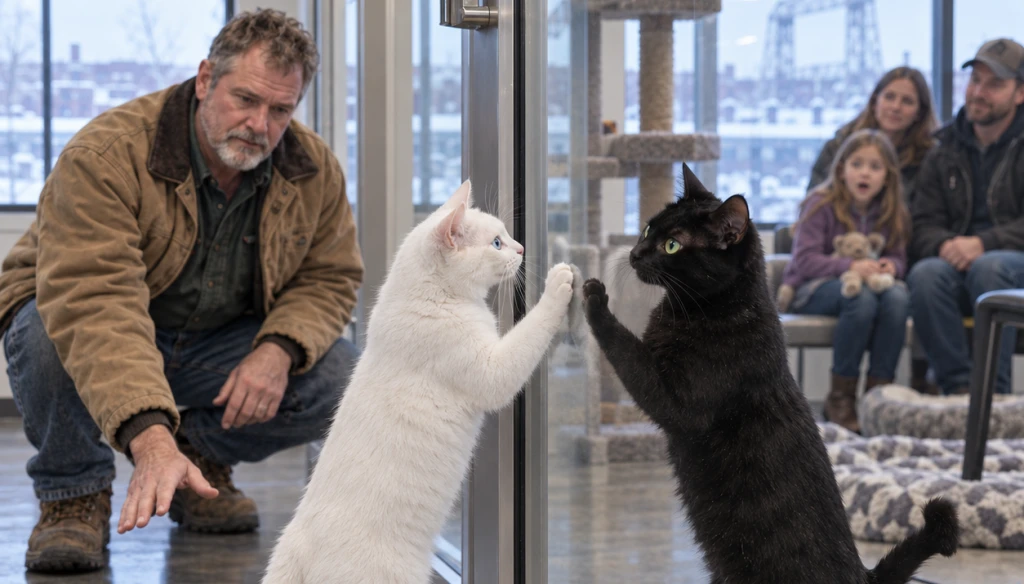
She looked at Snow once, then crossed the corridor and curled against David’s work boot. Inside the open condo, Snow raised one white paw toward the threshold.
To read the rest of the story – CLICK the NEXT button 👇👇👇