


Grant Holloway had just placed the open prescription bottle on a shelf of granite when a raw, rising cry came from below the trail. The sound cut through the October woods and stopped his right hand above the tablets. His left hand, drawn close to his ribs since the stroke, did nothing at all. He listened until the quiet returned. Wind shook water from the alders. Somewhere uphill, his truck waited beside an empty logging road, and at home Ellen would eventually find the note he had weighted with the saltshaker: Out for a walk. Don’t hold lunch.
The cry came again. It was not a child, though panic gave it a child’s broken pitch, and it was too large for any bird Grant knew.
He twisted the cap onto the bottle and slid it into his jacket. The choice felt temporary, almost administrative. He told himself he only wanted to identify the sound before returning to the business that had brought him so deep into the timber.
Two years earlier, a stroke had weakened his left side and dismantled the daily grammar of his life. His foot scuffed roots he once would have stepped over. Buttons required planning. Ellen cut tough food on his plate with a briskness she meant as kindness, and he endured it as evidence.
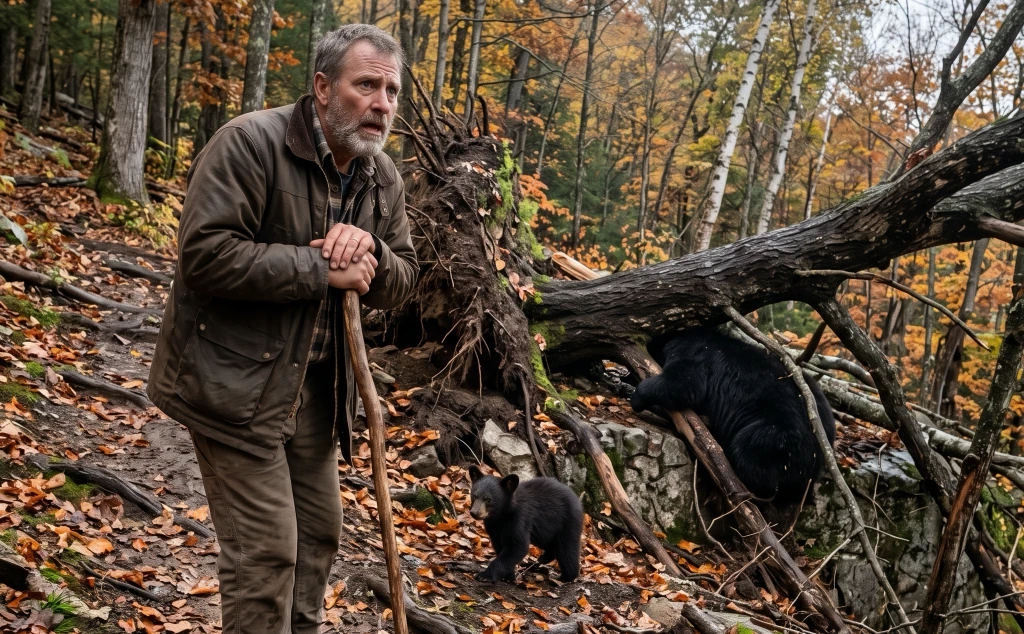
Grant lowered himself off the trail with his cane angled across the brush. The slope fell toward a storm wash where a maple had toppled during the previous week’s gale. Mud filled its root plate. The trunk reached across the hollow to a granite ledge, suspended at both ends like a failed span.
A young black bear moved beside it.
The cub was bigger than its voice suggested—perhaps sixty pounds, narrow through the middle, with long legs it had not yet grown into. It paced to the trunk, backed away, and bawled into a pocket beneath a heavy fork.
Grant saw the mother when she lifted her head.
The branch across her rear quarters was thicker than his waist. Most of the maple’s weight rested between the uprooted base and the ledge, but the fork had bent low enough to trap the sow against the soaked ground. Soil masked one side of her muzzle. The movement of her ribs was short and shallow.
She caught his scent and peeled her lips from her teeth.
Grant stopped breathing. Every warning he had ever heard about an injured sow returned at once: keep your distance, leave her an exit, never come between mother and young. None of that advice had accounted for a man with a dragging foot standing downhill from both animals.
He eased backward. The cub rushed around the trunk, veered away from him, then darted close enough to seize the cuff of his jacket. It pulled once and released before Grant could swing the cane.
The contact was probably fear, not a plea. Grant knew better than to make a messenger out of a wild animal. Yet the cub returned to its mother’s head and struck the leaves with both front paws, as if the earth itself had failed to answer.
“You picked the wrong man,” Grant said.
His voice startled all three of them.
For twenty-six years, he had inspected short highway bridges across northern Maine. He had crawled under rotting deck beams, calculated temporary supports in sleet, and made impatient contractors move a jack half a foot because force did not care about anyone’s schedule. A load always traveled somewhere. Find its path, change its bearing, and a structure could sometimes be saved.
Now he could not close his left fingers around the cane.
The sow’s head settled onto the leaves. The cub touched her ear with its nose and cried again.
Grant looked at the pocket in his jacket. He had entered the woods convinced that Ellen, his brother, and their grown children were serving sentences imposed by his body. The bears knew nothing of that verdict. One animal was pinned; the other had refused to leave.
He laid down the cane.
The first limb he dragged to the maple snapped as soon as he drove it beneath the fork. Grant pitched forward onto his weak knee. The sow lunged as far as the branch allowed, teeth closing on air close enough for him to smell wet fur and leaf mold.
Grant scrambled back and sat hard in the mud. Pain spread from his hip, and his heart beat out of sequence. His doctor had warned him about that flutter. She had also prescribed daily walking, which he had abandoned three months earlier along with occupational therapy.
He waited for the woods to steady. Then he studied the tree instead of the bear.
He could never lift the trunk. He might not need to. The fork was loaded between two natural supports, and there was a narrow space near the root plate where a lever could enter. If he flexed the branch by fractions and blocked each gain, the sow might eventually pull herself clear.
Might was not a calculation. It was all he had.
Grant found a straight sapling nearly ten feet long and stripped away a broken spur. He rolled a slab of granite toward the trapped point, padded its upper edge with bark, and threaded the sapling into the gap. His left forearm could steady the pole if he pinned it against his body, though the hand could not hold.
He leaned his right shoulder onto the long end. The sapling bowed. Nothing else changed.
He reset the stone closer to the maple and tried again. Fire climbed through his right shoulder. His weak foot slid until he braced it against a root, but the branch gave only a dry complaint.
After the third attempt, Grant sat among the ferns with his head between his knees. Ellen had once sat across from him during breakfast and said she could not keep wanting recovery more than he did. He had called that cruelty. Afterward she stopped arguing, and the silence between them acquired the neat efficiency of a hospital room.
Anger got him upright when hope could not.
He selected flat stones and arranged them beside the fork, rejecting shale and anything rounded enough to roll. On the next push, the maple flexed so little he felt the change before he saw it. A hairline of gray light appeared between bark and ground.
Grant kicked a stone into the opening. The fork settled against it and held.
The sow’s breath left her in a rough rush. The cub froze, staring at the new gap.
Grant laughed once, without pleasure. One stone had bought less than half an inch. He would need many more, and the work might take the rest of the day. There was no signal in the wash. His cane was the strongest short brace he owned and his only reliable way back to the road.
When he bent, the bottle knocked against his chest.
He took it out and considered the dark space beneath the roots. Instead, he buried it under his spare gloves at the bottom of the pack. That did not make him safe; it made the next choice harder to reach.
Grant positioned the cane beside the first chock. He trapped his left wrist against the lever, keeping the useless fingers clear. Needles of sensation ran through the arm, sharp enough to make him gasp.
The cub came within a few feet, cried toward its mother, and retreated. Grant set his shoulder under the pole and fixed his eyes on the thin line of daylight beneath the maple.
“Again,” he said.
To read the rest of the story – CLICK the NEXT button 👇👇👇