


Eli Mercer set the enamel bowl beneath Ranger’s nose and watched the steam disappear into the January air. Beef, barley, and broth—the old shepherd’s favorite—had cost him the last good soup bone in the freezer. Ranger smelled it once, turned his gray muzzle toward the spruce trees, and lowered his head to his paws.
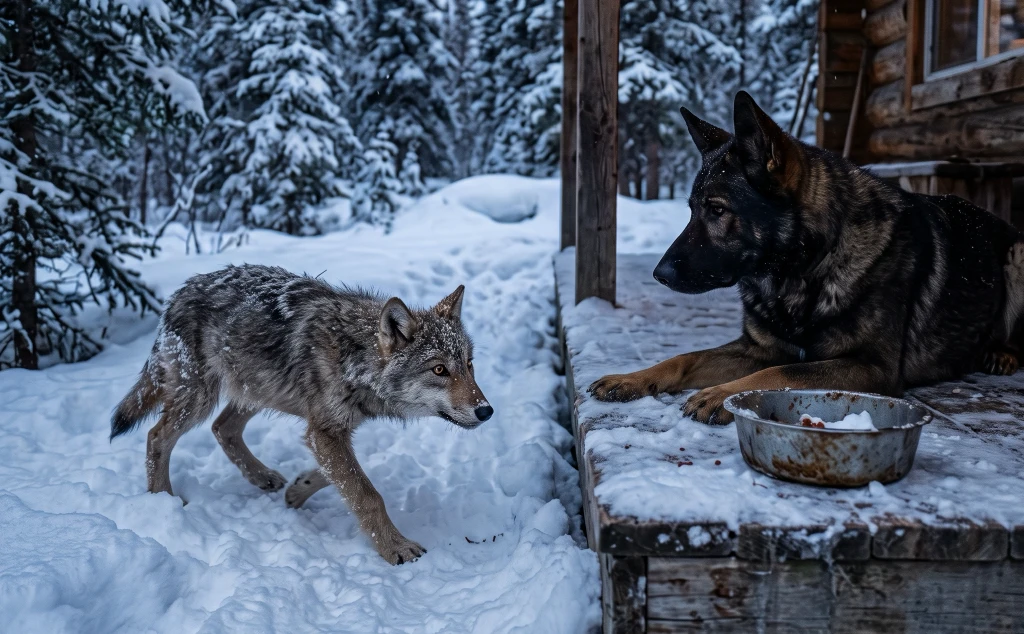
Beyond the yard, hidden by a black spruce, a small gray animal watched steam lift from the bowl. Eli never saw it.
“Three days,” Eli said. “That’s enough of this.”
Ranger’s ears moved at the sound of his voice, but nothing else did. A dusting of snow had gathered along the black saddle of his back. Until a month ago, no flake would have landed there. He and Tess, the little brown mutt who had ruled Eli’s forty acres outside Tok, had raced each other from barn to porch every morning and checked the sheep fence every evening. Then Tess had died at fourteen, curled on the rug beside Ranger, and the working dog who had once searched miles of Alaska timber for lost hunters had stopped searching for anything.
The homestead sat past the last maintained road. Eli kept twelve ewes, a truck, and a generator. Solitude had never troubled him; there was always fence to mend, wood to split, or weather moving over the mountains. Ranger’s silence was different. It filled the kitchen even when the dog refused to come inside.
Eli had buried Tess beyond the garden. Ranger had watched every shovelful. For six nights afterward he slept beside the gate instead of the stove, as though a small brown dog might return by the route she had always used.
Eli crouched, his knees objecting. Beneath Ranger’s coarse winter coat, his ribs felt too near the surface. “She wouldn’t ask you to follow her,” he said, because there was nobody within twenty miles to hear a man reason with a dog. “And I’m not ready to lose both of you.”
The shepherd shut his eyes. Eli left the bowl at the porch edge and went inside to tend the woodstove. Through the kitchen window he could see the dark shape of Ranger facing the trees, waiting for an answer that would not come.
Near dusk, a dry branch snapped at the edge of the clearing.
Ranger lifted his head. The movement was slow, but it was the first alert motion Eli had seen from him in weeks. A small gray animal stood under the lowest spruce bough, so thin that its legs seemed too large for its body. Its ears lay flat. Snow clung to the rough fur along its belly, and every breath tightened the hollow behind its ribs.
Separated from his pack, the pup followed the smell of meat past his fear. When Ranger pushed himself upright, the pup folded close to the ground. It did not run. It looked at the shepherd, then at the bowl, with the fixed stare of an animal whose hunger had used up every other choice.
Ranger took one stiff step toward the food. Instead of eating, he set his nose against the rim and shoved. Metal scraped over the porch boards. The bowl stopped beside the top step, several feet closer to the yard, and Ranger backed away to his mat.
For a long moment neither animal moved. Then the pup crept forward, placing each paw as if the snow might betray it. It snatched one piece of beef and sprang back. Ranger stayed down. On the second approach, the pup kept its front paws on the bottom step and swallowed two mouthfuls without chewing. On the third, hunger won completely. The bowl rattled while the little wolf licked it clean.
From inside, Eli heard the metal knock against the boards. By the time he reached the dark window, the pup had vanished into the trees. He saw Ranger watching the place where it had gone and, in the weak reflection of the kitchen lamp, mistook the empty bowl for the answer he had been begging for.
“There you are,” he murmured. “Knew you had some sense left.”
The next morning Ranger gave one quiet sweep of his tail when Eli brought breakfast. That single motion loosened something in Eli’s chest. He set down a larger helping, rubbed the shepherd between the ears, and went to pitch hay in the barn.
As soon as Eli disappeared, Ranger nosed the bowl to the porch edge.
The pup returned before sunset. It came the next day too, and the day after that. Ranger never barked. At first he surrendered the whole evening meal; later, when Eli began bringing enough for two feedings, he ate what remained. The arrangement was silent and exact: bowl at the step, old dog on the mat, gray pup appearing between the trees only after the barn door closed.
Eli saw the change without understanding it. Ranger began listening again. He rose when Eli crossed the yard. Once, he walked halfway to the sheep pen before age and weakness sent him back. His eyes no longer rested on the place where Tess should have been. They kept returning to the tree line.
By the eighth evening, the pup’s coat had begun to fill in and his gait no longer wavered. After he finished eating, he did not run. He climbed the second step and stood six feet from Ranger, trembling hard enough to shake snow from his sides.
Ranger remained on his belly. The pup moved closer, stopped, and stretched his neck until the two black noses touched. The contact lasted barely a second. Then the pup bounded off the porch and disappeared among the spruce.
Ranger slept that night with his back to the woods for the first time since Tess died.
The weather broke the following afternoon. Wind came down from the Alaska Range in long, punishing gusts, driving snow sideways across the clearing. Eli brought Ranger inside before dark and barred the door. He fed the stove until its iron sides glowed, filled the shepherd’s bowl, and settled at the table with coffee.
Ranger paced from the door to the window and back. He ignored his dinner. Every few minutes he pressed his nose to the crack beneath the door, then looked at Eli.
“Nothing out there tonight,” Eli said. “Nothing with any sense.”
Outside, unseen through the white churn, the pup had already left the shelter of the spruce. Wind knocked him sideways each time he crossed open ground. He crawled the last yards with his belly on the crust, following the smell of the porch until his forepaws touched the bottom step. He managed one climb, collapsed beside the boards, and disappeared under blowing snow.
The dog struck the door with one paw.
Eli tried to lead him toward the stove, but Ranger twisted free and barked—one deep, carrying note, followed by two sharp ones. Eli had not heard that pattern since Ranger’s search-and-rescue years. It was the bark he gave when he had found someone who could not answer.
Eli was in his parka before he had decided to believe him. When he lifted the bar, the wind tore the door from his hand. Ranger lunged onto the porch and began digging at a smooth drift beside the steps. Snow flew between his legs. A gray ear appeared, then a narrow muzzle glazed with ice.
Eli pulled off one glove and touched the pup’s side. It was rigid beneath the wet fur. He could find no breath.
Every rule he had learned in fifty years of living near wolves told him to shut the door. A wild predator did not belong beside a man’s stove, and mercy did not make one tame. But Ranger lay down in the blowing snow, pressed his muzzle against the pup’s face, and made a sound Eli had last heard on the night Tess died.
Ranger had not eaten, but he had risen for the pup. Snow was already filling the bowl’s scrape marks.
Eli slid both hands beneath the frozen little body and lifted the wolf into his arms.
To read the rest of the story – CLICK the NEXT button 👇👇👇