


The sign around the old dog’s neck was written on the back of a feed invoice: FORTY DOLLARS OR HE’S GONE BY NOON. He sat beside a dented stock trailer at the Saturday market in Pine Ridge, shivering hard enough to stir the loose skin along his ribs, yet he never lowered his head. I had come for laying mash and a used well pump. Ten minutes after I saw him, I was spending grocery money on a dog I did not need.
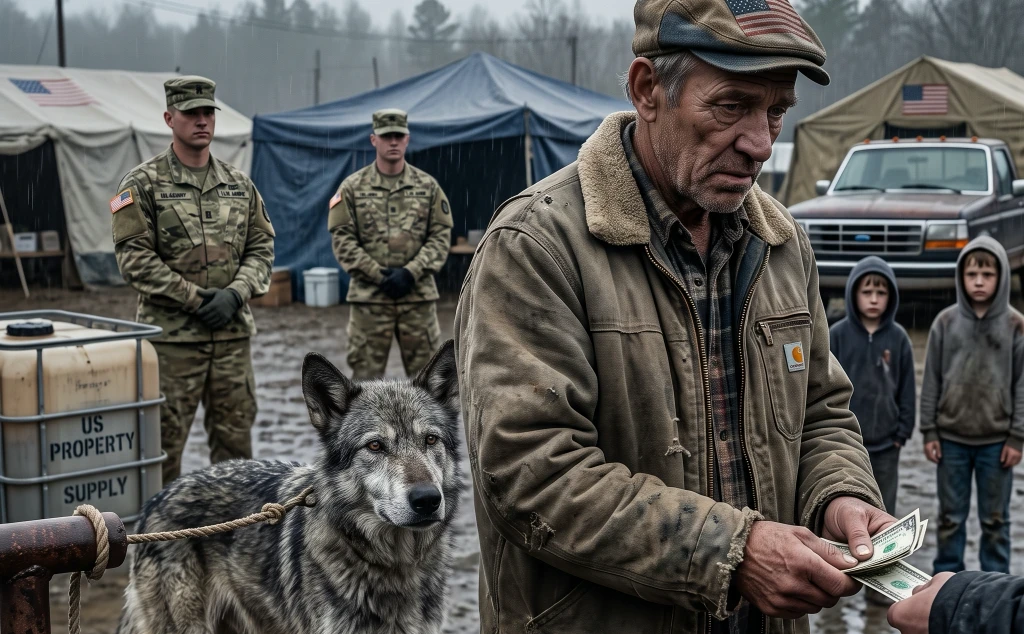
“He bite?” I asked.
The seller looked past me toward the auction barn. “Not lately.”
“That wasn’t what I asked.”
“Old working dog. Eats too much. Won’t stay where he’s put.” The man wound the frayed rope once around his fist. “You taking him or giving me a lecture?”
The rope had rubbed the dog’s neck raw beneath a collar that was too small. One rear paw bled at the edge of a cracked pad. I asked where he had come from, and the seller shrugged toward the highway as though the dog had blown in with the dust.
“Had him a few weeks. Traded for some tools.”
“From who?”
“You want a pedigree, go buy yourself a poodle.” He glanced at the clock above the auction office. “Noon means noon.”
I gave him two twenties. When the rope changed hands, the dog rose without being pulled and placed himself at my left knee. That should have told me he had belonged to somebody who knew more about dogs than the man taking my money.
My name is Graham Hale. I was sixty-eight that spring, a widower with eleven acres of stubborn ground, twelve hens, a coughing Ford tractor, and no talent for company. Folks around Pine Ridge called my place a ranch because Montana people are generous with that word. It was really an old farmhouse at the end of a county road, with Blackwater Hollow beginning beyond the back fence.
Ruth had been the one who brought strays home. A barn cat with half an ear, a magpie with a broken wing, once a goat that belonged to a family three roads over and knew perfectly well where it lived. I complained every time and built whatever shelter she said the animal needed. Standing in that muddy market, I heard her old answer as clearly as if she were beside me: You already looked at him, Graham. Now he’s your problem.
The dog climbed into my pickup as if he had done it every morning of his life. Under the mats and burrs, his coat was charcoal and rust, shepherd coloring gone silver around the muzzle. One ear carried a thick crescent scar. His eyes were amber, clear and watchful.
“You look like weather,” I told him as rain freckled the windshield. “Storm, then.”
He gave no sign that the name belonged to him, but he leaned toward the heater vent when I turned the fan up. That small admission of need settled the matter between us.
At home I made him a bed from Ruth’s old wool blanket on the enclosed porch. My wife had been dead four years, and I still kept things because throwing them away felt like choosing her absence. Storm sniffed the blanket, ate half a bowl of chicken and rice, and lay facing the door. He did not beg to come inside. He did not sleep deeply either. Every time the house creaked, one ear lifted.
When I reached over him to check the sore place on his neck, he froze but did not snap. The collar had once held a metal plate; only two empty rivet holes remained. His teeth were worn, not rotten, and the muscles beneath his starved flanks still felt hard. Someone had trained him, worked him, and then gone to trouble to erase the proof.
I sat beside him until the last blue went out of the sky. Having another creature breathe nearby changed the silence. It did not make the rooms less empty, exactly, but it gave the emptiness an edge I could walk around.
The next morning, the porch was bare.
The water bowl lay on its side. A smear of mud crossed the threshold, and pawprints led through my garden toward the sagging north fence. I stood in my socks, angry at the seller, the dog, and mostly myself for having mistaken one quiet evening for a promise.
“Storm!”
No bark came back. Beyond the fence, the prints entered the timber along an abandoned skid trail. They were deep and evenly spaced. The dog had not wandered; he had gone somewhere with purpose.
I pulled on boots and a canvas coat, took my walking stick, and followed. The woods were wet from the night’s rain. Cedar branches brushed cold drops down my collar, and the earth smelled of needles and thawing soil. The track bent away from the county road, then crossed a dry creek bed toward the rough country locals called Blackwater Hollow.
Blackwater was not one hollow but a broken mile of ravines, limestone cuts, and second-growth forest. A logging company held leases on much of it. The rest had been closed after a slide years ago, though hunters still used old trails and children still dared one another to approach the warning signs. Seven years earlier, search teams had filled those woods for nearly a month. Nobody spoke much about that anymore.
I remembered the orange vests moving through the timber and Eli’s school picture taped in every store window. I had taken thermoses to the volunteer tent twice but never joined the line search; Ruth was in treatment then, and I used her appointments as an excuse for staying out of other people’s grief. The memory followed me now with each print in the mud.
I had gone perhaps half a mile when I heard claws striking frozen earth.
Storm stood beneath the roots of a wind-thrown cottonwood, digging with a violence that did not belong in his tired body. Dirt flew behind him. His breath rasped, but he would not stop when I called. I caught his collar, felt the ridged scar tissue under it, and tried to pull him back.
“Easy. You’ll tear your paws open.”
He twisted free, plunged his muzzle into the hole, and dragged out a knot of blue fabric. It landed against my boot with the soft weight of something long buried.
At first I thought it was a child’s jacket. Then I found the straps.
The backpack was small, its nylon bleached nearly gray except where roots had covered it. A cartoon mouse still showed on the front pocket. The zipper had rusted shut, and the cloth came apart when I tried to lift it. Inside a cloudy plastic tag sleeve, protected by two folds of tape, a name remained legible in faded marker.
The hole was too neat to be a place where floodwater had dropped it. Flat stones had been laid over the pack before roots grew around them, and a rotted strip of yellow jacket showed beneath one edge. I did not touch that. Even frightened, I understood I was looking at evidence, not lost property.
ELI CARTER. MRS. DAWSON. SECOND GRADE.
My fingers went numb around the strap.
Everybody in Copper County knew that name. Seven-year-old Eli Carter had disappeared during an elementary school nature outing. Deputies, volunteers, dog teams, and a National Guard helicopter had searched until early snow made the higher ground dangerous. The official conclusion was that he had fallen into a flooded sinkhole somewhere beyond the marked trails. No body had ever been recovered.
Storm sat back on his haunches. Mud streaked his muzzle. He watched me for one long second, then turned toward the darkest crease of Blackwater Hollow and pulled against his collar until the buckle groaned.
Seven years after Eli vanished, an old dog had dug up his backpack—and he was still trying to lead me deeper into the woods.
To read the rest of the story – CLICK the NEXT button 👇👇👇