


At six on an October morning, Grant Mercer opened his eyes and studied the hairline crack above the bed. It crossed the plaster in three crooked segments, and after two years of sleepless nights he knew every bend of it. Ellen lay on her side facing the wall. Once, she had slept with a knee across his legs and her palm spread over his chest; now eighteen inches of cold sheet separated them, a small distance that seemed harder to cross than any river Grant had ever bridged.
At fifty, Grant had expected his body to complain, not become foreign territory. His left arm rested against his hip, heavy and faintly tingling; when he told the fingers to close, the index finger trembled and the others remained still.
The neurologist called that progress. Grant, who had spent twenty-three years calculating what steel and concrete could bear, called it a cruel joke.
He sat up without waking Ellen, or without making her admit she was awake. Dressing took twelve minutes: weak arm into sleeve first, shirt pulled around his back, buttons managed with his right hand while his left shoulder burned. He had become skilled at tasks he despised and impatient with the people who praised him for them.
In the kitchen he wrote, Gone for a walk. Don’t wait for lunch. His handwriting leaned downhill, as if even the words lacked the strength to stand.
Then he slipped a prescription bottle into his coat pocket.
For three months he had saved the stronger sleep medication, one or two pills at a time. The doctor had warned him never to exceed the dose printed on the label. Grant had counted twenty-three tablets the night before and decided warnings no longer applied to a man who would not be there in the morning.
He paused beside the framed family photographs in the hall. There was Ellen at twenty-four, laughing under a borrowed wedding veil; Anna and Ben with popsicle-stained mouths; Grant accepting an engineering award while a projected image of the Allegheny River glowed behind him.
The man in that photograph had trusted numbers, his body, and tomorrow. The man holding the bottle trusted none of them.
Outside, Hawthorn Ridge, Pennsylvania, was barely awake. Porch lights floated in the blue-gray dawn, and wet maple leaves stuck to the road. Grant planted his cane, swung his left leg through, and listened to the uneven rhythm carry him past the last house: tap, drag, step; tap, drag, step.
Before the stroke, he had walked these woods with Ellen and sometimes with his younger brother, Mark. He knew where the old logging road narrowed, where a spring crossed under slate, and where cell service disappeared. That last fact mattered today.
The trail climbed for half a mile. Grant’s hip tightened and his breath came hard, but he refused to rest until the houses vanished behind the ridge.
At a flat boulder overlooking a ravine, he sat and took out the bottle. The safety cap resisted him. For one bitter second, he almost laughed: the final indignity would be needing Ellen to open the pills he meant to use to leave her.
His right palm finally filled with white tablets. He unscrewed his water bottle, lifted the first pill—and heard a high, broken bawl below the trail.
It came again, too rough for a child and too frightened for any sound he knew. Grant lowered his hand.
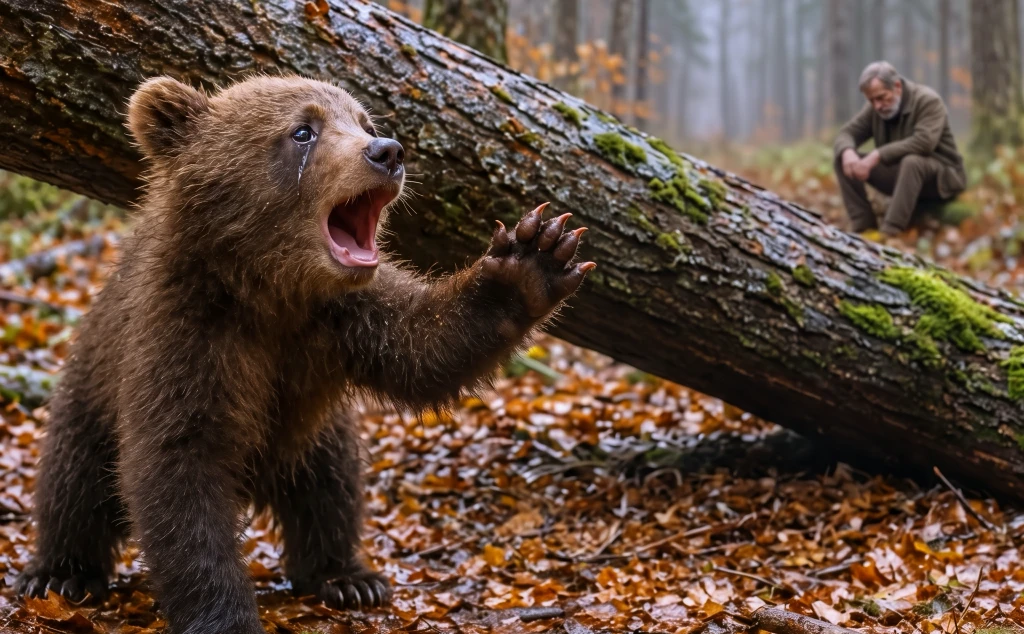
The brush shuddered thirty yards downslope. A young black bear burst into view, stopped when it saw him, then wheeled toward the ravine and bawled again. It did not come begging to him, as a storybook animal might. It paced, slapped at leaves, and kept looking toward something Grant could not see.
He poured the pills back into the bottle. Curiosity, he told himself. Nothing more.
The descent was slick, and twice his left foot folded under him. At the bottom he smelled torn earth and wet wood. A red oak had come down in a recent storm, its root ball lifted like a wall and its lower trunk wedged across a shallow wash.
Beneath it lay a black-bear sow.
The trunk had pinned her across the haunches, not crushed her whole body, but every breath moved through her in a harsh shudder. She turned her head when Grant appeared. Her ears flattened, and a low warning came from deep in her chest.
Grant stopped well beyond the reach of her forelegs. The cub scrambled up the bank and disappeared behind mountain laurel, still calling.
“Fair enough,” Grant whispered. “I wouldn’t trust me either.”
He backed away and pulled out his phone. No service. He tried 911 anyway, then the Pennsylvania Game Commission emergency number saved from years ago, but neither call connected.
The correct choice was to climb out, reach the road, and bring trained help. It would take him close to two hours to reach a signal and longer for a crew to hike in. He watched the sow’s breath hitch. One hind paw twitched beneath the oak, then went still.
Grant knew loads. The fallen oak might weigh several tons, but he did not need to lift several tons; he needed to raise one section a few inches around a fulcrum and hold it there. It was the same principle that let a crane move a bridge girder, stripped down to stone, wood, and one half-working man.
He searched the wash and found a six-foot length of sound hickory, probably torn from another tree. With his right hand and shoulder he dragged it through the leaves. The left arm bumped uselessly at his side.
He chose a block of sandstone for the fulcrum and rolled it into place with his boot. The sow watched every movement. Grant kept the oak between them, spoke quietly so he would not surprise her, and never mistook her exhaustion for permission.
The first lever snapped before the trunk moved. The recoil threw him onto his back, and the sow struck the ground with one forepaw.
Grant lay still until she settled. His heart hammered with an old, familiar terror: not fear of death, but fear of failing while someone watched.
The cub called from the laurel. Grant pushed himself up.
His second branch was shorter and thicker. He used two stones beneath it, changing the angle until the geometry looked right. Then he leaned his right forearm over the branch, trapped his weak left hand against it with his chest, and lowered his weight.
The oak rose less than an inch.
It was enough to slide a flat rock beneath it.
For the next two hours Grant worked in increments too small to impress anyone. He levered the trunk, shoved a stone into the opening, rested until his pulse slowed, and began again. Mud soaked his knees. Bark opened his right palm. His left shoulder spasmed from being used as a brace, but he could feel pressure traveling through it, dull and real.
He built a crib of flat stones, alternating their direction the way timber mats had once been stacked beneath his bridge equipment. If one stone rolled, the others might catch the load. Might was doing dangerous work in that sentence, and he knew it.
Around noon, thin sunlight reached the wash. The sow raised her head more often now, whether from returning strength or rising alarm he could not tell. Grant kept watching her ears and shoulders. A trapped bear was still a bear.
He found a longer pole and used his cane as a second lever, protecting the aluminum shaft with a fold of his coat. His left hand could not grip, so he looped the cane strap around his wrist and used his torso to keep the pole from twisting.
The trunk rose. Grant kicked another slab into the crib.
“That’s all,” he panted. “That’s the weight I can move.”
The words were for himself.
By the fourth hour, he had created perhaps four inches of clearance, but the sow was too depleted to pull free. Grant changed the lever point by a foot. The new position would raise the trunk nearer her hips, yet it also put him on unstable shale at the edge of the wash.
He tested the ground with his cane. It held.
The cub appeared briefly above him, then vanished at a growl from its mother. Farther back in the brush, leaves stirred in two separate places. Grant assumed wind or squirrels; he had no attention left to spare.
He bore down. The oak lifted, the stone crib creaked, and the sow’s trapped leg shifted half an inch.
“Again,” he told himself.
He reset his feet, pressed his left forearm against the pole, and committed all his weight. For a moment, the lever held perfectly. Then shale broke loose beneath his right boot.
Grant dropped to one knee. The crib began sliding toward him, and the full weight of the oak followed.
To read the rest of the story – CLICK the NEXT button 👇👇👇