


Twice a week, Atlas waited in the front hall of Bright Steps while someone fetched eight-month-old Eli. That Thursday, infant-room aide Taryn Bell waved Nora through. “We’re short two people. You can come to the doorway if he stays with you.”
Nora shortened the leash. Ten years on an ambulance had taught her to respect rules around children. “Doorway only,” she said.
Atlas was familiar to the staff; his calmness was why Celeste had permitted him in reception months earlier. Nora had never asked for more.
Atlas crossed the painted yellow sun on the linoleum and stopped so hard that the leash cut into her palm.
Through the open door, six cribs stood beneath paper clouds. A sound machine whispered rain. Eli lay on his back in the nearest crib, one fist beside his cheek, too still for a boy who normally kicked at the sight of her.
Atlas lowered his head. The soft skin around his muzzle tightened, and a vibration—not quite a growl—started deep in his chest.
“Atlas.” Nora touched two fingers to his collar, the old signal for wait.
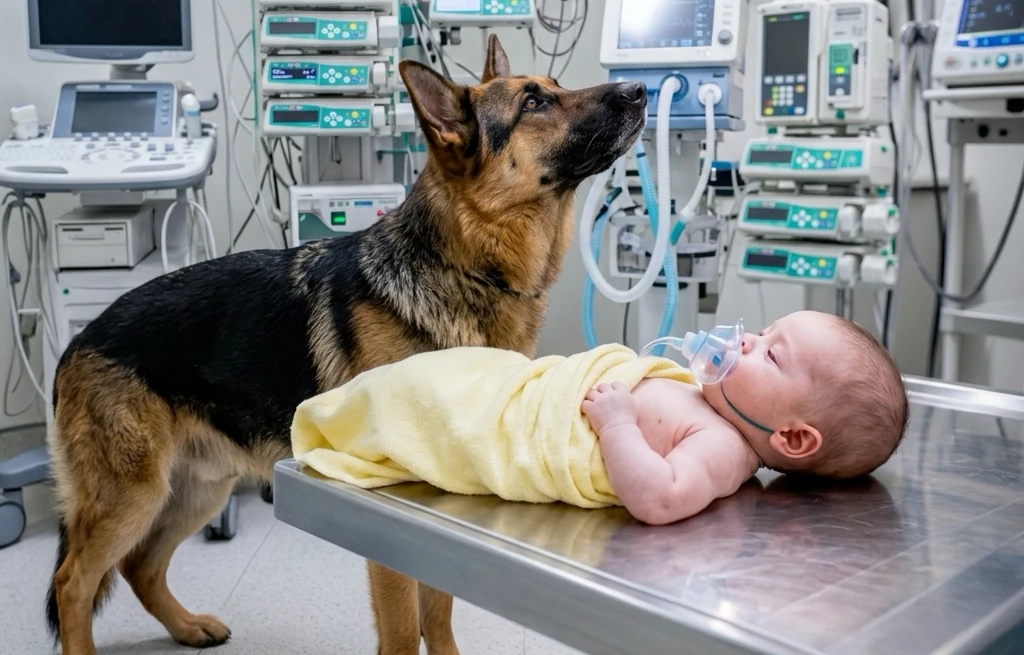
He pulled her across the threshold and planted himself against Eli’s crib. His right paw struck the mattress support twice, then pressed Nora’s thigh—the alert Daniel had taught him after a warehouse fire damaged his lungs.
“Show me,” Nora said.
Atlas touched the crib again.
Eli’s cheek felt cool, and the color around his mouth had the washed-out blue Nora remembered from ambulance calls. His breaths came shallow and far apart.
“Call 911.” She lifted him, supporting his head and neck. “Tell them an infant has depressed respirations.”
Taryn reached for the wall phone. Another aide backed toward the other cribs, staring at Atlas. He stood at Nora’s side now, rigid but quiet, his nose angled toward Eli.
Celeste Rourke entered in low heels and a cream suit. She took in the dog, the open gate, and Eli in Nora’s arms, then fixed on Atlas.
“Get that animal out of my infant room.”
“He’s the reason I checked Eli.” Nora counted again. Four breaths in thirty seconds. “Where is the emergency oxygen?”
Celeste’s expression sharpened. “You were told he had to remain in reception. There are frightened children here.”
The rule was reasonable. Using it to ignore a gray infant was not.
“Oxygen,” Nora repeated.
Taryn pulled a pediatric mask and tank from a cabinet. Nora opened the flow and held the mask near Eli’s face. Atlas shifted when Eli failed to protest.
The sirens reached them three minutes later. Lead paramedic Luis Moran recognized Nora, then disappeared into work.
“Eight months,” she told him. “No chronic conditions. Shallow respirations, cool skin, circumoral cyanosis. I found him less than five minutes ago.”
Luis fitted a monitor while his partner prepared assisted oxygen. “How did you know?”
Nora looked down at Atlas. “He alerted. He was trained for respiratory changes.”
Celeste folded her arms. “He charged a crib and growled at my staff. We have cameras.”
“Then save the footage,” Luis said without looking up. “Oxygen saturation is low. We’re transporting now.”
Atlas followed the stretcher without crowding anyone, then braced between Nora and the ambulance when Luis’s partner tried to shut the doors.
“He can’t ride in back,” the partner said.
“Front footwell,” Luis decided. “Secure his leash. If he’s trained, he’ll settle.”
Atlas climbed into the front footwell and sat facing back toward Eli.
Celeste stood under the daycare awning with her phone against her ear. She did not wave.
At St. Agnes, Dr. Lena Ortiz met them in a pediatric bay. Nora’s answers stayed clean until someone asked what medication Eli had received that day.
“None from me. He finished amoxicillin three weeks ago.”
“Anything at daycare?”
“Nothing authorized.”
Dr. Ortiz ordered blood work and toxicology. Eli’s color improved under oxygen, but he did not stir when a nurse taped his IV. Nora held the crib rail.
When Eli’s breathing changed, Atlas rose before the monitor’s audible threshold, touched Nora’s calf, and looked toward the bed.
The nurse checked the screen. “Small dip. It’s correcting.”
Dr. Ortiz watched Atlas settle again. “That was specific,” she said.
“Daniel trained him after smoke inhalation.” Nora kept her eyes on Eli. “My husband was a firefighter. Atlas learned the sound and movement of his bad spells.”
She did not add that Daniel had been dead eighteen months or that Atlas had waited beside the garage each evening afterward. Those facts had no place on a chart.
The curtain snapped aside. Celeste walked in with a city animal-control officer and two Lakehaven police officers behind her.
“There he is,” she said. “That’s the dog involved in the incident.”
Nora stepped between Atlas and the control pole in the officer’s hand. “There was no attack. He alerted to respiratory distress.”
Celeste displayed a cropped security image: Atlas against the crib, teeth visible mid-bark. It looked brutal.
“Three employees saw aggressive behavior,” Celeste said. “I also made the required report to child protective services. A parent who brings an uncontrolled animal into an infant room raises a safety concern.”
“Your staff invited us past reception,” Nora said.
Taryn was not there to confirm it.
Dr. Ortiz came around the bed. “I observed him respond to this child’s breathing. He has been controlled and nonaggressive.”
The animal-control officer lowered the pole. “I can defer intake until tomorrow. He’ll need a temperament evaluation.” A police officer added that family services would contact Nora.
Celeste gave Nora the sorrowful look she used with parents at pickup. “I hope Eli recovers. I truly do.”
After they left, Nora sat on the floor because the chair was too far away. Atlas came to her without being called and placed his broad head under her hand.
The last time officials filled her life, a fire captain had brought Daniel’s helmet to her door. The words temperament evaluation and family services found the same weak places.
“Nora?”
Owen Barrett stood at the curtain, snow melting on his jacket. He had handled police dogs with Daniel before a back injury moved him into training work. After the funeral, Nora had stopped answering his calls.
Atlas’s tail struck the floor once.
“Luis called me,” Owen said. “He thought you might need somebody who knows what that dog looks like when he’s working.”
Nora meant to say she was fine. What came out was, “They’re going to take him.”
Owen crouched without reaching for Atlas and studied his body. “Daniel trained a clear alert chain. We can document it, and Dr. Ortiz can document what she saw.”
“Celeste called family services.”
His jaw shifted. “Then we answer facts with facts. We don’t guess, and we don’t let anyone edit the day down to one ugly frame.”
The words sounded like work, not rescue. Near midnight, Eli finally cried when a nurse changed his tape. Nora laughed once before the laugh broke; the crisis, for that moment, had eased.
Dr. Aaron Whitaker, Eli’s pediatrician, entered holding a printed lab report. He had treated Daniel after the warehouse fire and knew Atlas by the white crescent under his collar. Tonight he looked not at the dog but at Nora.
“Eli is responding well,” he said. “But the screen found a sedating antihistamine at a level that could suppress an infant’s breathing. It isn’t in his chart, and we didn’t give it here.”
Nora heard the monitor, Eli’s small cry, and Atlas breathing at her knee.
Dr. Whitaker set the report on the counter between them. “Then tell me who gave your son a sedative.”
To read the rest of the story – CLICK the NEXT button 👇👇👇