


At six twelve on the morning after the storm, the north-range camera sent Dr. Eliza Hart a picture made mostly of rain. One corner held a tawny shoulder. Another showed the white scar on a cottonwood that grew above Arroyo Three. The rest was a red blur, as if the land itself had moved across the lens. Then the camera went dark.
Eliza called Mateo Cruz before she pulled on her boots. Willow, the sanctuary’s pregnant lioness, had not checked in at either feeding station since the previous afternoon. Atlas, her mate, had missed the night patrol beacon too. A failed camera could mean a flooded battery box. Two missing lions after eight inches of rain meant they went looking.
Willow was fourteen, one of Red Mesa’s oldest lions. She and Atlas had been confiscated from a roadside menagerie nine years earlier. She disliked enclosed dens and usually slept at a den-box threshold. Yet the previous evening’s images showed her entering the cottonwood draw, turning back, then entering again. Atlas trailed her without crowding. The storm erased everything after that. If labor had trapped her in the arroyo, floodwater could seal both exits and keep a vehicle out.
Eliza packed for both a birth and an extraction. She left the ultrasound unit behind because its wheeled case would not cross fresh mud, then returned for the compact monitor after imagining the distance between a guess and a heartbeat. Every added pound would have to be carried. Every omitted tool might become the one she needed.
The north service road ended half a mile sooner than it had the day before. A new channel crossed it, shoulder-deep at the center and still carrying branches. Eliza left the veterinary truck on high ground. She and Mateo continued on foot with a field pack, a dart rifle, and two coils of yellow rope. Mud climbed over their ankles and tried to keep each boot.
They found Atlas by scent before they found him by sight: wet mane, musk, and the iron smell of blood. Mateo stopped so abruptly that the oxygen cylinder on his pack tapped its buckle.
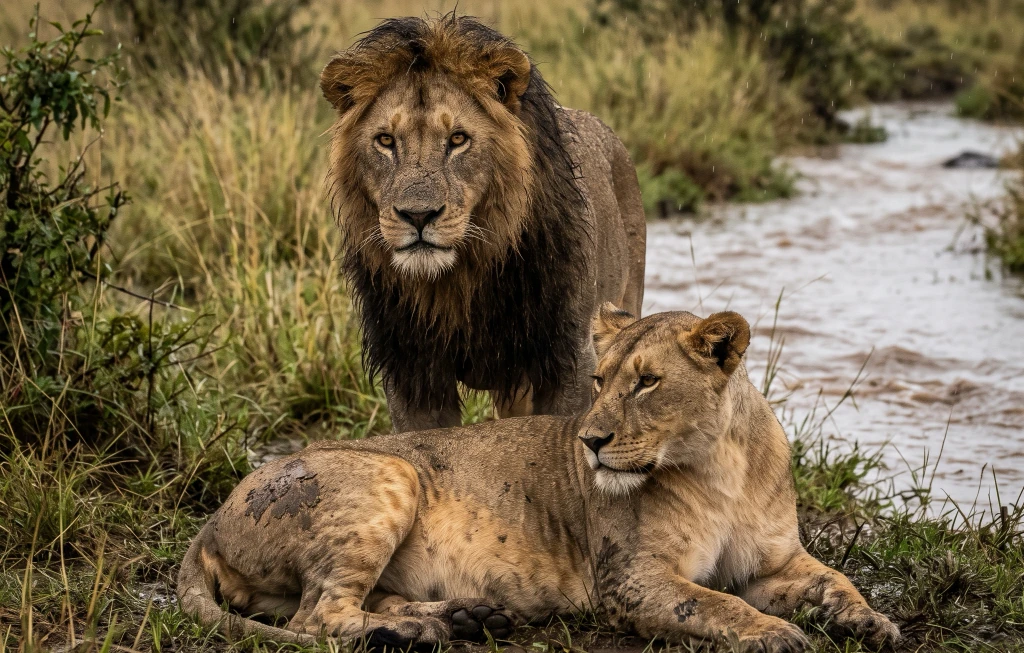
The male lion stood beneath the damaged cottonwood. He was not facing them. His body curved around something on the ground, and every few seconds he lowered his muzzle beyond his own forelegs. When he lifted it again, the fur around his mouth was dark.
Eliza moved three steps sideways until she could see past his shoulder.
Willow lay in a shallow basin where floodwater had pressed grass flat. Her abdomen was still distended. One hind leg jerked once, not with effort but with fatigue. The blood beneath her had thinned into pink threads that ran toward the arroyo.
“How long?” Mateo whispered.
Eliza studied the trampled earth. There were crescents where Willow’s rear claws had cut through the mud, then softer marks where the contractions had weakened. Rain had rounded every edge, but not erased them. “Most of the night. Maybe longer.”
Atlas turned his head.
Eliza had worked around him for nine years. She knew the notch in his left ear, the pale fur under his jaw, the way he flattened his whiskers before he struck a fence during examinations. None of that knowledge made him safe. He weighed close to five hundred pounds and stood in open ground with nothing between them but thirty yards of wet air.
Twenty-six years in wildlife medicine had taught her that familiarity predicted patterns, not outcomes. An animal could recognize a person and still kill that person without confusion.
She raised one hand, palm toward Mateo, and waited. Atlas watched. Behind him, Willow tried to gather her legs and failed. He looked back at her at once and pushed his nose under her cheek until her head shifted out of the water.
The movement gave Eliza a clean view of Willow’s gums. Even at a distance they looked too pale.
Atlas had guarded injured pride members before, but never with this degree of confinement. During Willow’s treatment for a torn pad two years earlier, he had paced outside a holding chute and allowed keepers to work behind steel. Here he had no familiar gate to tell him where his space ended. The boundary was his own body. Eliza could not expect him to understand that the people approaching with equipment meant to preserve what he was guarding.
“Call Erin,” she said. “Rescue rig, long stretcher, oxygen. Tell her to bring the two mesh shields and the bumper locks. Ben comes with her. Nobody enters the wash until I clear it.”
Mateo eased the radio from his vest. He spoke without taking his eyes off Atlas.
Eliza opened the field pack behind the trunk of a downed juniper. A handheld monitor, syringes, gloves, fluids—everything useful was on the wrong side of the lion. She took out the dart case and calculated from Willow’s last recorded weight, then reduced the amount. Full immobilization could worsen a circulation already failing. A lighter dose might leave enough reflex for transport, but it would also leave teeth and claws attached to an animal in pain.
The choice was not between danger and safety. It was between two kinds of danger, one of which might leave Willow alive.
Mateo finished the call. “Erin says twelve minutes if the ridge road holds.”
“Have her stop above us. Engines off.”
“What do you need me to do?”
“Watch him, not me. If his attention leaves Willow, say my name once. If he starts forward, get behind the truck.”
“And you?”
Eliza slid a dart into the rifle. “I need an angle.”
She moved upstream, using the broken bank for cover. Water hissed around stones below her. From this position, Willow was screened by Atlas’s ribs; from farther left, a shelf of mud would put Eliza above him and silhouetted against the sky. She crouched and waited for the only opening the site offered.
Willow’s abdomen tightened. Her forepaws flexed, carving four lines each. No cub appeared. Atlas bent over her and gave a low, pulsing call that Eliza felt through the soles of her boots.
“Eliza.” Mateo’s voice carried softly across the wash.
Atlas had found her position. His stare fixed on the rifle, then traveled to her face. The distance between them seemed to contract without either of them moving.
Eliza lowered the muzzle an inch. The wind pushed the smell of blood toward the male. He turned back to Willow and licked rain from her ear.
There was the angle: the broad muscle high on Willow’s rear leg, visible between his chest and the fallen branch.
Eliza set the stock against her shoulder. The red dot steadied, wandered with her breathing, steadied again. She had one clear shot before Atlas understood what the rifle meant.
The dart struck with a flat pop.
Willow flinched. Atlas spun so fast that mud left his mane in a ring. His roar arrived before Eliza could lower the rifle, a physical blow that emptied the cottonwood of birds.
“Back!” Mateo shouted.
Eliza stepped off the bank and stopped in the wash. The slope behind her was climbable, but reaching it would mean turning her back. The rifle had become a hazard in her hands. She rotated it crosswise at her hips, planted both boots in the red water, and watched the line of Atlas’s shoulders.
Atlas came through the basin in three bounds. The first threw red water behind him. The second carried him past Willow’s hindquarters. On the third, his head dropped and his eyes locked on the center of Eliza’s chest.
Nothing stood between them now.
To read the rest of the story – CLICK the NEXT button 👇👇👇