


The pole failed with a pistol crack, and Elias Ward went down on his bad side. His cheek struck wet leaves. Something hard bumped his ribs, slipped from his coat, and spun across the ravine floor: an amber prescription bottle with his name on the label. It stopped against the exposed claw of a red-maple root. Five yards away, a trapped black bear drove her teeth through the bark of the fallen tree.
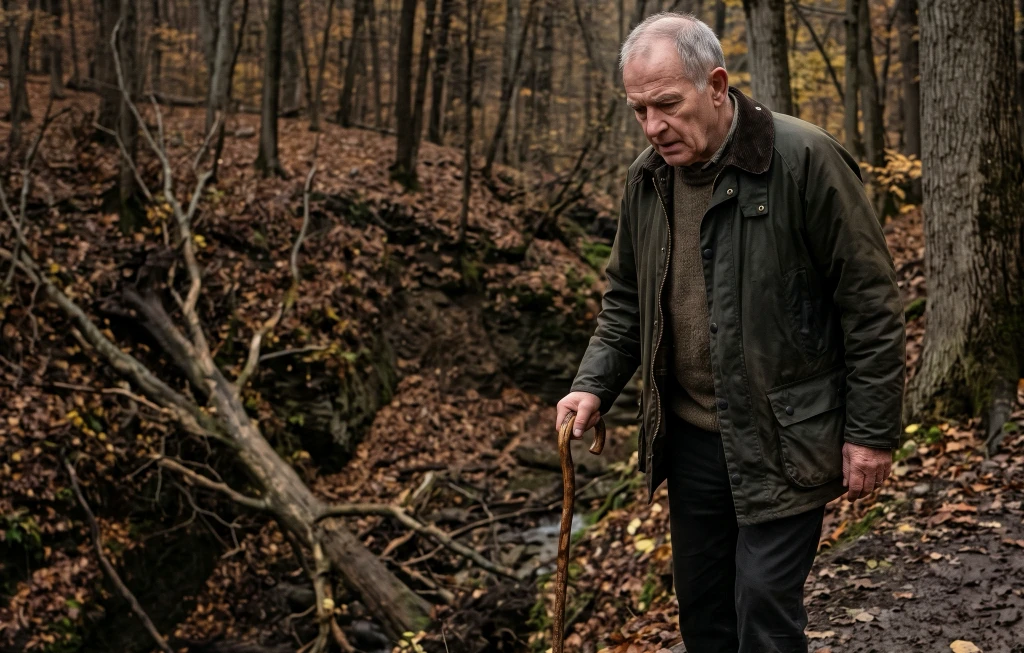
Elias did not move. The cub above him made a rasping cry, then crashed through the hobblebush. The sow’s forepaws churned mud, but the fork of the maple held her hips against a shelf of granite. The tree shuddered once and became still.
Forty minutes earlier, Elias had been sitting beside the abandoned fire road, trying to make himself open that bottle. He had picked a Tuesday in late October because the parking area would be empty. His note to Ruth—Back before dark—lay under the sugar bowl at home. It was a delaying sentence, not a promise. Two years after a stroke had taken the useful cooperation of his left hand and leg, he had become practiced at sentences that kept other people from asking the next question.
The cap had resisted his one-handed grip. That small humiliation nearly made him laugh. Then a grating bawl came from below the road, animal and desperate.
He put the bottle away and listened. The cry sounded again. A patch of brush shook downslope.
Before his stroke, Elias had inspected bridges for the state. His work had taught him that strange noises deserved witnesses. A ping in winter steel, a bearing that knocked when a truck crossed, a timber pile scoured clean on one side—none of them improved because a tired man preferred silence. The habit outlived the job. He planted his folding cane below him and descended.
The black bear cub appeared at the bottom of the slope. It was not storybook-small. Standing, it might have reached Elias’s belt, and its claws opened pale scratches in the mud. It retreated when it saw him, bawled toward the wreck of the maple, then rushed close enough to catch the loose cuff of his jacket in its teeth.
The pull lasted no longer than a startled dog’s nip. Elias jerked back; the animal bounded away. He did not tell himself it had asked for help. It could have been confused, defensive, or trying to move a threat. But it had turned his body toward the wash, and from that angle he saw the sow.
The maple had come down in a windstorm. Its root plate stood upright like a broken wall, while the crown rested across the ravine. One low fork had bent under the trunk and pinned the sow just ahead of her hind legs. She could reach Elias with neither claws nor teeth from where he stood. If the wood shifted, that fact could change without warning.
He backed uphill until the cane struck stone. There was no phone signal. The fire road was more than a mile behind him, and even if he reached it quickly, a wildlife officer might not reach this drainage for hours. He could leave a location marker and go. That was the reasonable choice.
The bottle pressed above his heart. Reasonable, Elias thought, had become a word people used when they wanted him to surrender without embarrassing anyone. It had described selling his workshop tools, moving the bedroom downstairs, accepting Ruth’s arm before he had decided whether he needed it. Some changes had been necessary. Others had accumulated because resistance required energy he no longer believed he owned.
The sow’s breath moved a small patch of leaves beside her muzzle. The cub came to that patch, touched noses with her, and sprang away when she snapped at the pressure on her body.
Elias set down his cane. He approached from the tree side, keeping the trunk between himself and the sow’s head. The entire maple was beyond anything one man could lift. Its weight, however, was not resting in one place. The roots bore one end. Granite held the other. Between them, the loaded fork behaved like a bent spring. If he could raise only that fork and keep each gain from returning, he might create room for the bear to pull free.
He found a dead spruce pole and dragged it into position. The first attempt was careless. Wet bark slid over stone, the pole kicked sideways, and that was when it broke and threw him into the leaves. Now, face down, he heard the bottle tap softly against the maple root as the tree settled.
He rolled onto his back. Pain had lit a wire from his left hip to his shoulder. The sow worried the bark, frustrated by a danger she could smell but not reach. Elias crawled to the bottle with his right hand and closed his fingers around it.
For several seconds, the original purpose of the day returned with terrible simplicity. No search for another pole. No climb out. No more forms asking him to rate pain from one to ten, as though the right number might restore a life.
The cub cried again.
“You are not a sign,” Elias told it. His mouth tasted of soil. “You’re a bear with bad timing.”
He shoved the bottle into the deepest pocket of his pack and threaded the pocket zipper through its own fabric pull. Opening it would now require two deliberate actions. Then he sat until the nausea passed and began again.
This time he treated the ground as part of the machine. He scraped leaf mold away from the granite, tested possible fulcrum stones with his boot, and rejected anything that rocked. From a standing deadwood snag he cut two-foot sections with the folding saw he carried for trail debris. He arranged the pieces in alternating layers beside the trapped fork, a squat crib that could accept the load if he gained any height.
The cub vanished and returned in nervous loops. Once it climbed halfway onto the trunk, and the sow’s struggle shook it off. Elias waited until both animals quieted before feeding a longer sapling beneath the fork.
His right hand could grip. His left could not, but the forearm still gave him a broad surface. He laid it along the pole, trapped it against his chest, and pulled a spare pack strap around both so the weak wrist could not slide away. His cane became a temporary prop for the first crib block. No inspector would have signed off on the arrangement. Approval was not available.
He pressed down with his shoulder.
The sapling bent until he expected another crack. Mud shifted under his good boot. He stopped, reset the stone a palm’s width nearer the fork, and tried with his weight rather than his arm.
Something changed—not visibly at first, but in the sound. The loaded wood’s low complaint rose half a note. A line of darkness opened beneath the fork.
Elias held the lever down. His right arm shook too violently to place a block. The cane stood beside the crib with its rubber tip jammed against a cut section of wood. He knocked the handle with his knee. The block toppled in the wrong direction.
“Of course,” he said.
He could release the pressure, reset everything, and try again. He also knew how little strength remained. Instead he dragged his left boot through the mud until the toe found the fallen block. He nudged it upright, caught its edge with the cane, and shoved. The block entered the gap crooked but deep enough to take weight.
Slowly, Elias let the lever rise.
The fork descended onto the block and stopped. His crude crib gave a dry wooden tick. He waited for collapse. None came.
The sow pulled once. The new space was not enough; her body moved less than the width of Elias’s thumbnail. Yet the movement proved the load had changed.
Elias sat back on his heels. The first support looked absurd beneath the maple, a child’s stack under a house. The canopy kept the ravine dim even before noon, and he would need several more lifts to free her.
He reached for another length of wood.
“Hold what you have,” he told the crib. “I’ll find you somewhere else to put the rest.”
To read the rest of the story – CLICK the NEXT button 👇👇👇