


At eight degrees above zero, the wind coming off the Talkeetna Mountains could turn dry snow into sandpaper; it was only the first week of October, but an early high-country whiteout hissed across the abandoned Granite Hook Mine road and erased Caleb Mercer’s tire tracks almost as soon as his old Ford made them.
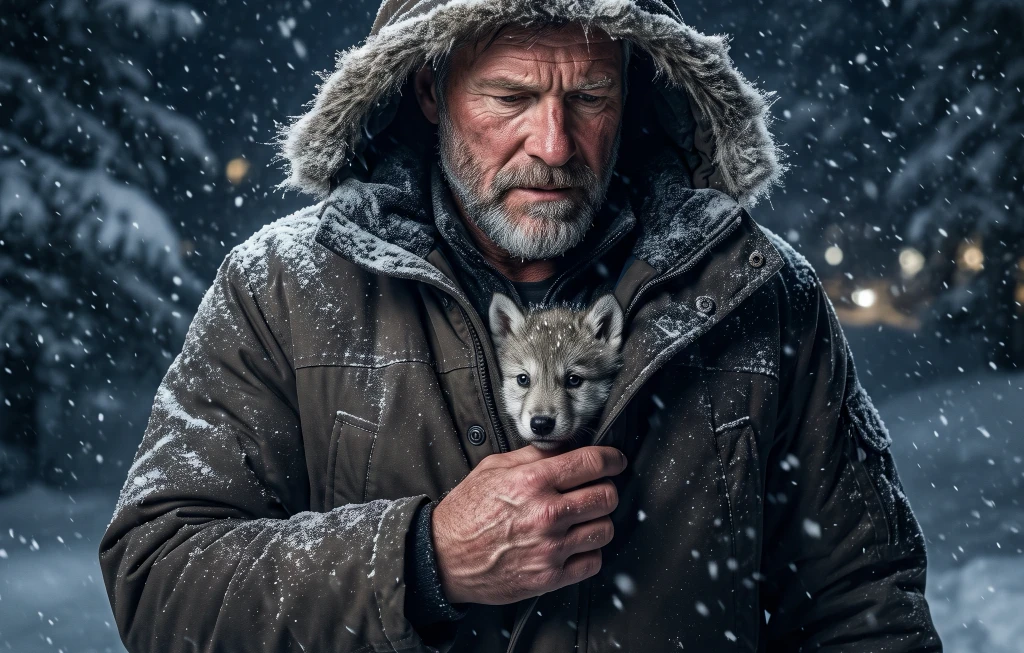
Cal drove with both hands high on the wheel, shoulders braced for the ruts he could no longer see. At fifty-two he was still broad through the chest, but shrapnel left from a route-clearing mission in Afghanistan had turned his right knee into a poor judge of weather and a reliable judge of pain. Every drop into a frozen pothole sent a hot nail up his thigh.
He was six miles from Kestrel Ridge Wildlife Rescue, the former survey bunkhouse where he lived among kennels and animals too injured to go elsewhere; Hatcher Pass was closing behind him, and spruce crowded the mine spur ahead.
The truck slewed in a drift, and a pair of black marks appeared under the blowing snow. They came from tires, not skis—one hard brake, a sideways correction, then acceleration. Whoever had made them had not stopped.
Cal eased onto the shoulder: down the embankment, something gray lay where the wind had worried the snow bare.
He keyed the radio clipped to his coat and got only static. His rehabilitation permit allowed emergency stabilization of injured wildlife, but it did not make him a game officer, and a wolf was never a casual intake. Cal logged the mile marker into the recorder anyway, took his medical bag, a flashlight, and a folded silver emergency blanket, then stepped into the white.
The slope grabbed his bad leg halfway down. He caught a spruce branch, waited for the pain to retreat from bright to merely vicious, and moved again with the economy the Army had taught him: test, place, commit. Snow packed the seams of his gloves.
The she-wolf lay in the ditch with a dark stripe along her spine and frost silvering her whiskers. Blood had frozen in a broken trail from the road. Cal touched two fingers to her neck although her open eyes had already told him what he would find.
Her body was curved around a hollow beneath the roots of a wind-thrown spruce. The storm had filled the ditch everywhere else, but under her chest the earth was still dark. One foreleg reached across the opening as if death had interrupted a final effort to close a door.
Cal removed his cap. He had seen men arranged by blast waves in ways the mind refused to keep, and he had carried dogs struck on the Glenn Highway from one ditch or another. Yet the deliberate wall of the wolf’s body tightened his throat more than the sight of blood. He made the sign of the cross with a stiff glove, an old motion performed badly but meant.
A sound came from beneath the roots—not a whine, but an indignant, chest-deep burr much too large for the throat producing it. Cal lowered the flashlight. Two yellow eyes flashed back.
The pup was wedged between roots, silver-gray on top and nearly white beneath, with one ear folded sideways as if the storm had bent it. He was a small young-of-the-year animal, perhaps four or five months old but made younger by hunger; his right forepaw bore a ragged cut. He shook so hard that his teeth clicked, but when Cal extended a gloved hand, he bared every one of them.
“That’s a fair opinion,” Cal said. His own voice sounded strange in the ditch; at Kestrel Ridge he could pass most days using no words beyond radio call signs. “I’m not impressed with people tonight either.”
Procedure said to mark the site and wait for wildlife staff. The road would be closed for hours, and at eight degrees the pup did not have them. Cal pulled the blanket from its pouch.
Cal opened the emergency blanket. The pup lunged once, without strength, then collapsed against his wrist. Cal wrapped him in the crackling silver sheet and tucked the bundle inside his parka, where a frantic heart struck his ribs.
Before climbing, he tore a strip of red survey ribbon from his pack and tied it high on a spruce limb. If the road opened in the morning, he would return with the district officer and help recover the mother. He had left too many dead behind under other people’s orders; he would not let the plow bury this one without a marker.
Cal pulled the zipper higher around the silver bundle. “She got you to the road,” he said. “I can manage the rest of it.”
Somewhere above the mine, the snowpack answered with a long wooden crack. Cal looked uphill, chose a line through the trees, and began climbing. His knee folded once; the pup pressed deeper against his chest, still growling as though failure were a disciplinary offense.
Inside the truck, Cal lowered the bundle into an emergency carrier and tucked a warming pack beneath the outer fold. The pup tried to stand, failed, and glared at his wounded paw. When Cal pulled away, he kept his head turned toward the red ribbon until the ditch vanished.
Kestrel Ridge emerged after dark as a square of amber behind the driven snow. The bunkhouse had an iron stove, two cots, a medical table, and a radio that worked when it felt respected; the adjoining sheds held five dogs, a fox with a healing pelvis, and one owl offended by everyone. Cal shouldered through the door with the pup held high and kicked it shut on the storm.
He carried the closed crate into the small isolation room off the main room, set the silver bundle on wool blankets well back from the stove, and raised the temperature slowly. Over the phone’s last weak bar, Mara told him to offer water, leave food alone, and flush the paw only with sterile saline until she arrived. The cut was ugly but shallow, and the pup objected to saline, gauze, the stove draft, and the indignity of observation with the same low motor of disapproval.
“You sound like the weather,” Cal said. A gust shook the stovepipe, and the animal answered it. “Gale, then.”
The name made the room seem occupied in a way cages never had. Cal felt that change and mistrusted it at once.
Headlights bloomed against the iced window an hour later. Dr. Mara Vance came in carrying a field case and wearing the red shell of the volunteer mountain-rescue unit. She was forty-seven, dark-haired except for a white seam at one temple, and so practiced at moving through frightened animals that the pup watched her hand instead of biting it.
Mara had treated Kestrel Ridge animals for six years. Before her husband, David, died in an avalanche four winters earlier, she had also handled search dogs with him; now she took veterinary duty and occasional base assignments, never the live snowfield. Cal did not mention the red shell or the pause she made when a slab of roof snow struck the porch.
She listened to the pup’s lungs, checked his gums, and unwrapped Cal’s bandage. “Cold and dehydrated. The paw should heal if infection stays out. Did you report the location?”
“Recorded it. Radio’s dead beyond the lower repeater.”
“I reached the district wildlife officer before that repeater went. We can stabilize him here under your permit until the road opens. After that, the state veterinarian decides what happens.” She tucked the gauze with precise fingers. “You did the right thing tonight. That doesn’t make the next thing easy.”
She entered the pup under a temporary case number, photographed the wound, and posted quarantine instructions on the isolation-room door. STATE CUSTODY—EMERGENCY HOLD ran across the top of the sheet.
Gale drank, one paw planted on Cal’s thumb, and then fell asleep while still trying to growl. Cal studied the small ribs lifting under silver fur. The bunkhouse had not sounded this alive in years.
Mara followed his gaze. When she spoke again, her voice was gentle and immovable. “Cal, he’s a wolf, not a lonely man’s dog. If he lives, you can’t keep him just because this place is empty.”
To read the rest of the story – CLICK the NEXT button 👇👇👇