


The scraping stopped when I reached for the rifle. Then came a heavy breath, close enough to stir the strip of weather seal beneath my door, and the scraping began again. It was three in the morning. Through the window I could see a black bear backing across my porch, dragging something between her teeth. She let it fall, stepped down into the April snow, and turned toward the cabin. A burlap sack lay against the threshold. As I watched, a small shape pushed at the fabric from inside.
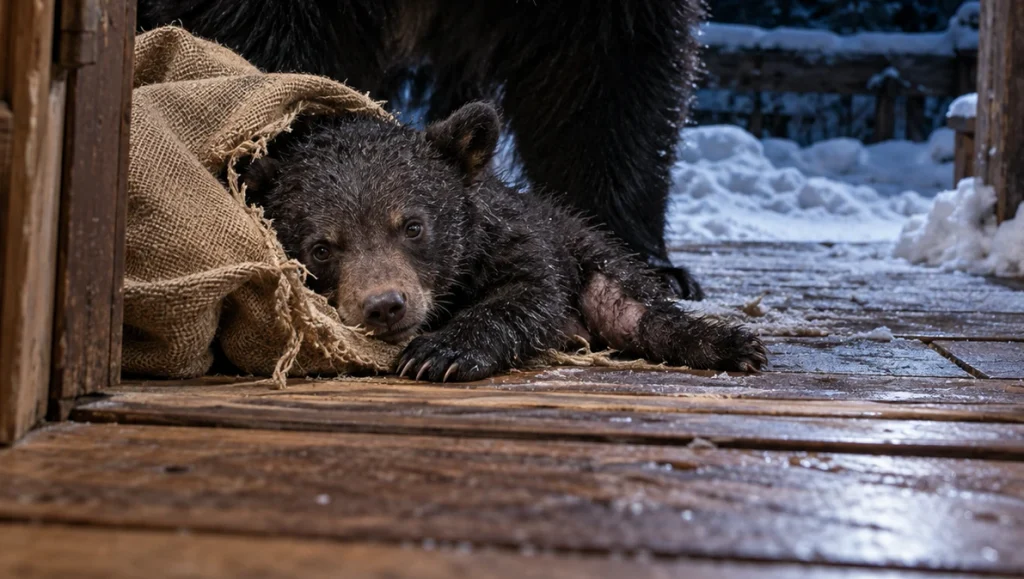
I opened the door a few inches. The bear withdrew toward the pines, keeping her head turned. Moonlight caught an old pale scar across her muzzle; beyond her, the clearing was empty.
The sack made a sound too weak to carry past the porch.
Its mouth was tied with stiff cord, but one side had been ripped open. I couldn’t know who had put that knot there, or how she had come by the sack. I had seen her pull it the last few feet to my door.
I set the rifle inside and knelt. Caught in the torn cloth was a bear cub, barely larger than a house cat, with a wet chin and a left hind leg he couldn’t draw beneath him. The smell reached me before I got the fabric away from the wound.
I had seen what an abandoned steel trap could do. I had never seen the result still small enough to fit between my hands.
The mother took one step out of the trees. I stopped moving, and so did she. We stayed that way while snowmelt dripped from the porch roof onto my neck.
“All right,” I said. My voice sounded rough. “I’ll try.”
She moved back into the dark. I gathered the cub inside my coat and carried him to the kitchen table, leaving the rifle where I had put it.
My name is Jack Mercer. I was fifty-one that spring, living above a little place called Elk Crossing in the northwest corner of Montana. Eight years earlier, a drunk driver had crossed the centerline and killed my wife, Sarah, and our twelve-year-old daughter, Lily.
After the funerals, I moved into the cabin I’d used while working timber surveys. I still bought supplies and spoke to people when I had to. Most days, there was nobody close enough to hear me say a word.
The cub dragged his good front paw across the tabletop, searching for purchase. I slipped a towel beneath him, and his claws caught in it. That small grip made me remember Lily holding my sleeve in the feed store, beside a handwritten notice about puppies.
I’d said we were too busy for a dog. Later she’d tried for a kitten, then a hamster; I had kept finding reasons to wait. It was a foolish thing to keep taking apart after a highway collision, but grief had left me plenty of time for foolish things.
I warmed the room and did what little my field first-aid training allowed. The damaged leg needed more than anything I had in the cabinet. When the cub stopped struggling and let his head sink against the towel, I put down the cloth in my hand.
My pickup sat beyond a drift on an unplowed logging road. There was no cell signal at the cabin. Hank Rusk, a retired ranger who still lived at the old station, had a radio and a maintained road; reaching him meant nine miles on the winter trail.
I pulled my father’s quilted hunting coat from a peg. The cuffs were frayed, and one pocket still contained a piece of string he’d saved for some purpose I would never know. I lined my pack with the coat and settled the cub inside, leaving his face uncovered.
Outside, large tracks led toward the creek. I checked the bundle once more, shut the cabin door, and took the trail to Hank’s.
Walking with a sick animal changes the way you use your feet. I tested each place before putting my weight down, trying to keep the pack steady. Every few minutes I stopped and felt for the faint movement beneath the coat.
At the creek, I brought the pack around against my chest. The old log footbridge had a handrail on one side and ice along the other. Water ran black beneath it, swollen by the thaw, and halfway across the cub gave a thin complaint.
“I know,” I told him. “I know. We’re going.”
By the time the station roof appeared, daylight had begun to show between the trees. My shoulders burned, and I had worn a damp place into the collar of my coat. Hank opened the door before I could knock a second time.
He looked at my pack, then at my face. Without asking, he cleared the breakfast things off his table.
“What’s in there?”
I opened the coat. Hank took his pipe from his mouth and laid it in an empty saucer.
“A bear left him at my door.”
He studied me for a moment. Then he bent over the cub, saw the leg, and went straight to the radio.
Hank got through to dispatch and asked them to reach Beth Hale. Her father, Frank, had taught me most of what I knew about working in the woods without getting somebody hurt. Beth had become a veterinarian; the last time I’d seen her was at Frank’s funeral, four years before.
While Hank relayed her questions, I watched the cub breathe. Beth was twenty-five miles away, and the road to the station was passable. She was coming with her emergency kit.
Hank put a mug beside me. I couldn’t get my fingers comfortably around it.
“Years ago, a fellow I worked with had a wolf drag an injured pup up to his shack,” he said. “Trapped leg. Swore to it till the day he died.”
“Did the pup live?”
“He got it back to her. That’s the part I remember.” Hank pushed the mug closer. “Drink some. You’re shaking the table.”
Beth arrived in her father’s old Jeep, her hair caught crookedly behind her head and her glasses fogging as she came inside. She washed her hands, opened her bags, and asked Hank for more light. Only after looking closely at the cub did she look at me.
“He’s very sick, Jack. The infection may have spread beyond the leg.”
“Can you do anything?”
“I can start. I can’t promise you where we finish.”
She had me stand where she needed me while she established a line and began warming and stabilizing him. Later, when she judged him ready, she gave him medication so she could examine and clean the injury without adding to his pain. Hank held the light, his cold pipe forgotten in the saucer.
There were instructions I had to ask her to repeat. My hearing seemed to narrow whenever the cub went still. Beth noticed and made me meet her eyes before she told me what to do next.
“He’s breathing,” she said. “You watch his chest. I’ll take care of this.”
I watched. Beyond the glass, the morning brightened, and a branch dropped its load of snow onto the station roof.
When Beth finished dressing the leg, she eased the cub into a padded carrier with the front open toward us. His temperature and breathing still worried her. She would stay until she knew whether he was beginning to respond.
Beth set Hank’s mug between my hands. “Dad used to worry about you up here.” I looked at the dark rim of the tea, unable to answer. She stayed beside me until I took a drink.
The cub lifted his nose from the towel and made a small, insistent sound. A shadow crossed the window above him. Then the scarred muzzle of his mother pressed against the glass.
To read the rest of the story – CLICK the NEXT button 👇👇👇