


“Forty dollars,” the woman said. “He’s had his first shots.”
Claire had almost reached the station doors. Behind her, a cardboard box scraped against a stone pillar, and something inside it made a small, breathless sound. She turned with one glove between her teeth.
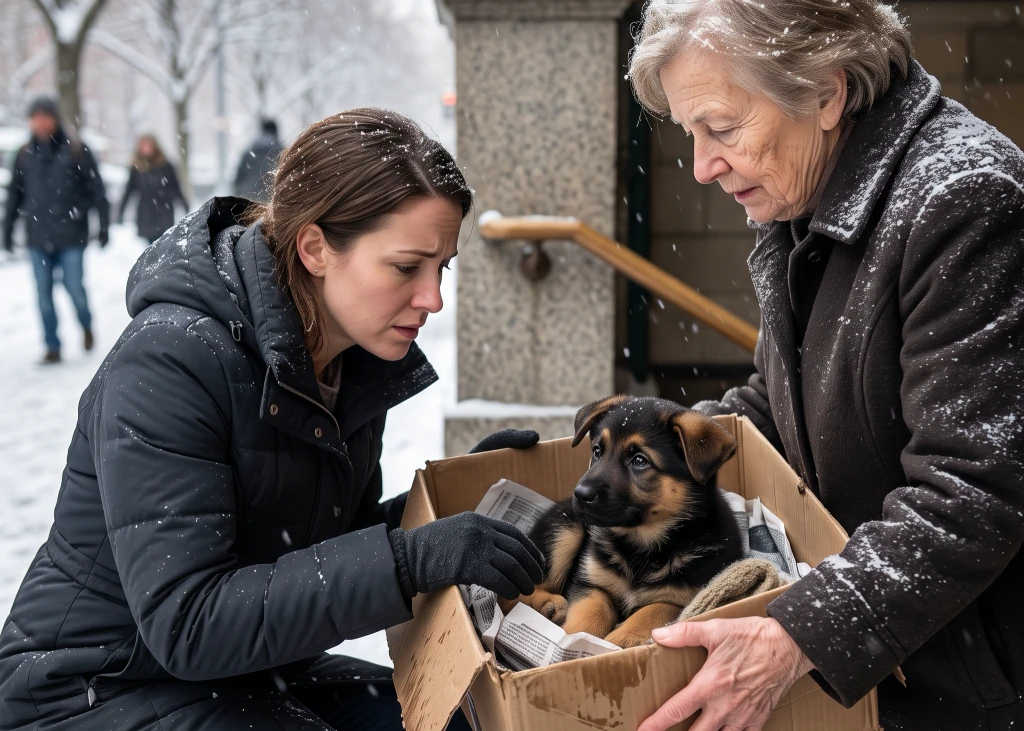
The woman looked about seventy. She was trying to pull her coat around the box without letting go of it. Snow had gathered in the seams of her sleeves. Inside, on damp newspaper, a German shepherd puppy lay curled around feet he had not grown into yet.
Claire wanted to be on the train. She had been at the hospital sixteen hours, eight of them in an operating room, and a muscle beside her shoulder blade had begun to jump. At thirty-two, she was a neurosurgeon who sometimes fell asleep standing up after a difficult case. She had never learned to sleep sitting on the subway without missing her stop.
The puppy lifted his head. One ear folded over; the other leaned against the cardboard.
“He needs to get inside,” Claire said.
“I know.” The woman looked toward the station as though someone might be coming for them. “I know that.”
Claire crouched and touched the newspaper. Wet through. She took off her scarf, tucked it around the puppy, and felt his small body press against her knuckles. She lifted him against her coat while she spread the scarf, then settled him back into the box.
“What’s your name?”
“Ruth. Ruth Bell.”
“I’m Claire.” She looked at the woman’s bare hands. “Can somebody pick you up?”
Ruth shook her head. “I need to get my husband’s prescription before they close. I wouldn’t be out here with him otherwise.”
For a moment she seemed about to say more. Then she adjusted the scarf over the puppy’s back, leaving his nose uncovered, and asked whether Claire had ever had a dog.
“Not as an adult.”
“He’s a good little fellow. He hasn’t learned much yet.” Ruth tried to smile. “Neither have I.”
Claire opened her wallet. There were four hundred-dollar bills behind the smaller ones; she took them all out and folded them into Ruth’s palm.
“No. Honey, no. I said forty.”
“Please get the medicine.”
Ruth kept looking at the money. Claire lifted the box before either of them could change her mind, and the woman fumbled in her pocket for a thin veterinary booklet. She tucked it between the scarf and the cardboard.
“His name is Toby.” Her hand stayed on the rim. “Will you keep that?”
“Yes.”
Only then did Ruth let go.
On the train, Claire held the box on her knees. Toby settled against her wrist, and she remained in that awkward position all the way home rather than risk waking him. She nearly missed her stop because she was watching his breathing.
Her apartment looked as she had left it: a clean mug upside down by the sink, no dishes in the rack, the bedroom door open onto a carefully made bed. She put the box down, filled a bowl with water, and watched Toby back away from the unfamiliar floor. He would not come out until she sat beside him.
“Well,” she said, looking around for something that belonged to a dog. “I didn’t think this through.”
She made a bed from towels near the radiator. After a trip to the corner store, there was puppy food in the kitchen and a roll of paper towels beside the door. Toby sniffed the food, took a little water, and lay down on the mat where her boots had been.
That night he kept returning to the door. Claire heard his nails cross the floor, pause, and cross it again. When she finally carried her pillow into the living room, he climbed against her ankle, but every noise in the hallway brought his head up.
By morning he had refused another meal. Claire called a veterinarian, arranged an examination before her next shift, and came home with feeding instructions, a follow-up plan, and no simple answer. Stress might be part of it, the veterinarian said, but a puppy eating so little needed watching. Claire wrote down what he ate instead of trusting her impression that he was improving.
She hired someone to check on him while she worked. Her scheduled vacation was still a week away, and the operating room would not empty itself because she had acquired a puppy. The arrangement cost money and several hurried phone calls. She made them from the hall, where Toby could see her.
Over the next few days, he chewed a chair leg and carried three separate shoes into his bed. He left a wet patch in the center of her pale rug, then stood nearby wagging tentatively while she cleaned it. Once, when she sank onto the couch without taking off her coat, he planted both front paws on her knee.
She stayed there until her phone rang.
Yet he ate only small amounts, even with the veterinarian following his progress. Between brief bursts of puppy destruction, he waited on the doormat. Claire began coming home quietly, hating the instant when he heard the key and scrambled up, followed by the smaller movement when he saw who had arrived.
On the fifth evening, she shook out his bedding and found a scrap of gray wool. It was no bigger than her palm, ragged along one edge, and smelled faintly of a house she had never entered.
Toby rose at once. When she lifted it toward the trash bag, he stood on his hind feet and made that same thin sound she had heard at the station.
“All right. Here.”
He took it gently, carried it back to the towel, and folded his paws over it. His nose went down into the wool. Within minutes, the anxious little movements of his ears had stopped.
Claire knelt beside him. She could buy another bed, another kind of food, a toy that squeaked differently. The rag under his chin had come out of the box with him, and she had nearly thrown it away.
She went to her coat pocket for the veterinary booklet. On the inside cover, beneath Toby’s name, Ruth had written an address in Boston in small, uneven letters. There was no phone number.
Saturday morning, Claire lined a soft carrier with a towel and put the scrap of wool inside. Toby stepped into it before she had finished opening the top. She carried him downstairs to her car with the booklet in her pocket and a sentence ready: I thought he might like a visit.
By the time she found the building, she had stopped rehearsing it. The entry door stuck against packed snow, and the stairwell smelled of boiled vegetables and old paint. There was no elevator. On the fourth-floor landing, she set the carrier down long enough to catch her breath, then knocked.
Ruth opened the door in a housecoat. Her gaze went immediately to the carrier.
“Is he sick?”
“He’s been checked. He’s eating a little better, but he misses you.” Claire lifted the booklet. “I hope you don’t mind. Your address was in here.”
“Did you want your money back?”
“No.”
Ruth’s fingers loosened on the door. She stepped aside and called to someone in the next room, her voice suddenly brighter than her face.
“Walter? We’ve got company.”
A man sat by the window in a wheelchair, a plaid blanket across his knees. He was about seventy-five, broad through the shoulders despite the weight he had lost. His right hand rested curled against the armrest; the right side of his mouth drooped slightly. Claire recognized the pattern, but the stillness with which he watched the window concerned her more.
Ruth touched his shoulder. He did not turn.
The carrier began to shake. Claire put it down and opened it, and Toby scrambled out, sliding on the worn floor before finding his footing. He went straight to the wheelchair and planted his paws on Walter’s left knee, tail striking the metal frame.
For the first time, Walter looked away from the window.
Then Toby went around the chair and began licking the man’s motionless right hand.
To read the rest of the story – CLICK the NEXT button 👇👇👇