


Ruth Bennett caught Ben’s sleeve before he put his hand through the kennel gate. The dog struck the wire where his fingers had been, and the latch jumped against its housing. Ben stumbled backward into the bucket Ruth had just moved out of the way.
“Leave it,” she said. “He can have the leash until he settles.”
The charcoal pit bull had come off the animal-control truck with a name, Flint, and a folder of neighborhood complaints. Nobody had brought anything that smelled of home. His wet chest drove against the gate again; Ruth watched the whites of his eyes, the floor he couldn’t find purchase on, the three men crowding his only exit.
“Everybody back up.” She waited until they did. “Ben, put a warning on the door.”
He wrote DO NOT APPROACH in thick black letters. Flint followed the moving marker with a low, exhausted growl, and Ruth caught herself calculating what a staff injury would cost before she wondered what had happened to the dog. At forty-nine, after twenty years at County Line, she had become quick at the wrong kind of arithmetic.
Upstairs, her phone rang beside an invoice for the furnace. It was late October in Alder Creek, Montana, and the first hard freeze was forecast before the replacement part would arrive. Daniel Mercer, the county’s animal-services administrator, had already heard about their newest intake.
“I can’t carry another serious incident into the budget meeting,” he said. “You understand that, Ruth?”
She looked through her office window at the porch light blinking over the entrance. County Line held more than a hundred animals; there wasn’t another open kennel in Pine County. “He’s in secure intake. We’ll evaluate him.”
“Then give me an evaluation I can defend.”
By the third morning, Flint had barked himself hoarse. Ruth passed his wing carrying four consent sheets Ellen Shaw had prepared for animals whose pain they could no longer control: two old dogs in kidney failure, two with advanced cancer. She checked the names and signed without turning to the photographs.
Outside the treatment room, Abby, their newest aide, stood wiping her face with her sleeve. One of the old dogs had rested his chin in her hand while Ellen prepared him. Abby couldn’t stop describing the weight of it.
“There are clean blankets to fold,” Ruth told her. “Go do something useful.”
The girl’s hand fell from her face. Ruth walked on, angry at the delay, then at the sound of her own voice. Five years earlier, during a distemper outbreak, she’d stood beside Ellen while twenty-two desperately sick dogs were euthanized; outside, volunteers had shouted through the locked gate. Since then, she’d learned to finish the paperwork before remembering a face.
At her desk she opened Flint’s record and typed that behavior work was underway. No behavior specialist had agreed to take him. She left the sentence there.
The call about the snow leopard came that afternoon. Owen Cole, a game warden Ruth knew from injured-deer calls, spoke over a rattling truck heater.
“A cub,” he said. “Maybe three months. We need somewhere warm while a proper place clears a space.”
“Owen, we take dogs and cats.”
“Ellen’s already talking to our vet. State keeps custody. I’m asking for a locked room, not a permanent exhibit.”
He had found the cub on Mica Ridge beside its mother’s body. The mother and cub had escaped an illegal exotic-animal holding months earlier; the men caught hauling her away had shot her for her skin. When Owen lifted the edge of their sleeping bag, the cub had crawled from under her foreleg and fastened its little claws into her fur.
Ruth turned her chair away from the kennel chart. “Was she still warm?”
“A little.” He stopped speaking long enough for her to hear the heater again. “He wouldn’t let go.”
The regional wildlife facility couldn’t take him immediately. With the state’s veterinarian directing his emergency care, Ellen could stabilize him in County Line’s unused veterinary holding room until a qualified center accepted the transfer. Ruth gave Owen the service entrance code and went downstairs to clear the room herself.
He arrived the next day carrying a secured crate in both arms. Through its screened door Ruth saw a dark-spotted face and paws much too large for the narrow body behind them. Owen had called him Mica after the ridge; on the custody tag the name was written above a case number.
Ellen set down the food she’d prepared on veterinary advice. Mica struck the screen, hissed, then retreated so far that his tail folded awkwardly under him. When the examination was finished, he pressed himself into the back corner and stayed there.
For three days, despite treatment and careful feeding attempts, every person at the door sent him into a fresh panic. The holding room had no useful hiding place, and supply deliveries passed its window. Ruth found herself checking his camera instead of answering her email.
They finally moved him into a quieter isolation room in the difficult-dog wing. Ellen inspected the solid partition, the separate ventilation, the two locked routes out. Flint’s kennel was next door; the animals could hear and smell each other, but could neither reach nor see through the wall.
“I don’t like this location,” Ellen said.
“Neither do I.” Ruth held the building plan flat with her palm. “Show me another room with these doors.”
That night Ruth stayed late reconciling food donations. Flint’s barking stopped while she was counting cans, and she reached for the camera monitor, expecting to find him collapsed. Instead he stood beside the partition, one ear turned toward it.
From Mica’s room came a thin, wavering call. Flint lowered his head and made a soft breathy sound Ruth had never heard from him. The cub called again; the dog answered, then lay down with his shoulder against the wall.
Ruth left the cans in uneven stacks. On the second camera, Mica had come out of hiding and settled along the other side of the same partition. She watched long enough for the motion-activated hallway lights to go dark around her.
In the morning Ellen found him resting there. He still hissed when she approached, but he took a little food after she withdrew, and Flint slept through the clatter of the breakfast cart. Ruth wrote both observations in the log, keeping her handwriting small and ordinary.
Two days later, Ellen took Mica in his carrier to the secure exercise room while Ben was returning Flint from the adjoining fenced run. The dog stopped at the scent. Ben shortened his hold on the leash; Ellen closed the separation gate between them.
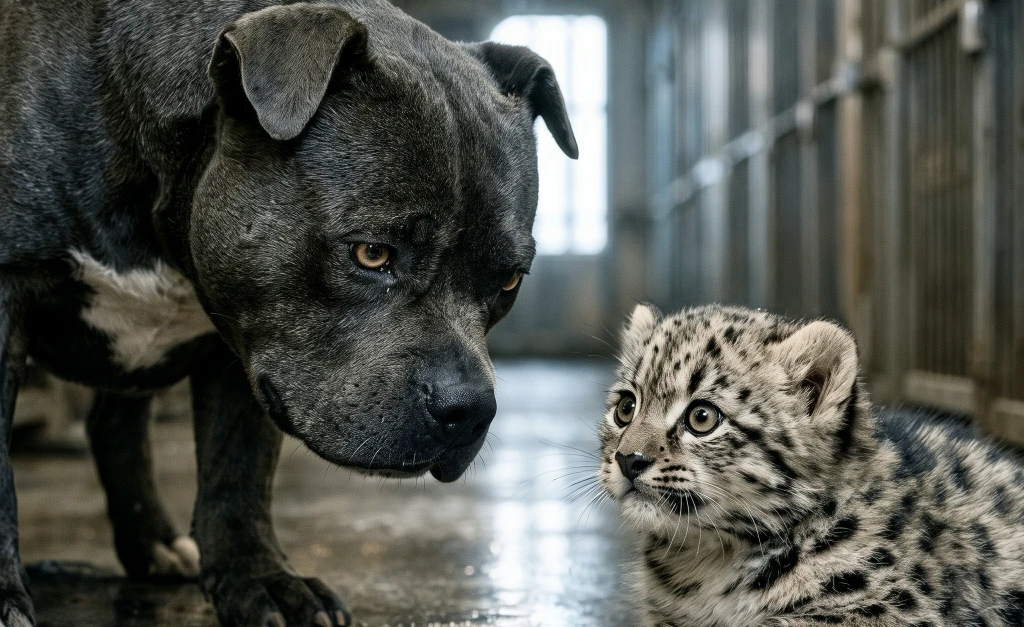
Flint approached without the stiff-legged rush Ruth expected. Mica hissed once through the carrier screen, then moved closer. Between the gate and the carrier there was room for no contact, but when Flint touched his tongue to the mesh, the cub lifted his nose toward the same spot.
“Hold him there,” Ellen said. “Just a minute.”
Ruth could see Ben’s fist loosening by degrees. He didn’t give the dog more leash; he simply stopped bracing for an attack. Mica sat down, his front paws side by side, and watched Flint lower himself to the floor.
Kelsey Reed, sorting donated towels nearby, took a picture. Ruth heard the little shutter sound and looked around, but Ellen was asking her to record the time. For the next minute, the room required nothing of her except to notice what was happening.
By supper, the photograph had traveled far beyond Kelsey’s volunteer page. People offered money, food, a new furnace. Kelsey brought Ruth the phone with both hands, delighted until Ruth began reading the comments below the hearts.
Someone had cropped out the separation gate. In the tighter image, Flint’s open mouth appeared inches from the cub’s face.
“Take it down,” Ruth said.
Kelsey touched the screen. Copies were appearing faster than she could answer them, and one had been sent directly to the county. Ruth’s phone began vibrating against the table before the original post disappeared.
She answered, still looking at the photograph.
“Ruth,” Daniel Mercer said, “tell me that dog hasn’t been near the snow leopard.”
To read the rest of the story – CLICK the NEXT button 👇👇👇