


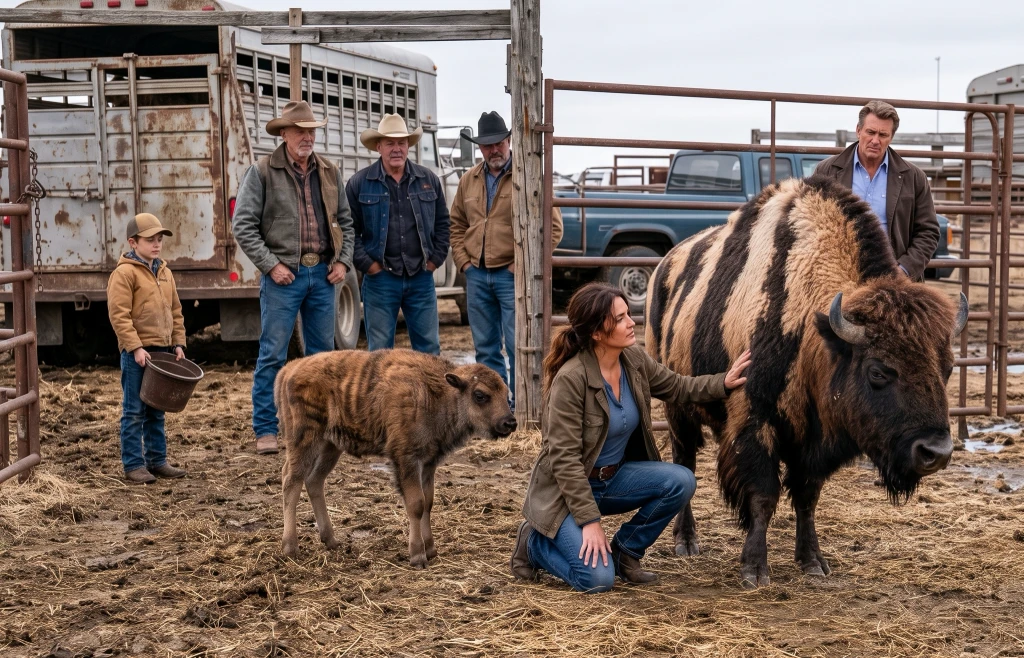
Rachel Voss had already put her checkbook away when the young bison turned sideways in the sale pen. Through the winter hair, dark bands crossed a pale flank. Rachel stopped with one boot on the bottom rail, and the old man beside the gate stopped trying to sell her a water tank.
“She’s sound,” he said. “Whatever you’re thinking about the color, she’s sound.”
Rachel hadn’t said anything. She watched the heifer plant her feet in the wet straw, then lowered her boot so the rail wouldn’t shake. I was standing beside her with a cup of coffee going cold. Until that moment, the most expensive thing she had considered buying was a tank with a repair along its bottom seam.
The sale was on the last Saturday in March, outside Graystone, Montana. The owner was retiring, though sick was the word people used once he was out of hearing. His equipment had been pulled into rows, leaving pale rectangles where it had stood for years. Rachel had driven over hoping for a cheap bred cow or that tank, whichever left her enough money to get through spring.
She was thirty-six, raising a boy on the forty-one acres her grandmother had left her. I lived down the road and sometimes hauled stock for her. She returned borrowed tools sharpened, with the handles wiped clean, and never let me forget a gallon of diesel I had put in on her behalf.
“How old?” she asked.
“A little past a year. Came in with that small dispersal over east.” The owner nodded toward a man selling chains off a tailgate. “I’ve had her since fall. Her name’s Bramble.”
The heifer was undersized, with a heavy front end and a narrow face. She kept her distance from the men and the gate, but her ears followed every movement. Rachel asked about coughing, loose manure, trouble eating. The man answered without trying to steer her back to the color.
Then Grant Calder came along the pens.
I knew his father, and his grandfather before that. Calder Range Ranch ran cattle and bison on acreage most of us encountered only on maps. At forty-four, Grant had added to the operation and could remember a bull’s breeding history after hearing it once. When he stopped at a pen, brokers stopped too.
He stopped at this one longer than I expected. Bramble swung her head toward the sound of a dropped chain, showing the ear with two tags. Grant leaned a little closer. Then he straightened and called to the men behind him.
“Anybody missing a zebra? Looks like somebody left the wrong gate open.”
A man near the coffee table laughed first. Others followed, and the joke traveled down the line faster than the auctioneer. Rachel kept her hand on the rail. The owner pushed his cap up, exposing a pale strip of forehead.
“You wouldn’t get a breeding buyer near that,” Grant said. “Imagine trying to explain the calves.”
He moved on. The brokers moved with him, leaving the little pen as empty of interest as if someone had hung a quarantine notice on it. Rachel waited while the auctioneer finished with a gate, then asked what it would take to buy the heifer.
“Eleven hundred,” the owner said.
Nobody raised him. The auctioneer repeated the amount, looking along the rail for a response, and Grant glanced back from the next pen.
“Expensive way to learn a lesson, Rachel.”
She took the checkbook out again. Her thumb rested on the edge of the cover long enough that I thought she might close it. Eleven hundred dollars bought several months of breathing room on her small bank note. It could also replace the pump that had begun rattling whenever her kitchen faucet ran.
“Who do I make this out to?” she asked.
The owner told her. She wrote slowly because her fingers were cold, tore the check free, and waited for a receipt. Grant was talking about another animal by then. He didn’t look back when the auctioneer marked the heifer sold.
I helped with the loading. We closed the side gates and gave Bramble time to find the trailer opening; she went up without the struggle I had expected. Rachel stayed outside the rails while I pinned the rear gate. Neither of us mistook a quiet young bison for a tame cow.
Near the trailer wall, the heifer turned her head. Beneath her plastic identification tag hung a small metal one, its edges worn dark. I could make out letters but not the number. Rachel crouched beside the slats and took a photograph, then enlarged it with her thumb.
“SR seventeen,” she read.
“Somebody’s herd number.”
“Whose?”
I couldn’t tell her. The owner couldn’t either; both tags had been there when he bought her. Rachel photographed the sale receipt before folding it into her wallet. Then she drove home with Bramble moving behind her and a tank she hadn’t bought reflected in the rearview mirror.
Her east enclosure had stout posts and heavy panels left from an earlier owner who had kept bison. Before unloading, she walked every section while I checked the gates. She had already told her son, Ben, that he was to stay outside the fence, even if the animal came over to him. He stood on the porch holding the screen door with his heel and asked whether she had a name.
“Bramble,” Rachel called.
He tried it once, softly. She looked up at the porch, chewed, and went back to the hay. Ben seemed satisfied with that introduction.
For a few weeks, Rachel had the ordinary pleasure of seeing an animal improve. Bramble ate well and filled out; there was no limp or labored breathing to justify the remarks people made. Rachel checked the water before breakfast and again before dark. Sometimes, when I drove past, she was just standing outside the fence with an empty bucket.
But the winter coat began to loosen, and the marks underneath grew clearer. Black bands ran down the ribs into the lighter hair, narrowing as they reached the belly. A neighbor took pictures from his car. By May, I had been shown those pictures in the hardware store, at the tire shop, and by a woman who knew perfectly well that I lived down the road.
Rachel heard the jokes through other people first. Then people began saying them in front of her. She stopped offering explanations, which some took as permission to get louder.
One Thursday I found her at the feed store with two bags of mineral beside the counter. Grant was near the register, wearing his ranch jacket. He read the label on her purchase before he looked at her.
“You’re putting the good stuff into that heifer?”
“It’s what the vet recommends.”
“For animals you intend to breed, sure.” He shifted so the clerks could hear him. “I’ve been thinking. Eight hundred cash, and I’ll send a trailer. You’d recover most of it.”
Rachel laid her checkbook flat. One of the clerks kept tapping a key after the screen had stopped changing. I was near the door with a sack of salt against my shin, waiting for her to tell Grant where he could put his trailer.
Instead, she asked, “Why eight hundred?”
“That’s about what I’d risk. Saves you another hauling bill, too.” He gave her a patient smile. “You’ve got a boy to think about. No sense making one bad purchase into a whole season of them.”
She uncapped her pen. There was a small white scar across her knuckle from replacing a broken fence staple that winter, and I remember watching it move as she wrote. Grant waited, certain she was doing the arithmetic he had handed her.
“I’ll keep her,” she said.
He laughed through his nose. “Forty acres doesn’t leave much room for pride.”
Someone behind me chuckled. I bent for her first bag before she could protest, and we carried the mineral out together. At the truck she took it from me and settled it against the wheel well, keeping the printed side up so the bag wouldn’t split on the torn bed liner.
She didn’t get in. She pulled up the photograph of the old tag and held the phone where I could see it.
“If he can’t do a thing with her,” she asked, “why does he want me to sell?”
To read the rest of the story – CLICK the NEXT button 👇👇👇