


Something was being pulled across the porch boards. I listened from the cot until the sound stopped under my door. Then a breath pushed against the weather stripping, followed by a scrape so close I could feel it in the floor. The rifle stood behind the stove. I took it down and looked through the side window, expecting a bear after the garbage can. Instead a black bear was backing away from the cabin with an empty mouth. She had just deposited a tied burlap sack on my doorstep. Beneath one torn corner of it, something moved.
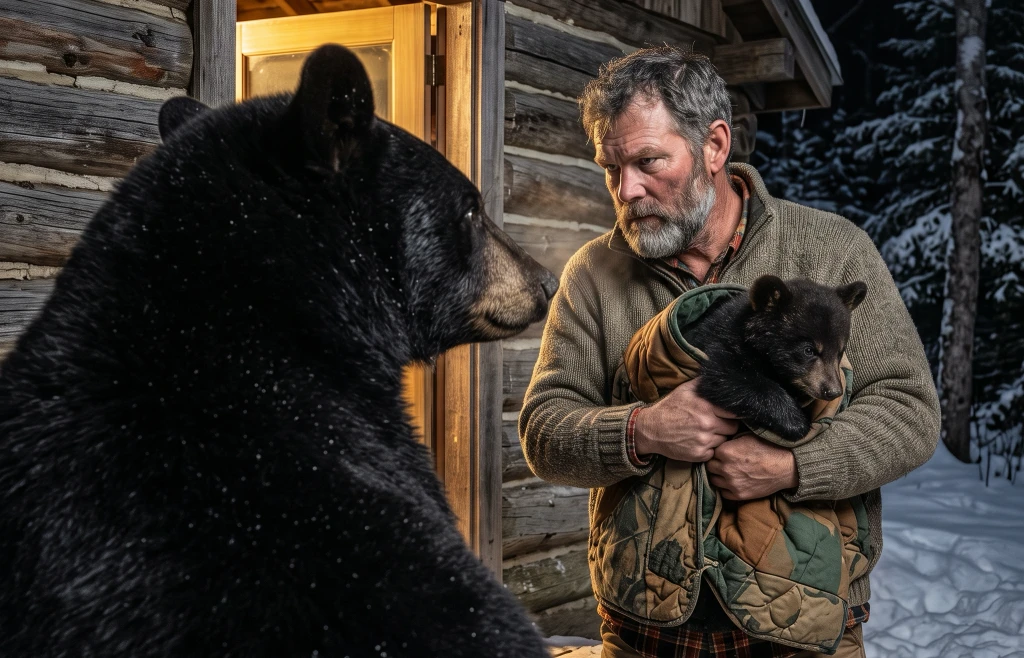
Snow still occupied the shaded parts of the clearing, though it was April. The bear stepped off the porch and waited in the pines. A pale line crossed her muzzle, bright enough for me to distinguish it in the moonlight.
I opened the door no wider than my shoulder. The sack was wet along one side. I couldn’t tell who had tied the cord, or where she had found it. The only part I’d witnessed was her hauling it to my house.
When I lowered the rifle onto the floor, she shifted her weight but didn’t leave. I pulled the ripped cloth back. A black bear cub was caught inside, no bigger than a house cat. He moved his front paws against my fingers and left his left hind leg behind him. There was a smell from the wound that made me quit thinking about how close his mother stood.
I had seen damage from old steel traps on timber surveys. This was an animal I could lift with both hands. He tried to cry and produced a dry little breath.
The bear came out from between the trunks. I froze with the cub still partly in the sack. Meltwater from the eaves ran down the back of my shirt while she watched us. I told her, as though I could bargain from a porch, that I was taking him in. She backed into the trees again.
Inside, I wrapped him in a towel and put him on the kitchen table. The rifle remained by the door. For the first time in years, I wished the room held another person who might know what to do.
My name is Owen Reed. I was fifty-one then, living above the little northwest Montana town of Alder Creek. Eight years earlier, a drunk driver crossed into our lane and killed my wife, Nora, and our twelve-year-old daughter, June. I’d moved into the old survey cabin after the funerals. I worked alone when I could.
The cub clawed weakly at the bare table. I put the towel under his feet, and he caught a fold. June used to catch the cuff of my jacket in stores when she wanted me to stop and look. One Saturday it had been a notice for puppies at the feed store. I’d told her a dog would have to wait. A kitten and a hamster had met the same answer. I couldn’t explain why that small history kept returning to me, except that waiting had become something I had plenty of practice doing.
I built up the fire and followed the first-aid knowledge I still had from working in the backcountry. I could keep him warm and avoid making the leg worse. The infection needed someone with training and supplies I did not possess. He ceased pushing at the towel, and I made myself stop touching the wound.
The truck was stranded beyond a snowbank on the logging road. My phone had no service. Nine miles away, the former ranger station had a radio, a plowed approach, and Walt Dyer, who had never once made me explain why I preferred a short visit. He’d retired from the service but stayed in the building through another winter.
My father’s quilted hunting coat hung by the door. One pocket still held a length of string he had saved. I folded the coat inside a pack, settled the cub against it, and left room around his face. Tracks the size of my palm crossed the clearing toward the creek. His mother was somewhere along the same woods I had to enter.
At the footbridge I moved the pack around to my chest. The single rail was slick, and thawing water struck the supports below. A thin noise came from inside the coat as I crossed. I kept my eyes on the next place to put a boot. When I reached the opposite bank, I waited until I could feel him breathing again before I walked on.
Walt opened the station door at the second knock. I had worked with him for years; he could tell from my hands that something was wrong. He cleared the table without asking for the story. When I opened the coat, he took the unlit pipe from his mouth and set it in a saucer.
“That sow brought him to my porch,” I said.
Walt looked at the leg. His questions could wait. He went to the radio, raised dispatch, and had them call Dr. Claire Bell in town.
Claire’s father, Arthur, had taught me how to work a slope without sending a tree down on somebody. I had last seen his daughter at his funeral four years before. She’d gone on to become a veterinarian, and the woman Walt reached over the radio asked about the cub’s temperature, breathing, and injury before she asked who had carried him. She was twenty-five miles away with a usable road to the station. She said she was coming.
Walt poured tea. I held the mug and watched its surface shake. He told me about a coworker who claimed a wolf had once dragged a trapped pup to his shack. Walt had heard the account more than once and never settled whether he believed it.
“What happened to the pup?” I asked.
“Got back to the mother.” Walt took the untouched mug from me, wrapped my fingers around it again, and said, “Start with that.”
Claire arrived in Arthur’s old Jeep, carrying bags she had packed in a hurry. Her glasses fogged in the doorway. She washed up, had Walt bring the lamp closer, and examined the cub before she met my eyes. The infection might be beyond the leg, she said. She could begin treatment, but she would not promise he would live.
I held where she directed while she worked to stabilize and warm him. When he was ready, she medicated him for a closer examination and cleaning. Walt managed the light. I missed half an instruction because the cub had gone still, and Claire made me look at her.
“See his chest move, Owen? Keep watching there. I’ll tell you when I need your hands.”
I watched it move. A load of snow slid from the station roof and startled Walt. Claire went on working until the wound was clean and dressed. She eased the cub into a padded carrier, still troubled by his breathing and temperature, and said she’d stay to see whether he responded.
Walt put fresh tea on the table. Claire sat beside me. Her father, she said, had worried about me living so far out after Nora and June died. I had nothing useful to say to that. She didn’t require an answer, just nudged the mug within reach.
The cub raised his nose from the towel. He made a weak but demanding sound, as if the room had finally become worth complaining to. A shape passed over the window.
His mother’s scarred muzzle came up against the glass.
To read the rest of the story – CLICK the NEXT button 👇👇👇