


Something dragged across my porch boards at three in the morning. I was out of bed before the second scrape, my hand on the rifle by the door. Through the kitchen window I saw a black bear pulling a burlap sack backward, inch by inch. She dropped it against my threshold and retreated into the last dirty snow of April.
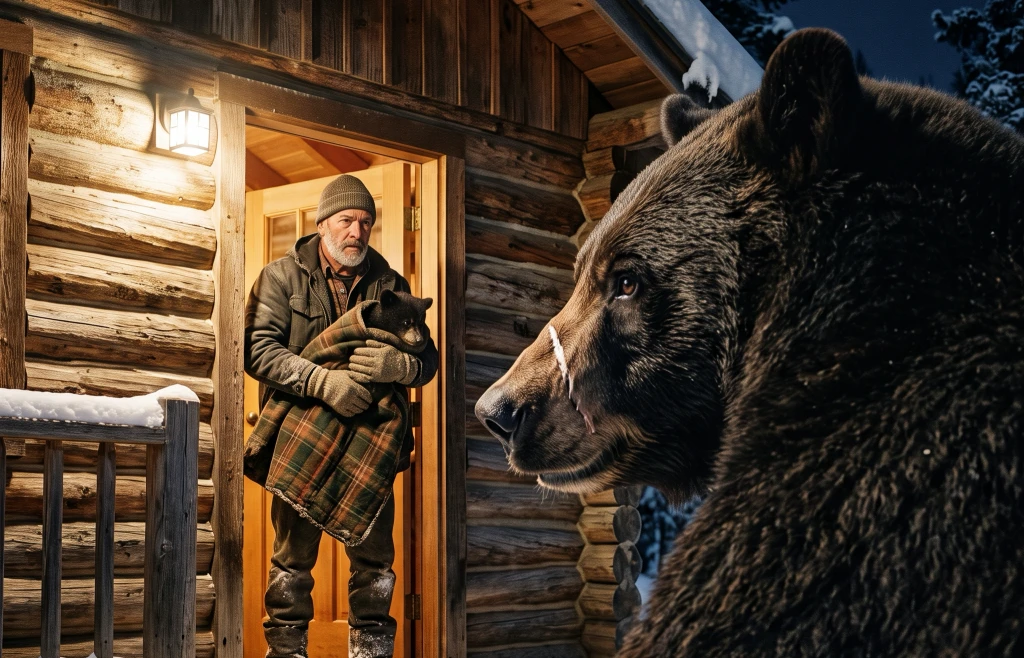
The sack moved after she let go.
For a long time I watched the gap between the pines. The bear remained there, almost invisible except for a pale mark slanting across her muzzle. When I eased the door open, she shifted her weight away from me. I set the rifle on the floor inside. Whatever was in the sack made a thin, exhausted noise.
Its opening had been knotted with rough cord. A tear along the side had caught around a small black body. I had no idea who tied the sack, or where the bear found it. All I knew was that I had watched her bring it here.
The porch light had burned out the week before. I had meant to replace the bulb whenever I next went down for supplies. Instead I found myself working by the gray window light and the small lamp over the stove, trying not to pull the cloth across the cub’s leg.
I worked the fabric loose. A cub lay inside, no bigger than a house cat, his left hind leg held out at an angle that made my stomach contract. There was a bad smell beneath his wet fur. I had come across rusted traps during timber surveys, and I recognized what metal could do to flesh even though no trap was there now.
The bear emerged a step from the trees. I held still with the cub between my hands. Water fell from the roof onto the back of my shirt; neither of us moved until she backed away again.
“I’ll see what I can do,” I told the darkness. Then I carried him to the kitchen.
I was fifty-one, a former timber surveyor living nine miles up an unplowed road from the old ranger station above Elk Crossing, Montana. Eight years before that night, a drunk driver had crossed into our lane. Sarah, my wife, and Lily, our twelve-year-old daughter, were killed. I had moved into the cabin after the funerals and stayed. I went to town for flour and fuel, spoke when a transaction required it, and otherwise let the days pass without much sound.
The cub’s good paw raked the table. I slid a towel under him, and his claws caught the weave. Lily used to hold onto my coat sleeve that way. Once, at the feed store, she had steered me to a hand-lettered notice for puppies. I said we’d talk when things were less busy. After that came her campaign for a kitten, then a hamster. We never got any of them. That was not what killed her, and I knew it; it was still one of the things that came back to me at odd hours.
I lit the stove, cleaned what I safely could, and stopped when the wound proved beyond my field kit. The cub’s head slipped sideways on the towel. I touched his ribs and waited for their faint rise.
There was no phone signal in the cabin, and my truck was stuck beyond a drift. Hank Rusk, a retired ranger, kept a radio at the station. I took my father’s old quilted hunting coat from its peg and tucked it around the cub inside my pack. The coat had a piece of saved string in one pocket, and its cuffs were worn almost to the lining. I left his nose clear and lifted the pack carefully.
Outside, the bear’s prints angled toward the creek. I locked the door and started down the winter trail, pressing a hand to the pack each time I stopped. For all I could tell, she might have been watching from the timber. I had to attend to the ground beneath my boots instead.
At the log footbridge, thaw water ran high and black. Ice coated the rail on one side. I brought the pack around to my chest and crossed a foot at a time, listening to the cub’s thin protest when the bridge shifted. On the far bank I checked him again.
He was breathing, though I could barely feel it through the padding.
The station appeared among the trees as morning took the dark out of the snow. Hank opened after my second knock, saw the shape against my chest, and swept his breakfast off the table without being asked. When I uncovered the cub, he put his unlit pipe down in a saucer.
“The mother brought him to my porch,” I said.
Hank’s eyes went to the snow melting off my sleeves. He took my pack and laid it where I could reach in without shifting the cub. I had walked through the night thinking of the station as a destination; now the waiting began in a room that smelled of coffee and damp wool.
Hank looked at the leg. He did not ask me to prove the first part. He called dispatch on the radio and had them find Beth Hale.
Beth’s father, Frank, had been the man who taught me how to work timber country without leaving another person in danger. I had last seen Beth at his funeral four years earlier. She was a veterinarian now, twenty-five miles away by road. Hank repeated her instructions as he received them and set a mug of tea in front of me. I left it untouched; both my hands were busy keeping the cub from rolling toward the edge.
“A ranger I knew said a wolf carried a hurt pup to his place,” Hank said. “Years back.”
“And?”
“The pup got back to its mother.” He nudged the mug toward me. “The table can hold him. You take a drink.”
Beth came in through the station door carrying two bags, with wind-reddened cheeks and her hair twisted up in a hurry. Her father’s Jeep was still ticking outside. She asked Hank for a brighter lamp, examined the cub, and finally met my eyes.
“This is serious, Jack. I don’t know how far the infection has gone.”
“Tell me what to hold.”
She made room for me beside her. First she warmed and stabilized him; only when she judged it safe did she medicate him enough to work on the leg. Hank held the light. I missed one of Beth’s directions and had to ask twice. Whenever the cub became quiet, I thought he’d stopped breathing.
Beth caught my wrist. “Watch his chest. I’ll tell you if I need something else.”
I watched while the window changed from black to gray. Snow slid from a branch and struck the roof hard enough to make me flinch.
The cub did not.
When the leg was dressed, Beth settled him in a padded carrier. She kept its opening where she could monitor him and checked his temperature again. She would not say he was safe yet. She did, however, sit beside me for a moment and put Hank’s mug into my hands.
“Dad wondered how you were doing out here,” she said.
The tea had gone lukewarm. I took a swallow because she waited. Then the cub lifted his head and called, faint but unmistakable. A shadow crossed the carrier. On the other side of the station window, the scarred mother had put her muzzle against the glass.
To read the rest of the story – CLICK the NEXT button 👇👇👇