


Ruth had put his coffee in the blue mug again. For thirty-two years, she had known he disliked the chipped rim and poured for him in the plain white one. Mason looked at the mug, then at his wife standing at the sink, and understood that even the small kindnesses between them had begun to require an effort.
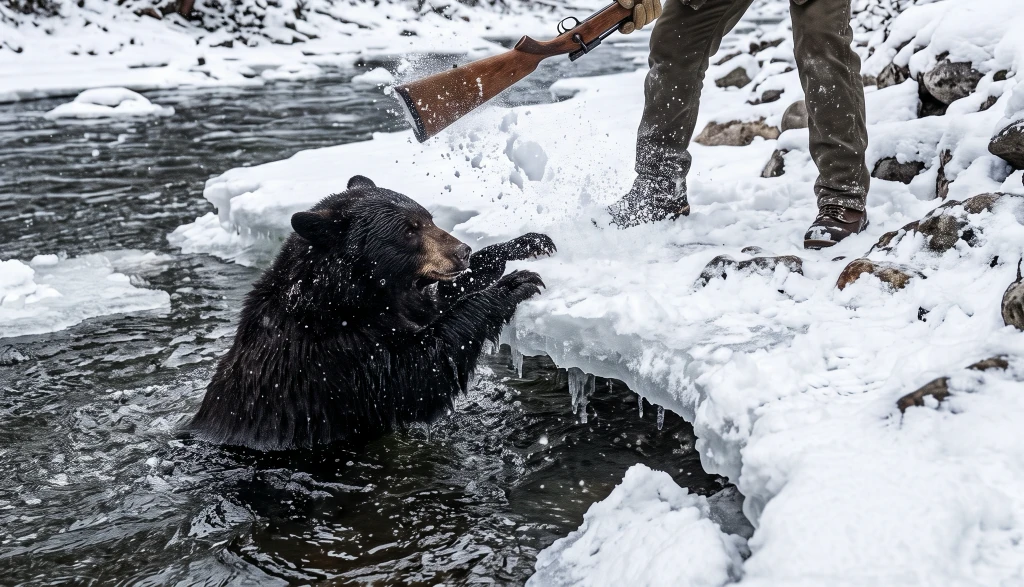
“I’ll check the north boundary before dark,” he said.
“You told me.” Ruth dried a plate that was already dry. On the refrigerator, beneath a magnet from their daughter’s home in Boise, a photograph showed their grandson Owen grinning with two missing front teeth. Ruth had wanted them to move closer to him since June. Mason had offered reasons to wait—another survey, another season, somebody needed to watch the forest—and then, finally, offered nothing. Six months of silence had filled in around them.
He took his father’s old rifle from the rack, slung his pack over one shoulder, and left their house at the edge of Alder Creek. The little settlement in Idaho’s Boundary County looked asleep under a late-November snowfall. A hard early freeze had sealed the sheltered bends of the creek, though water still moved beneath the gray ice. Mason, fifty-five and a forestry technician for most of his adult life, knew where the current made that ice treacherous. He kept to the bank as he read the tracks of deer and foxes crossing the timber.
Something hit the water ahead of him.
He stopped to listen. Another splash came from beyond a stand of spruce, followed by an animal’s rough, exhausted breath.
In a quiet backwater, a black bear fought to stay above a gap in the ice. The animal was a large male, perhaps four hundred pounds. Its front claws scraped at a brittle shelf that crumbled each time it tried to lift its weight. Blood darkened the fur high on its shoulder. A shot had grazed it; Mason could see the narrow track where the coat was torn. The bear went under, came up, and struck the edge again.
Mason had a radio in his pack. A wildlife officer could be hours away. He could call, mark the place, and do nothing foolish. The bear’s head disappeared, and Mason heard his father’s voice as clearly as if the man were beside him: You’re there. Decide what that means.
He stayed on firm ground where the roots of a fallen spruce held the bank. He opened the rifle’s action, removed the cartridges, and put them in his coat. Gripping the gun near its barrel, he brought the butt down on the overhanging lip of ice. The stock jarred his hands. A crack ran toward the open water. He struck again, and a slab broke loose. Now the bear had a low, sloping reach to the bank instead of a vertical wall.
The maneuver had cost him more strength than he expected. He could not pull the animal out and would not survive being dragged in after it; he could only change the shape of the obstacle. He dropped his pack behind a tree and retreated along the bank, testing each step with a branch. Once, the ice beneath an exposed root gave a sharp report, and he froze until he could place his weight on soil again. The bear, submerged to its ears, found the lower edge by feel. Its claws caught, slipped, caught again.
It surged toward him. Mason backed into the trees with the unloaded rifle held across his chest. The bear dragged itself onto the snow and lay there, sides working, water running from its coat. It raised its head once. Mason could see the old fear in its eyes and knew better than to put a human story there. After several minutes, the animal got up and moved into the spruce with a hitch in one hind leg.
He waited until the last branches stopped moving before going back to the bank. A bloodied tuft of fur lay on the snow near the torn ice. He folded it into a paper packet from his pack. It could show that the animal was hurt; it could not tell him who had hurt it. Across the creek, Ellen Ward stood on a narrow ski trail with a thermos under one arm. The middle-school teacher had watched from a safe distance. When Mason lifted a hand, she nodded once and skied away.
He photographed the broken shelf and the tracks before fresh snow softened them. His first instinct was to follow the bear, but the wet animal had enough trouble finding shelter without a man behind it. Mason used the radio instead, leaving a report for the district office about the wound and the creek. The reply came in fragments through the trees: acknowledge, keep back, update if it approached town. He walked home with his rifle stock scarred and his sleeves frozen stiff. The distance from the creek to the house seemed much longer than it had that morning.
At home Ruth saw his soaked cuffs. “Are you hurt?”
She had already crossed the kitchen to him before he answered. He noticed the look on her face, a brief flash of alarm that disappeared as soon as she took in his steady breathing and both his hands. For a moment he might have caught her wrist and brought her into what had happened. He could still feel the rifle buck against the ice; he could hear the animal striking water. The story was too strange for the ordinary room, and he chose the familiar task of peeling off wet boots.
“No.” He meant to tell her about the bear, the rifle stock, the cold water rising against the bank. Instead he hung his coat and asked whether there was any bread left. Ruth set a bowl of soup before him. Her own spoon remained beside her plate. Mason went to bed wishing he had begun with the truth.
By morning, Ellen’s account had traveled through Alder Creek. Mason entered Mara Quinn’s store with a ten-dollar bill and found Deputy Seth Rourke by the counter. The deputy wanted to know exactly where the bear had gone. Mason told him about the wound and the direction of its tracks, but Seth’s attention kept drifting to the customers gathering behind him.
“There are kids out walking to school,” said June Dwyer, drawing her small son close. “What if it comes this way?”
“I can’t promise where a wounded bear will go,” Mason said. “I can check the route and call Fish and Game.”
Old Mr. Bell tapped his cane against the linoleum. “You let it out. Now we all get to wait and see what it does.”
Mason offered the bill to Mara for a loaf. She left the bread where it was. She was not a cruel woman; he had known her for twenty years. He saw fear in the set of her jaw, and that made her refusal harder to answer.
“Take your money someplace else today,” she said.
There was no other store for twenty miles.
He put the bill back in his pocket. Outside, Ellen stood with a grocery bag, her gaze fixed on the road. “You saw how badly he was hurt,” Mason said. “Will you tell them?”
“I did,” she replied. “That’s why they’re frightened.” She went on toward the school, leaving him with the unhappy possibility that both of them had told the truth and neither had made the town safer.
Ruth was at the stove when he returned. She noticed his empty hands, then the muddy smear across the butt of his rifle. He finally told her what had happened at the creek. She listened through the whole account without interrupting. When he finished, she laid down the wooden spoon.
“You risked your life for him,” she said. “And you came home and asked me about bread.”
Mason could explain the bear. He could explain the ice. He had no answer for the part of the day she had just named.
To read the rest of the story – CLICK the NEXT button 👇👇👇