


By the time the county took possession of the Mercer place, its horses had learned to wait at empty feeders without making a fuss. Eighteen stood in the lot when Cassidy Vale arrived, their coats dull beneath the June sun. The Mercers had missed one feed payment, then another, until there was no longer a business to save. Nobody had found a dramatic act of cruelty. The animals had simply gone hungry while their owner kept hoping that one more month would turn things around.
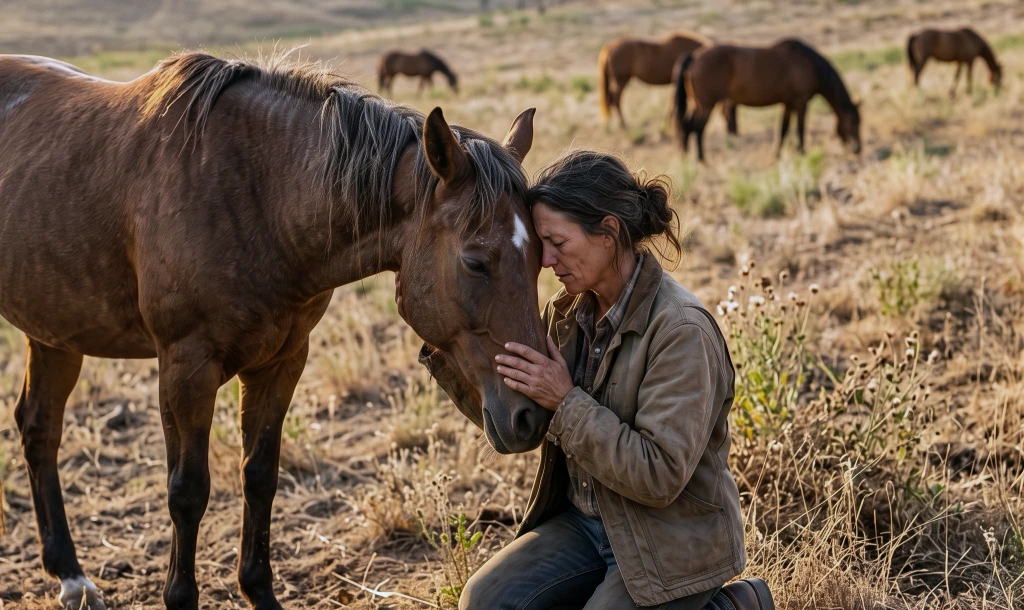
Cassidy had come prepared to take two.
She might stretch to three if one was young enough to recover quickly. Her cattle barn was empty, and the fences on her forty-six acres at Veil Creek Ranch were sound, but the balance in her checking account had no room for eighteen veterinary bills.
At home, her eleven-year-old daughter had already outgrown the shoes Cassidy had bought in spring. She went along the rail studying the horses, troubled most by the fact that none backed away from her hand.
Dr. Reed Palmer showed her his notes. Several animals needed time and feed; others needed teeth worked on before they could use the feed. Two were elderly, and for them the best possible recovery would mean a comfortable life, not useful work.
The worst of the lot was a bay mare whose back had begun to dip.
A scrap of tape on her halter said CLOVER. Palmer estimated her age at twenty-four. When Cassidy asked about her prospects, he told her what he could promise and, more carefully, what he could not.
The county handler mentioned that most of the herd had lived together for years. They would be divided among several buyers by the weekend. Cassidy knew what an abrupt move could do to an underfed horse: a familiar companion gone, a strange trough, a few days refusing food that its body could ill afford to miss. She looked at the tally again.
She had bought forty rolls of hay in April while prices were low. The barn was there. She could repair its stalls. There was enough pasture for a careful rotation, if the summer held.
“All of them,” she told the clerk.
He made her repeat it. Palmer warned her that signing a paper was the least expensive thing she would do for these animals. Cassidy signed anyway. Before she left, he put his private number on the back of a feed-store receipt and told her to call before a small problem became an emergency.
Getting them home took more than the trailer she had brought. Cassidy made the twenty-two-mile drive repeatedly and arranged help for the remaining loads. At Veil Creek, she separated the horses Palmer wanted monitored most closely, checked the water, and brought hay into the barn a little at a time.
Her daughter waited at the gate, counting heads against the names Cassidy had written on the county sheet. The last horse stepped off a trailer after dark.
Preston Blackthornne arrived while she was backing her two-horse trailer toward the gate. His family owned four hundred irrigated acres across the valley, along with a show stable called Blackthornne Equine Estates. He had come to examine two young geldings, but stopped when he saw the number on Cassidy’s paperwork. Within earshot of the men at the fence, he asked whether Veil Creek was about to become a rescue operation or a graveyard.
A couple of men laughed. Cassidy kept checking her trailer latch.
Then Preston paused beside Clover. He studied the mare’s white mark, her left shoulder, and the pale sock on her hind leg. He offered Cassidy five hundred dollars to let him take that one animal away and “handle the hard part.” It sounded like another performance for the men at the rail.
Cassidy said she was keeping her. Preston smiled as if the answer mattered very little, then walked back to his truck.
The first weeks were measured in unglamorous increments. Palmer checked mouths and feeding plans; a farrier came twice in three weeks. Cassidy paid that bill in installments.
She drove posts into the south fence, made stall fronts from an old shed, and penciled eighteen names and weights on a chart by the barn door. Her daughter read the figures aloud on evenings when Cassidy’s hands were too dirty for the pencil. Some numbers barely moved.
A few began, at last, to climb.
There were small rewards the chart could not hold. Deacon, one of the geldings, broke into a canter for the pleasure of it. A wary paint mare accepted a hand against her neck, then reconsidered the arrangement the next day.
Ash and Pepper started their games at dusk. Clover ate, gained a little, and stood apart when the stronger horses crowded the feeder. Nearly every afternoon she left them and faced the west hill, where the grass was poor and a dead cottonwood marked a shelf of stone. Cassidy put it down to an old mare’s preference for quiet.
At night she and her daughter sometimes stood just inside the barn doors, listening to the ordinary sound of chewing. The girl knew which horses would take a carrot from a palm and which needed more room. Cassidy had no trouble giving the animals time to recover. It was harder to be patient with herself when another bill came due.
At Holloway Feed and Supply, Preston calculated the weekly cost of eighteen recoveries for everyone at the counter to hear. His estimate was close enough to sting. He spoke softly, as he always did, and suggested that winter would correct Cassidy’s figures for her.
She took her mineral block and left. By August she had sold her flatbed trailer for eighteen hundred dollars, accepted fence work for two other outfits at forty dollars an hour, and postponed repairs to the well housing and mudroom roof. She could cover the next invoice. She could no longer pretend the invoices would stop.
In eastern Oregon, the dry summer narrowed the margin further. The creeks lost their shaded pools, and the old well began filling the pasture tank slowly. Cassidy timed the pressure cycle twice. Preston visited on a Friday, admired the horses’ improvement, and offered to buy Veil Creek for a price that assumed she had nowhere else to turn.
He listed the failing well, the feed she would need in winter, and the weakness of the land market. Each point sounded reasonable by itself. Cassidy refused. He told her the offer would still be there when she was ready.
In September, a water delivery cost three hundred twenty dollars for three thousand gallons. It lasted roughly twelve days with eighteen horses and careful use. Cassidy borrowed a neighbor’s spigot and carried another sixty-five gallons in a tank in her pickup bed, four trips on some evenings.
The quote for a new well was thirty-one thousand dollars.
Preston heard the figure at the feed store and gave her a look of practiced sympathy. At home, Cassidy kept a pencil beside her daughter’s school calendar, adding columns after the girl had gone to bed.
Before dawn on Monday, September 14, she found the west fence down at a weak brace post. One horse had gone through. With a halter over her arm, she hurried toward the county road, then saw that the single trail of hoofprints ran the other way. It climbed the barren hill in a straight line toward the cottonwood. Cassidy followed, breathing hard enough to hear it.
Clover was on the flat ledge below the tree. There was nothing to eat there. The old mare lowered her head, brought a forehoof down on one small patch of pale earth, and scraped it backward. She did it again, with the deliberate effort of an animal who could spare very little.
Cassidy stopped a few yards away. Clover raised her hoof for a third blow, exactly over the same place.
To read the rest of the story – CLICK the NEXT button 👇👇👇