


Every time one of the sale-barn hands came up on her left side, the bay mare shifted her weight off that shoulder. Wade Tolliver watched her do it twice. Then he put a hand on her neck, flat and still, the way his grandfather had taught him to touch a horse he hadn’t been introduced to. All around the back pen, men were calling numbers over the rails, pulling lips back to read teeth, running their palms down legs. Nobody had asked the mare to take a step.
A smear of yellow chalk sat on her hip, as if somebody had wiped a thumb there. Out of the forty-seven horses in the pen, Wade had counted eleven marked the same way. The chalk meant nobody had bid on them, and a truck was coming Monday for whatever was left. Lonnie Greer, who ran the Sayer County sale barn, liked to say those horses were going north. Wade had grown up on a horse farm, and he knew what was north.
“You buying, or just giving her a free checkup?” Lonnie said behind him.
“How long’s she been carrying that shoulder?”
Lonnie leaned on the rail. The mare was a little Morgan cross, fourteen hands and change, with a pale ridge of scar running slantwise across the point of her shoulder. She’d come in Thursday, Lonnie said, with a load from a breeder up near Blowing Rock who had died in the spring. The family had sold everything but the house. Nobody had said a word about an injury, and Lonnie hadn’t asked.
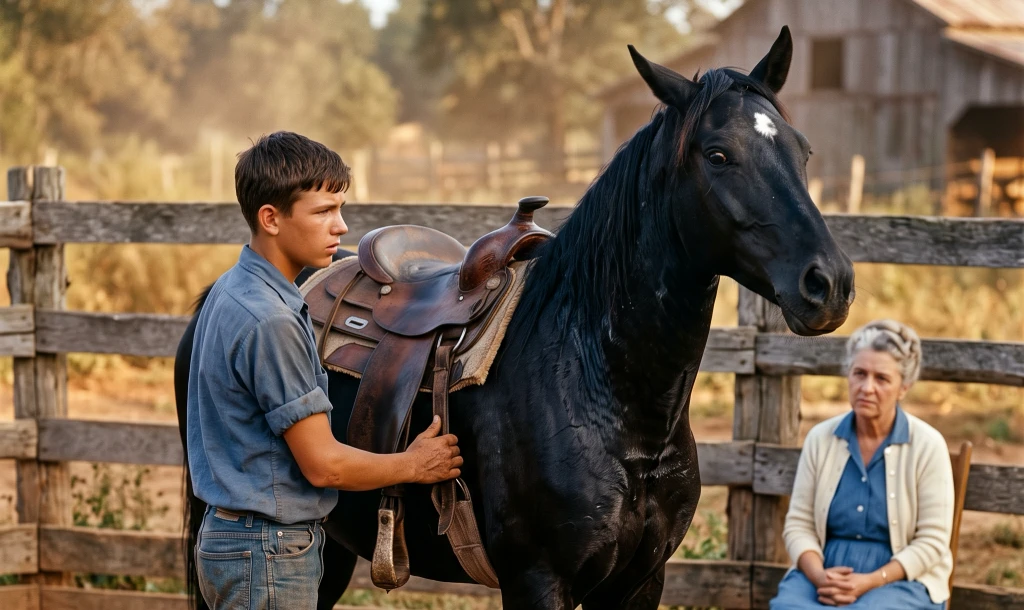
Wade worked his way around the pen. The bay wasn’t the only horse the buyers had passed over. A black mare with a white star let Wade stand near her and let nobody else close. A stocky chestnut backed away the moment a man brought a lead rope toward the gate, and he kept backing until the fence stopped him. The others had their own reasons: a sorrel who planted his front feet and would not turn, a brown gelding breathing harder than the cool morning called for, a hind toe that dragged, a flinch on the left, ribs that wouldn’t see winter. Wade went around a second time, slower, watching what changed when a horse had some room.
His grandfather would have taken all afternoon. Amos Tolliver had made his living on horses other men gave up on: logging teams with sore feet, ponies that bit, mares that wouldn’t load. He died in February of 1956, sixty-seven years old, on his knees in the straw beside a gray gelding whose bruised hoof he’d been soaking. Wade was thirteen. He found him with the feed bucket tipped over and the gelding standing very still above them both. The barn at home hadn’t sounded right since.
At noon Wade found Lonnie in the office. “What do you want for the eleven with chalk?”
Lonnie looked over Wade’s shoulder for the grown man who must have sent him. “Who brought you, son?”
“Nobody. Grandma would’ve, but the fuel pump went out on the Ford. I walked from the county road.”
He had four miles of red mud on his boots and $271 in an envelope inside his grandfather’s barn coat. He’d earned it setting fence posts, hauling hay, splitting oak, and mucking stalls at fifty cents an hour. The money had lived behind the loose board over the tack room at home. Amos had kept his own cash there ever since the bank in Lenoir went under in 1931, next to a cigar box Wade had never opened because it wasn’t his. One more year of saving and it might have been a used pickup.
Lonnie did arithmetic on the back of a feed-store calendar and asked who would sign for a boy. Wade said his grandmother would. Lonnie studied him for a long time, and Wade wished he would study the horses instead.
“Two thirty-six,” Lonnie said. “That’s as near the killer buyer’s number as I can come.”
Wade asked him to hold them. Lonnie said he’d keep them off Monday’s truck until Tuesday morning and not an hour past, and only if an adult came to sign. Wade walked home doing sums that got worse with every mile.
Hazel Tolliver counted his envelope at the kitchen table under the forty-watt bulb. Then she opened her green ledger. The property taxes were $304.18 past due, and the bank held $96. Six mornings a week at the Starlite Café paid her twenty-two dollars, plus a plate at the end of each shift. After that came the leaking south stalls, the tractor that hadn’t turned over since May, six weeks of feed, a back field that might give one more cutting if the weather held, and Dr. Haskins, who would let them pay by the month. She made Wade sit through all of it. He knew the numbers as well as she did, but he let her say them.
“You can’t sign a bill of sale,” she said. “So this is my debt, too.”
“Yes, ma’am.”
“Tell me why these horses.”
He could tell her about every limp and every refusal. He couldn’t tell her what any of it meant. “I’d have to get them home to find out.”
Hazel looked past him to the window, where the barn made a darker shape against the dark. Amos’s eye for a horse had saved more animals than anybody could count. It had also put bills on this same table, in winters when he’d been right about three horses and got paid for them too late to keep the lights on. Wade knew she had loved him through all of that. He also knew who had kept the ledger. She closed the book with one finger still holding the page.
“I’ll sign,” she said, “if I’m standing at the rail any time you put your hands on one you don’t know yet. No showing off. And you call Haskins when a horse needs a vet, not when you’ve run out of ideas.”
“Yes, ma’am.”
“Your grandfather couldn’t be talked out of anything either. He’d work a colt with a cracked rib and tell me it was a pulled muscle.”
On Tuesday Earl Dockery came with his flatbed cattle truck. He was seventy-two and had known Amos since before either of them owned a truck worth fixing. The evening before, without being asked, he had fixed Hazel’s fuel pump and left his socket wrench on her porch rail. Hazel signed. Wade paid Lonnie $236 and put the thirty-five dollars that remained back in the envelope. They were loading the seventh horse when a cream-colored Cadillac rolled through the sale-barn gate.
Garland Pryor got out in clean boots. His father had started Pryor Stables with six stalls in 1928, and Garland had built it to forty, with a covered ring, hot walkers, grooms, and customers from three states. He knew Wade by sight, and he knew what the chalk meant.
“Amos’s boy bought the culls.” He studied the bay mare for a while, and when he spoke again it wasn’t unkind. “That’s an old wire cut. She’ll carry that shoulder tight the rest of her life. Your granddaddy knew his trade, son, better than I know mine. But people want a horse they can ride on Saturday. That one’ll eat you out of house before Christmas.”
Wade kept tying off her lead. Hazel was close enough to hear every word, and she chose that moment to check the latch on Earl’s tailgate. Pryor waited, then walked back to his Cadillac.
That evening Hazel carried one of the kitchen chairs out to the round pen and set it against the rail. She didn’t explain it, and Wade didn’t ask.
At the end of Old Mill Road, the eleven filled the paddocks, and the barn, quiet since Amos, sounded like hay being pulled apart. For one whole day Wade let himself just watch them eat. Then he began to see how much he had missed at the sale. The brown gelding had an old abscess track in his hoof wall. The bay moved as if the healed shoulder were still tied to something. When a rope brushed the black mare’s hind legs, she threw herself sideways into the fence. The stocky chestnut, listed on his papers as Boone, could stand calm for ten minutes and then fly backward for no reason Wade could find.
Wade watched them for five days. On the sixth, with Hazel holding the lead at the stall door, he went to pick up the sorrel’s right front foot. When the horse fought him, he held on. The sorrel slammed his other foot into the stall wall, split a plank, and laid open his pastern. Haskins’s visit cost seven dollars. Wade listened to the vet’s truck go down the road while Hazel, without a word, measured a board for the broken place.
He did no better with Boone. Amos had taught him how pressure worked: ask, then let go the instant the horse gives. So Wade asked Boone to stand at the stall door, over and over. After three sessions the gelding stopped eating whenever he saw a halter, and within two weeks his ribs were showing. Wade told himself they had to get through it, even as each session ended farther from the door than the last. Hazel watched from the kitchen window and didn’t come out. Boone wasn’t a stranger anymore, and Wade hadn’t asked her to.
In October, on a Saturday when Hazel was working the long shift at the Starlite, Wade led the black mare into the round pen. Hazel had said she’d be home by two. At one-thirty the mare was standing so still and soft in the autumn sun that waiting felt like wasting her. He laid a saddle blanket on her back, and she didn’t move. He set the saddle on, and she didn’t move. He took that for a yes and drew the girth up snug.
The mare went over backward so fast that the saddle horn drove into the dirt a hand’s width from his leg. He heard the Ford’s door slam out by the house and Hazel running, and then she was at the gate while the mare scrambled up. The mare stood trembling, her knees knocking together hard enough that he could hear it. Wade was still holding the loose end of the girth.
Hazel looked at the empty kitchen chair against the rail. Then she looked at him. “What did you ask her?…”
To read the rest of the story – CLICK the NEXT button 👇👇👇