


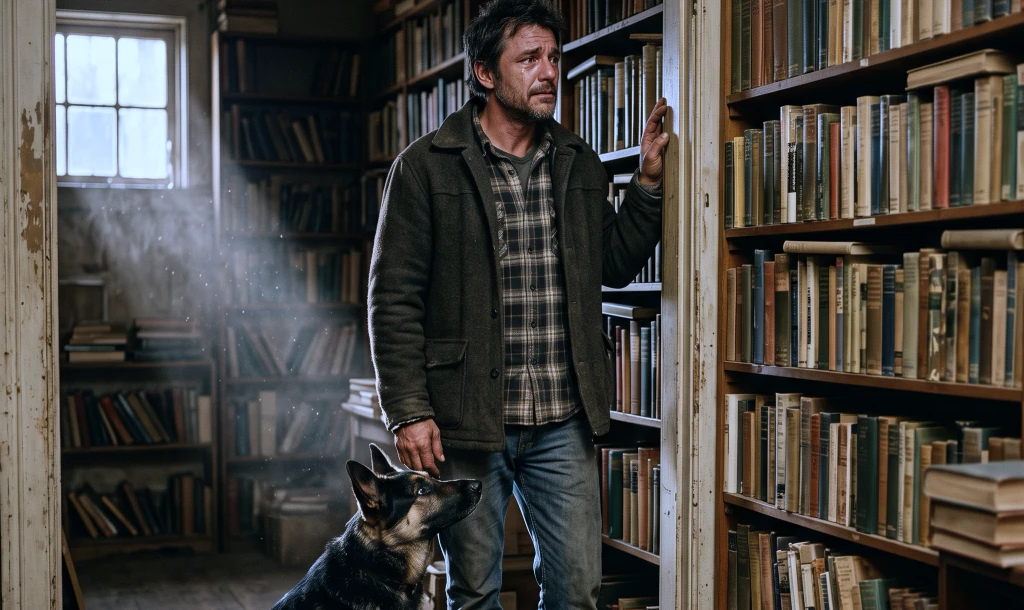
The coffee had barely begun to drip when Bram Keredine’s phone rang. He was camped near the Vermont border, with frost still clinging to the pickup’s windows and his German shepherd watching the trees. At forty-three, Bram could sleep through a storm and wake at the shift of a dog’s breathing. He had spent fourteen months doing both in roadside lots and winter campgrounds. The number on the screen belonged to someone in Vermont. He let it ring once, then answered before Vesper could give him the look he reserved for avoidable mistakes.
“Keredine.”
The caller introduced himself as Harold Winslow, Miriam Lockwood’s attorney and the executor of her estate. Bram set the kettle down. The old woman had owned Juniper Lantern Books in Larks Hollow. Laurel used to take the chair by its stove on Sunday mornings, open whatever she had bought before paying for it, and read to Bram while he occupied the chair nearest the door. Miriam had never hurried them out. She had died in her sleep five days earlier, Harold said.
Miriam’s kindness had never made much noise. She could remember a title Laurel mentioned only once in passing, then place it on the counter months later without insisting she take it. When Vesper first came to the shop, Miriam had found a bowl and set it beneath the desk. She also pretended not to notice when Bram sat close enough to the stove to thaw his hands but kept his boots pointed toward the exit. He had thought of her as a careful bookseller. Harold said he had been her attorney for twenty-two years and sounded as if he, too, had once been made to feel quietly observed.
Bram looked at the steam escaping the kettle. “I’m sorry.”
Harold allowed the silence its space. Then he explained the will. The shop, its upstairs rooms and rear apartment, its eleven thousand books, and a savings account containing twenty-three thousand dollars had been left principally to Bram. The estate still had to go through probate. The building needed an inventory and inspection; accepting the gift was not a decision he had to make over the phone.
“You’ve confused me with somebody,” Bram said.
“I checked your identification with considerable care.”
“Laurel was the customer. I followed her in.”
“Miriam did not see it that way.” Harold found a page among his papers. He read one line from her instructions: even in the weeks when Bram failed to come, she kept expecting him on Sundays.
Vesper rose from beside the stove. He was eight, black and tan, with the first gray hairs at his muzzle and a scar on his right shoulder. He had spent part of his life working alongside Bram overseas and the years since learning how to lie still when there was nothing to guard. He walked to the edge of the campsite and stood facing west. His scratched old tag did not make a sound.
Bram had not been inside the shop since shortly after Laurel’s funeral. He remembered two attempts: on the first, he stood by her vacant chair until his legs ached; on the second, he bought nothing and could not make himself look at it. The third time, he stayed on the sidewalk. He had been driving ever since, taking small repair jobs in towns where no one knew his history. A fixed address would have meant explaining why he was always alone except for the dog.
“I don’t want the place,” he told Harold.
The attorney said he could decline after seeing the documents. Miriam had asked him to visit first. Bram nearly argued, but what would he say? That a building could keep him awake more effectively than any road?
“I’ll call you back.”
He ended the conversation. His coffee cooled while he tried to account for the decision. The roof would cost money. Heating shelves of old books would cost money. Nell, the woman who managed the store, would need answers he did not have. Miriam had given him an apartment with a bed he would be expected to sleep in again the following night. No one had asked whether that was possible.
Bram rinsed his cup though he had not drunk from it. He knew how to bring a stalled generator back to life, how to brace a barn door until its owner could afford a carpenter, how to clear a road after ice brought down a tree. Those jobs came with an ending. A stranger thanked him, or didn’t, and he drove on. A shop would open again the next day. If the bell rang and he was behind the counter, the person entering would assume he had chosen to remain. The fact that Miriam was gone would not spare him that choice.
Vesper left his post among the trees and climbed into the truck bed. His claws scraped the canvas box beneath Bram’s bunk. Bram knew what was in it. A green ribbon, the maple-leaf pendant Laurel wore, fountain pens that had run dry, a small watercolor she had made of Vesper asleep beneath a table. Bram had stored them where he could travel with them without having to see them every day.
“There’s no food in there.”
The dog sat down and waited. Bram pulled the box into the weak sunlight. Near the bottom, under a packet of old papers, he found a cream card printed with Juniper Lantern’s wooden-lantern emblem. Laurel had written on its reverse in the loose blue strokes he still recognized at a glance. If he ever returned to the store without her, he was to ask Miriam about the North Room.
He checked the papers around it. An expired trail permit from nearly three years before her death lay beside the card. The card itself had no date. Bram could not know when she had written the instruction, only that Laurel had known of a room in the shop that he did not.
Bram sat on the tailgate. When he and Laurel first visited Juniper Lantern, she had reached for his hand in the poetry aisle. In the years that followed she learned to let him keep a clear view of the entrance. She never turned his habits into an argument. He thought he had understood how much of her life took place there: the books, Miriam’s clipped recommendations, the stove, the two chairs. Now he held evidence of another part.
It would have been easier to blame her. He had already spent fourteen months blaming himself.
On the afternoon Laurel suffered her stroke, Bram had been with Micah Row in a remote Maine hunting cabin. Micah had served with him. The anniversary of a mission had driven him into a dangerous isolation, and Bram had gone to stay when Micah said he should not be alone. A snowstorm closed the roads. Laurel texted him that she was all right and told him to come when travel was safe. When he finally reached the hospital, she could no longer answer him. He held her hand through the last eleven hours of her life.
Micah called sometimes. Bram usually let the phone ring, then sent a short message so his friend would know he was still alive. It was the least he could do for a man who believed, with reason, that Bram had reached him at the right hour. Micah had given Harold his number only after making sure the attorney would ask permission to speak, not for Bram’s location. Even in that, his friend had tried to leave him a little room. Bram wondered whether Miriam had asked Micah to find him, or whether the two people simply understood that a direct demand would make him vanish again.
No physician had blamed his absence for the stroke. Micah had needed him and survived the night. Laurel had urged him not to drive in the storm. Bram could repeat each fact without believing the conclusion everyone else drew from it. He had been there for one person and had not been there for the other. He knew the arithmetic was false. He kept doing it anyway.
Vesper lowered his chin onto Bram’s knee. Bram held the card by one corner so the ink would not smudge, though it had dried years ago. He could refuse the shop after an inspection. Harold had made that clear. Seeing a room was not the same as taking responsibility for the building.
He put Laurel’s card in the inside pocket of his field jacket. Then he began packing the stove and bedding. Vesper climbed into the passenger seat before the truck was ready, keeping his eyes on the road toward Larks Hollow.
By dawn, Bram had decided what he would ask first. Miriam could no longer answer him. Nell might. But the last time he had seen her through the shop window, he had been unable even to open the front door. This time he would have to reach it.
To read the rest of the story – CLICK the NEXT button 👇👇👇