


Owen Bennett had come to the auction with enough money for one horse. Then the man beside him drew a yellow chalk line across the little bay mare’s hip, and she moved away so carefully that Owen followed her along the fence. She shortened her stride on the left. Above that shoulder, an old scar disappeared beneath her mane. When another horse crowded her, she turned her sounder side toward it without pinning her ears.
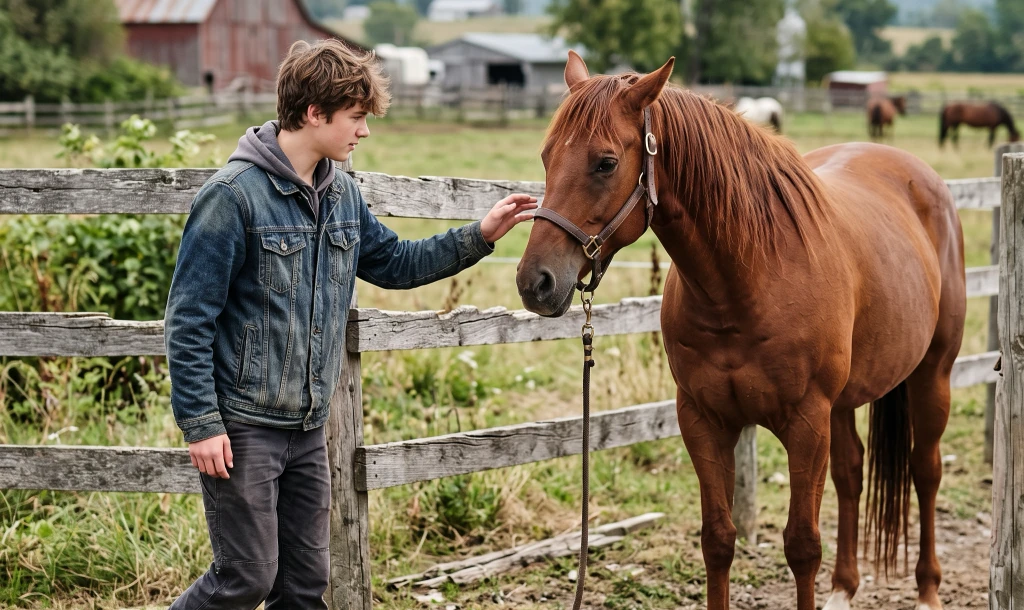
“What’s the chalk for?” Owen asked.
Wade Kincaid, who ran the sale barn outside Hickory, North Carolina, finished marking a chestnut gelding before answering.
“These eleven didn’t sell,” he said. “Kill buyer made an offer on the lot. His truck comes Monday.”
Owen put his fingers around the wire. He had expected the decision to look different somehow—to involve somebody examining their feet, or asking why the chestnut backed away whenever a man stood in the gate. Instead, Wade was putting the chalk in his shirt pocket.
“What did he offer?”
“Where’s your grandmother?”
“Home.”
Wade looked at him then. Owen was sixteen, narrow through the shoulders, wearing the boots his grandfather had bought him before his last winter. The toes were good; the leather behind one heel had split.
“You came with Earl?”
Owen nodded toward the parking lot. “He’s looking at a trailer.”
“Then go find him.”
He did, but only after Wade gave him a price.
At home that evening, Ruth Bennett left her café apron on while she counted the money. Owen had saved $4,580 over two summers of hay work, fence repair, and whatever else neighbors would pay him to do. Until that morning, it had been his truck money.
“Thirty-six hundred and thirty,” she said. “For all eleven.”
“Yes.”
“And you looked at one shoulder.”
“I looked at all of them.”
“With what veterinarian?”
He slid the envelope closer to her. She pushed it back, then opened the green account book beside the salt shaker.
The overdue property taxes were written in her small, upright figures: $3,186.40. There was $810 in the bank. A folded estimate for the south barn roof marked the page, though neither of them had mistaken it for something they could afford.
“Earl said I could work off hay,” Owen told her. “And there’s the grass until it gets cold.”
“Earl said that about one horse.”
Owen had hoped she would call Earl herself. Ruth put the cordless phone between them and waited while he did.
Earl Sutton had known Owen since he was small enough to sleep across two sacks of shavings in a pickup cab. He listened without interrupting, then asked to speak to Ruth. She wrote for several minutes, crossed something out, and went into the hall with the phone.
Owen stayed at the table. Through the open back door he could see the barn, its middle passage dark between the paddocks. His grandfather Henry had been dead for two years, and Ruth still turned on the porch light at feeding time, although there hadn’t been anything out there to feed since the last boarder went home.
She returned with a hay arrangement that would get them through the first weeks. After that, they would buy by the month. Owen would owe Earl Saturdays until spring.
“Dr. Price has to see them,” she said. “Before you decide what any of them can do.”
He nodded too quickly. She waited until he stopped.
“And if I say stop, you stop.”
“I will.”
Ruth pulled off her apron. There was a gray band of dishwater along the hem, and Owen noticed she hadn’t eaten the sandwich she’d brought home.
“I’m trying to work out whether I can say yes,” she said. “You could at least let me finish.”
He got up and put her sandwich on a plate. By the time she had eaten half, they had agreed on another condition: at the end of winter they would look at the money again, including everything he owed other people. He couldn’t count an unpaid bill as something he’d managed without.
On Monday, Earl made two trips with his stock trailer. Ruth signed the sale papers, and Owen watched Wade count out the eleven horses through the sorting gate. The chestnut kept stopping until Earl asked everyone to move back from the opening.
Graham Voss came over from the next aisle while the last load was going in. His riding business occupied the property behind the Bennett farm; from Ruth’s kitchen, they could see his arena roof above the trees. He wore expensive boots with manure on them and held a broken snap in one hand.
“Your side latch isn’t catching,” he told Earl. “Hold this door a second.”
He worked the latch until it seated, then watched Owen lead up the bay mare. Owen knew him mostly as the man who had twice asked Ruth whether she might sell. Voss wanted an entrance on their road so his customers’ trailers wouldn’t have to negotiate the steep drive behind his arena.
“All yours?” Voss asked.
“All eleven.”
Voss glanced at Ruth. “Henry used to take two at a time.”
“I remember,” she said.
He didn’t congratulate Owen. Before he went away, he told Earl to replace the latch instead of trusting it for another trip.
For the first afternoon, Owen let himself enjoy the noise. Water running into tubs, hay pulled apart, the blunt knock of a hoof against a feed pan: every sound came from a place that had been empty. The little bay drank, lifted her wet chin, and rested it briefly against the top rail beside him.
He called her Fern. The chestnut’s papers said Mack, which suited the solid head and short, impatient ears. The black mare had no usable name on her paperwork; Ruth called her Nell after the woman at the café who wouldn’t let anyone else load the dishwasher.
Dr. Lena Price came that afternoon and again later in the week. She checked the records that had traveled with the horses, examined them, and showed Ruth how to keep the new horses apart for their first weeks. Several needed dental or hoof care. One old gelding would probably never carry a rider again.
Owen followed with a notebook, trying to distinguish what might improve from what they would simply have to accommodate. When he asked how soon Fern could be ridden, Dr. Price turned the question around.
“How long has she been moving like that?”
“I don’t know.”
“Then let’s start there.”
He wrote it down as if it were a date she had given him.
September passed into October. Earl delivered hay, the farrier came, and the money remaining in Owen’s envelope became receipts.
Ruth began leaving for the café before he went out to feed, so she could be home when he worked with the horses after school.
He knew she was tired. He also knew that if he could get just a few of them going, he would have something besides bills to put beside her plate.
Mack was the first horse he tried to hurry. In the open paddock, the gelding would accept a halter and stand while Owen brushed him. At a stall entrance he backed, and Owen kept shortening the rope, convinced he was making the request clearer.
By the third session, Mack walked away at the sight of him.
Owen wrote difficult at doors in the notebook. He didn’t write what his own hands had been doing.
When Ruth asked how it had gone, he said he was getting somewhere.
Nell seemed easier at first. She tolerated a brush and a saddle pad, and Dr. Price found nothing on the initial examinations that explained the way she flinched when anything touched her belly. She told Owen to go slowly, keep watching for discomfort, and call if anything changed.
One Thursday, Nell stood so still beneath Henry’s old saddle that Owen thought he had finally done something right. Ruth watched from outside the round pen, a grocery bag hanging from her hand. There was melting ice cream in it; she had stopped on her way home because he’d passed the algebra test he had been worried about.
“She’s awfully tucked up,” Ruth said.
“She was like that with the pad.”
He reached beneath the mare. Nell’s skin twitched along her ribs, but her feet stayed planted.
“Owen, leave it for today.”
“I’m just taking up the slack.”
He wanted Ruth to see something finished. The mare’s stillness seemed like the first useful thing the whole month had given him, and he was afraid that if he let it go, he would have to begin again.
He pulled the cinch strap a little tighter.
Nell’s head came up. Owen had time to move away before she rose and lost her balance, the saddle striking the dirt as she went over. Ruth dropped the grocery bag and ran to the gate.
“Get clear,” she said.
Ruth pulled Owen through the opening and swung the gate shut. Nell scrambled onto her feet and stood trembling with the saddle displaced, the loose stirrup knocking against her side. He reached for the latch, but Ruth caught his wrist.
“Stay here.”
This time he did. Ruth called Dr. Price, and they kept the pen quiet until Nell could be approached safely and the tack removed. The mare was standing when the veterinarian arrived, but Owen couldn’t look at the dirt where the saddle horn had struck without measuring the distance to his own leg.
Dr. Price examined Nell, arranged to check her again, and told them to call at once if the mare stopped eating or lay down and wouldn’t get up. There would be no further saddle work. Owen carried the damaged saddle to the tack room while Ruth listened to the rest.
The ice cream had leaked through its carton onto the grocery bag. He picked it up from beside the fence and found a can of soup beneath it, cold and sticky in his hand.
Ruth stood in the barn entrance. She didn’t raise her voice. “If your grandfather had told you to stop, would you have?”
To read the rest of the story – CLICK the NEXT button 👇👇👇