


Leah Gunnell was shelling peas into an enamel basin on her lap when Vesta Pruitt came up from the river. The wheelchair sat in its summer spot under the apple tree. The left wheel pulled, as always, so Leah’s free hand kept correcting it without her thinking about it. The dust in the yard lay hot and fine as flour. Where Vesta’s bare feet crossed it, it lifted and hung in the slanting light, gold, and wouldn’t settle. She never used the drive. She came through the gap between the woodshed and the cordwood stack, where nobody else walked, with her skirt hitched into her waistband and a canvas bag over one shoulder bristling with dry stalks.
“Anybody alive in here?”
The screen door banged. Darlene came out onto the porch drying her hands on her apron, and her face arranged itself into a welcome before she reached the top step.
“Oh, thank the Lord you came. Vesta, I haven’t stood up straight since Tuesday. I went down the basement for a jar of peaches and something grabbed my back like a fist.”
“We’ll see about your back.”
Vesta set her bag on the bench and looked around. Phlox grew heavy and pink along the fence, and bumblebees droned over it. Split rounds of lodgepole waited by the barn wall for the maul. Past the roofline the mountains stood back in two ranks. The near ridges were green with dark tongues of fir. The far peaks were bluish, and on the farthest one a snowfield lay white in the first days of August.
Cody had bought the wheelchair used in Boise, and its chrome rims were scratched. In summer they parked Leah under the tree with potatoes to peel, berries to pick over, peas to shell. Her hands worked. Her legs didn’t.
“And there’s our girl,” Darlene said without looking over. “Been out here since breakfast.”
Vesta looked at Leah for a long time. There was no pity in it, and none of the careful softness Leah had learned to turn her face from. It was the way Leah used to look at a wheel of cheese before deciding whether it was ready to cut: patiently, with her whole attention.
“How long you been sitting?”
“Going on two years in the chair,” Leah said. “Three since it started.”
“All at once, or a little at a time?”
“A little at a time. I got dizzy first. Then my knees would just quit on me, and I’d fall. Then that was it.”
“Vesta, my back,” Darlene called. “Come on in. I’ve got milk set aside for you, and a jar of honey.”
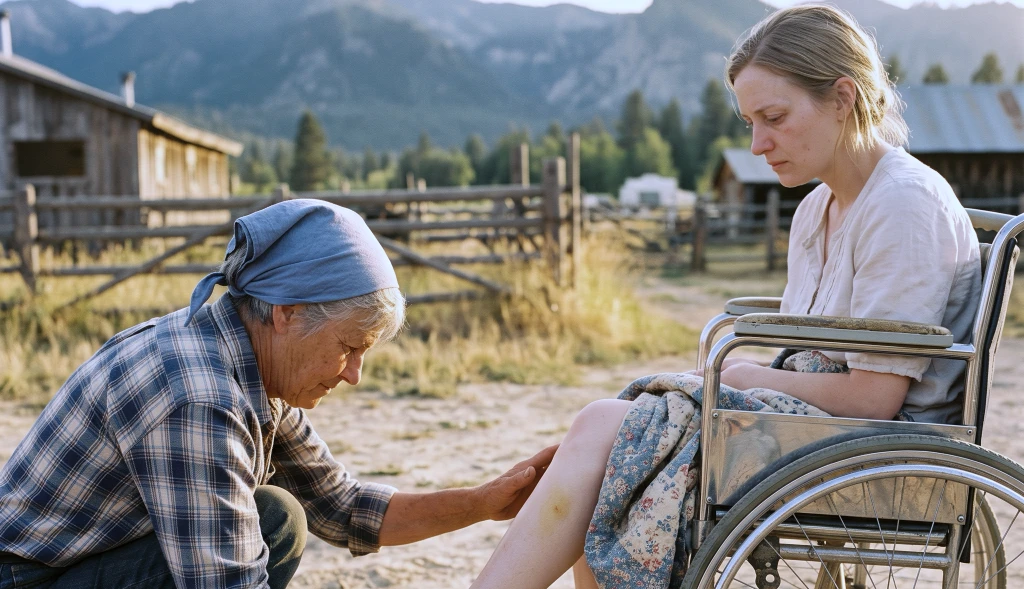
Vesta didn’t go in. She crouched in front of the wheelchair, easily, with no pop in her knees, and folded back the quilt from Leah’s lap.
Leah had stopped looking at her own legs a long time ago. They had thinned to sticks, and the skin on her shins was smooth and white. Along the left one spread a bruise, purple going yellow at the edges. Two days earlier the chair had tipped at the lip of the cheese room door, and Darlene had dragged her across the gravel by the wrists, hurrying and angry.
Vesta took Leah’s foot between her palms. Her hands were dry and hard and very warm. She ran her thumbs down the shin and pressed behind the knee and above the ankle bone. Then she did something nobody had done in years: she closed her hand around Leah’s whole foot and squeezed, firmly, the way you shake hands with someone you mean to know.
“That hurt?”
“No.”
“This?” Vesta dug a thumb in between the long bones of the foot.
Leah flinched.
“There. You feel that.”
“A little. Sometimes I do and sometimes I don’t. The doctors called it residual.”
Vesta didn’t answer. She stroked the calf against the grain of the fine hair and watched the muscle move under the skin. Then she lifted the leg by the ankle. It rose without resistance, loose as a rope. She laid it back down as if it might spill, tucked the quilt around it, and looked Leah in the face.
“Let me see your eyes.”
“My what?”
“Your eyes.”
Leah lifted her face into the sun and squinted. Vesta took her chin between two fingers, turned it, and held it. She studied Leah’s pupils longer than was polite, long enough that the whole yard went quiet except for the bees in the phlox.
Then she leaned to Leah’s ear and spoke low, in the tone people use for something they mean to be heard.
“You aren’t sick, honey. Somebody’s been dosing you.”
The words sat beside Leah without going in, like talk at the next table.
“A little at a time,” Vesta said. “Three years of it.”
Then Leah heard it with her whole body, from her scalp down into legs that felt almost nothing. It was like the river in March, when the ice gives a long groan under your boots before the whole sheet starts to move. One hand came up over her mouth on its own. The other knotted in the collar of her dress.
“Vesta!”
Darlene was crossing the yard fast, her back forgotten, red blotches rising on her neck.
“What are you telling her?”
Vesta stood and brushed off her skirt. “What I see.”
“What you see. She’s been seen by specialists in Boise. They ran her through the MRI from her head to her heels. She has polyneuropathy. You couldn’t even say the word.”
“Polyneuropathy,” Vesta said. “That’s a good word. Nice and long. You can fit a whole lot underneath it.”
“Get off my property. And don’t you ever set foot on it again.”
Vesta picked up her bag. At the gate she turned and raised her voice so it carried over the fence to the neighbors and up to the magpie on the power pole.
“Leah! That braid they cut off you, you hang on to it. Hair keeps track of what a body’s been fed.”
Then she was gone. Leah sat with her hand pressed to her mouth and watched the dust where Vesta had walked settle slowly in the light.
That evening the house felt the way it does before a thunderstorm. Darlene banged pans harder than she needed to and talked to nobody, loud enough for everybody.
“I let that crazy woman in the gate, that’s what I did. Comes around whispering and waving her hands. Scares folks half to death so they’ll send her home with a sack of elk steaks.”
Cody ate hunched over his plate. He was thirty-seven, broad in the shoulders, with a sunburned neck. When Leah was twenty she had thought he was the best-looking man in the valley, and he still was. But these last years his face had gone soft somehow, like a photograph left too long in a window.
“Cody. Did you hear what she said to me?”
“I was out at the pens.”
“Your mom didn’t tell you?”
His spoon stopped for one second, then kept going. “She told me.”
“And what do you think?”
“I think the old lady’s lost her marbles,” he said to his plate. “You’ve been to real doctors. You think she knows more than the doctors?”
“The doctors didn’t find anything.”
“Right. Because there’s nothing to find. Come on, Lee. Don’t start. I’m beat.”
He rinsed his plate and went out to smoke on the porch.
Leah didn’t sleep. She lay on her low bed by the window, the one with plywood under the mattress, and watched the apple tree’s shadow move across the ceiling. A hundred times she told herself Vesta was kind but odd, living alone out past the ford and seeing curses in everything. A hundred times she came back to the same snag.
Last May, Darlene had gone to Salt Lake City for cataract surgery. Cody drove her and stayed at his cousin’s, because his mother couldn’t be left alone right after. They were gone two weeks. Joanie Buck from three houses down came every day with bread and helped Leah into the tub.
On the third day of those two weeks, Leah’s headache stopped. She noticed only when she was reading to Sam at bedtime and realized she hadn’t lost her place once. On the sixth day she woke and could feel the sheet against her feet. On the eighth, sitting up with both hands on the headboard, she drew one knee toward her chest. She didn’t lift it with her hands. She pulled it.
On the tenth day she stood. She held the windowsill and shook all over, and she lasted maybe ten seconds. For those ten seconds she looked out at the mountain from standing height, which she hadn’t done in a year, and it made her dizzier than any sickness had.
She had decided it was a miracle. She planned a surprise: when they came home, she’d be waiting in the doorway on her own feet.
They came home on a Saturday. Darlene walked in wearing wraparound dark glasses, set down her suitcase, and said, “Well, I bet you haven’t had one drop of your tonic this whole time. Let me fix you some.”
The brown bottle had gone to Salt Lake in Darlene’s purse. Leah remembered asking, “What about me?” and Darlene saying, “You’ll live. It’s two weeks.”
Three days after they got home, her legs were strangers again.
Two weeks without it, and she stood. Three days with it, and she lay back down.
In the morning Darlene brought the cup. She always did it the same way. She ran warm water two fingers deep, took the brown bottle from her housecoat pocket, shook it, and counted drops with her lips moving. Then she handed over the cup and stood there until it was empty.
Leah held the cup in both hands and looked into the water. She could ask right now. What is this? Let me see the bottle.
Then a thought came, cold and clear as springwater: if she asked, she would never find out anything again. That bottle would disappear and another would take its place, and they would go on feeding it to her, only more carefully.
“Drink up before it gets cold.”
Leah lifted the cup, took the whole bitter mouthful, and held it behind her teeth while her mother-in-law watched…
To read the rest of the story – CLICK the NEXT button 👇👇👇