


There were eleven horses with yellow chalk on their hips in the back pen at the Ridge County auction, and a truck was coming Monday for any that remained. The chestnut gelding let the auction handler touch his neck. When the man tried to lead him through the narrow gate, the horse stepped backward. The handler pulled, and the gelding backed until the rope drew tight. Beyond the rail, two buyers turned away to look at another pen.
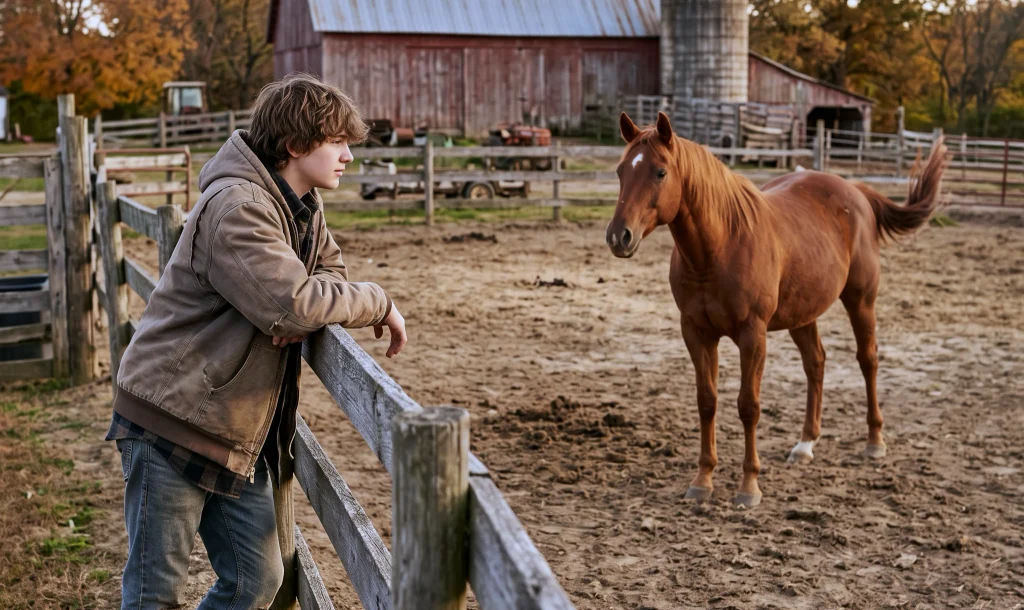
Noah Price watched the horse glance past the handler, toward the open space at the far end. He had seen that look twice already. The handler had been watching the gelding’s feet.
Ray Sutter, who managed the sale, said the truck was headed north. Noah knew what north meant.
It was September 2009. Noah was sixteen and had walked four miles to the auction because his grandmother’s truck needed a fuel pump. Inside his jacket was an envelope holding $2,890. He had earned it over three summers repairing fences, hauling hay, and cleaning stalls. Until that morning, it had been pickup money.
He went around the pen again. A small bay mare favored her left shoulder. Her scar was easy to see, though Noah could not tell what still hurt beneath it. A sorrel resisted anyone who tried to lift a front foot. A black mare stood quietly at the rail, but a strap brushing her ribs made her skin jump. Two horses were thin enough that winter would be hard on them. The chestnut accepted a hand on his neck as long as nobody led him toward the gate.
His grandfather Ben would have stayed until the sale closed. Ben had taken in horses people called stubborn and sometimes found a sore tooth, a bad fit, or a person asking too much too quickly. He had never claimed he could fix every horse. He had died two winters earlier beside a gelding whose bruised hoof he was tending, and Noah could still picture the overturned feed bucket.
Ray found Noah leaning on the back rail. “Come to look, or come to buy?”
“What would you take for the eleven?”
“Who’s signing for them?”
“My grandmother, if she agrees.”
Ray named a price of $2,430. A buyer had offered almost as much for the lot, and Ray would not hold them beyond noon Monday. Noah walked home trying to work out how to explain eleven horses when the envelope would leave him only $460.
Evelyn Price had just come in from her shift at the Maple Grill. She was still wearing her diner apron when Noah put the money on the kitchen table. She counted it, then opened the green ledger she kept beside the salt shaker.
The property taxes were overdue. Ben’s tractor had not run since spring. Rain came through the south barn roof, and the hay they had cut from the back field would not feed eleven horses through winter. Evelyn worked six mornings a week. Her pay covered the two people who already lived on the farm.
“Leon has hay,” Noah said. “I can work some of it off.”
“Leon Rusk has his own animals.”
“I’ll ask him what he can spare.”
Evelyn turned a page of the ledger. “Tell me why you picked these horses.”
Noah described the sorrel’s foot and the bay mare’s shoulder. He told her about the chestnut at the gate. She asked what each horse would need and how long it would stay. He had no answers he trusted.
“I can find homes for them,” he said.
“When?”
“By spring. Most of them, anyway.”
He had no reason to be sure. Evelyn watched him long enough that he could have taken the promise back. He did not.
She looked toward Ben’s barn beyond the kitchen window. People still spoke well of him; he had known horses. Noah knew she was counting other winters too, the ones when Ben’s work paid too late to keep the bills off this table.
Evelyn telephoned Leon about hay and hauling, then called Dr. Lila Keene to arrange examinations. Leon could extend them some feed if Noah worked on his fences, but it would cover only part of the winter. Keene could come after the horses arrived. Evelyn put both obligations in the ledger before she agreed to sign.
“In January,” she told Noah, tapping an empty line, “we decide what we can still afford to keep. You stay in school. If Keene says a horse isn’t ready for work, it doesn’t work. And when I tell you to stop, you stop before we argue.”
“Yes, ma’am.”
“Don’t promise me spring again unless you know what it takes.”
She signed the bill of sale Monday morning. Leon made three trips with his trailer to bring the horses home. The back pen emptied a little more each trip, and Noah breathed easier. Old Mill Road looked a little smaller each time they turned onto it.
Grant Whitcomb watched the last horses load. Ben had occasionally worked for Grant’s stable, which had a covered ring, paid grooms, and customers who wanted a reliable horse ready on the weekend. Grant checked a trailer latch before speaking.
“Your grandfather knew his trade,” he said. “Be careful, son. You just bought eleven appetites.”
Noah was tying a lead rope and kept his eyes on the knot. Grant waited, then returned to his truck.
That first evening, every paddock seemed to have a horse at its fence. Noah carried feed until his arms ached and stood for a moment listening to them eat. Ben’s barn had been quiet for two years. He had missed the sound.
By morning the work looked different. The little brown gelding had an old problem in his hoof. The bay mare walked more freely after she had been out for a while, though Noah could not tell whether the shoulder scar explained her shortened stride. The chestnut, called Copper on his papers, followed him across an open paddock. At the narrow stall entrance he pulled back so sharply that the rope burned Noah’s palm.
Keene came out twice that week. She treated the brown gelding’s hoof, examined the thinner horses, and made a list with Noah of what they knew and what they did not. The sorrel objected when his front foot was lifted. Keene could not yet tell how much pain was in that foot and how much came from bearing his weight elsewhere.
Three days later Noah wanted to clean the foot before school. The sorrel leaned away; Noah held on. A hoof struck the stall wall, split a plank, and cut the horse’s leg.
Keene returned. Evelyn entered the cost of the visit in green ink while Noah replaced the plank. When the veterinarian left, Noah stayed in the stall and looked at the new board. The fresh wood was paler than the planks around it.
Copper was no easier. Ben had taught him to use light pressure on a lead and release it when a horse made the right move. At the stall door, Noah kept asking Copper to step forward. The gelding retreated each time. After two weeks, he began leaving his feed when he saw Noah approach with a halter.
Noah came home from school with an unsigned algebra assignment and a note from his history teacher. Evelyn read both at the kitchen table. That evening she took the water buckets so he could finish his work. Noah heard her boots scrape the back steps after dark and remembered that she would be at the diner before sunrise.
In October, on a dry afternoon, he led the black mare into the round pen. Noah had begun calling her Nell. She accepted a blanket laid gently across her back, and she stood while he placed a saddle over it. He waited a moment. She did not move.
Noah reached beneath her belly and drew up the girth. Nell went over backward. The saddle horn struck the dirt beside his knee, and he scrambled clear of her legs. She struggled upright and stayed where she had landed, shaking.
Evelyn reached the gate as Noah freed the saddle. She took it from his hands and set it outside the pen. Nell walked several uneven steps on her own. Neither of them went to catch her.
Evelyn looked at Noah. “Was she trembling before you tightened it?”
To read the rest of the story – CLICK the NEXT button 👇👇👇