


The calf made a sound with no voice in it, only air, and Maggie Tolliver heard it over the rain because Ray Lindqvist had stopped talking. She had been out since before daylight in weather blowing sideways off the flats, pushing eleven head of a grazing association’s cows back toward a slack wire they’d walked through in the night. They had bunched themselves against the county service road that ran along the east side of Whitcomb Land & Bison, and Ray, who was the association’s vet, had called her at five because she came fast, didn’t talk much, and took cash. She was forty-one. She owned sixty-eight acres free and clear and leased more when she could afford it, which wasn’t often. Days like this paid for the propane.
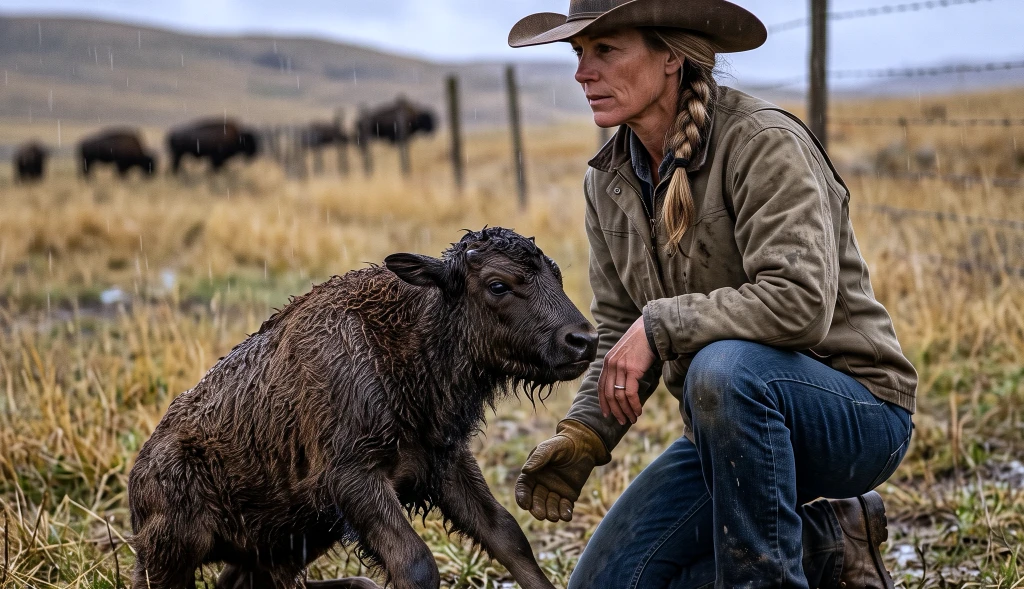
Ray was standing by his truck, where his stock trailer sat hitched with the gate swung open, and he said her name. In eight years she had heard him say it in that flat voice twice. The first time was over a heifer with a calf turned wrong inside her. The second was over Maggie’s father.
She followed his eyes past the fence. Thirty yards onto the Whitcomb side, a long way from the dark humps of the herd grazing up the draw, something small lay in the wet grass. It lifted its head, and then it tried to get up. The front end came off the ground. The back end stayed down, and the whole animal folded into the mud again.
It was a bison calf. If it had held still, she might have taken it for a stump.
They went over the wire together. Up close it was worse. The hide was plastered flat with rain over every rib, and the hip bones pushed up like tent poles under a collapsed tent. The belly had drawn so far up toward the spine that the legs looked borrowed from some other animal. Maggie had seen starvation in cattle at every stage, and she knew this one. It came after the stage where people still called the vet.
Ray knelt in the muck and ran his hands down the calf’s neck and along its side. He didn’t say anything hopeful. When he did talk, he gave her the short version, because it was cold and there was nobody to soften it for. A bull calf, five months or close to it, sliding for weeks, not days. Most likely he’d lost his mother to a cull or a death nobody wrote down. In a herd that size, Ray said, a calf like this could drop out of sight while everybody counted heads and liked the total.
While he talked, the calf tried again. He planted his front feet, jammed his chin into the ground for leverage, and pushed until his hindquarters shook and gave out. He lay there breathing. Then he did it again. He didn’t quit between tries; he rested, and then he went again, with nothing in him to do it with.
A Whitcomb hand named Troy Beckett came up the service road in a side-by-side, leaned over the fence to read the ear tag, and got on the radio. When the answer came back, he told Ray the calf had been flagged in September and pulled off the working list, and that somebody was supposed to have come back for him.
“Guess nobody did,” Troy said.
Twenty minutes later, a gray three-quarter-ton stopped on the gravel and Graham Whitcomb got out. He was fifty-one and wore a barn coat so clean it could have come off a store rack that morning. He ran one of the largest commercial bison herds in that part of the state, along with most of the creek bottom east of town, and he had a gift Maggie had watched work on other people: for the first ten minutes of any conversation, he made you feel like the most sensible person in the county.
He looked down at the calf for about as long as it takes to read a gas pump.
“We marked him a poor doer in September,” he said. His people had pulled him off the list, and the math wasn’t complicated. Every month spent on a calf going backward was hay, labor, and vet bills out of a program that made its money moving in one direction.
“So what happens to him?” Maggie asked.
Graham shrugged, the way men shrug about weather. “Nothing happens to him. He’s not worth the diesel to haul.” He checked his phone.
“Then I’ll take him.”
She heard herself say it before she’d finished deciding to. Graham laughed, and at first it wasn’t unkind. He glanced past her at her truck, a 2007 Ford with a bed rail she had welded back on herself, and asked whether someone who ran her fence on secondhand T-posts had any idea what a bison ate in a winter. Did she know what one did to a corral panel the day it decided to leave? Had she priced a mineral program? He asked it all pleasantly, and the pleasantness made it worse. Troy laughed half a second behind him, because that was part of the job.
Maggie didn’t argue. At nineteen, standing beside her father at a sale barn, she had learned that arguing with a man like this in front of his own help was a fight you lost even when you were right. She told him she’d sign whatever he needed signed. The calf could die at her place or at his, and either way he’d stop being Graham’s problem in about ten minutes.
She watched him run the numbers, and the calf wasn’t in them. He was pricing a dead, starved bison with his tag in its ear, lying beside a county road where anybody with a phone might stop.
He sent Troy to the truck for a transfer form and wrote $1.00 on the consideration line. “Paper needs a number.” He handed her the pen with a little turn of the wrist. She signed, dug a damp dollar out of her coat, and held it out. He took it, folded it in half and in half again, tucked it into his shirt pocket behind his pen, and patted the pocket once.
At his truck door he turned around. “Come see me next fall,” he said. “You’ll have learned the one thing about this business nobody can teach you. When to stop.”
She didn’t answer. Behind her, the calf was trying again.
They loaded him into Ray’s trailer on a tarp. Ray took the front corners and Maggie lifted from the hindquarters, and he weighed so little that she nearly overbalanced. Inside, out of the wind, Ray went over him again with a flashlight in his teeth, joint by joint, running his palm down each leg from shoulder to hoof and pressing along the spine. Maggie crouched by the gate and waited for him to tell her she’d bought an expensive mistake for a dollar.
He stayed down longer than the exam needed. When he finally sat back on his heels, she couldn’t read his face.
“Look at his legs.”
She looked. The cannon bones were long. The knees and hocks were heavy and knobbed like an older animal’s, and the hip bones stood wide apart with nothing between them.
“That’s not a small calf,” Ray said. “That’s a big calf with nothing on him. The frame’s all wrong for the weight. Way wrong.”
“So he could make it.”
Ray switched off the flashlight. Rain drummed on the aluminum roof.
“His bones say he was built for a lot. The next three days decide whether he gets there.” He looked straight at her. “And the thing most likely to kill him now is you. You’ll want to feed him. Everybody does. Feed him like he’s hungry and he’s dead by Friday…”
To read the rest of the story – CLICK the NEXT button 👇👇👇