


Bare feet crossed the yard, and the dust rose behind them, hot and white, and hung in the air for a while as a golden haze. Pru Tate came up from the river the way she always did. She never used the gate. She took the path between the wash house and the woodpile, where nobody else walked. Her kerchief was tied low, down to her eyebrows, and her skirt was tucked up. She carried a canvas bag with dry stems sticking out of the top.
“Hello. Anybody alive in here?”
Linda Pruitt came out onto the porch, wiping her hands on her apron. Her face turned welcoming all at once, as if someone had flipped a switch.
“Oh, thank God you made it. Pru, my back won’t straighten. Three days now. It caught me down in the root cellar like a knife.”
“We’ll look at the back.”
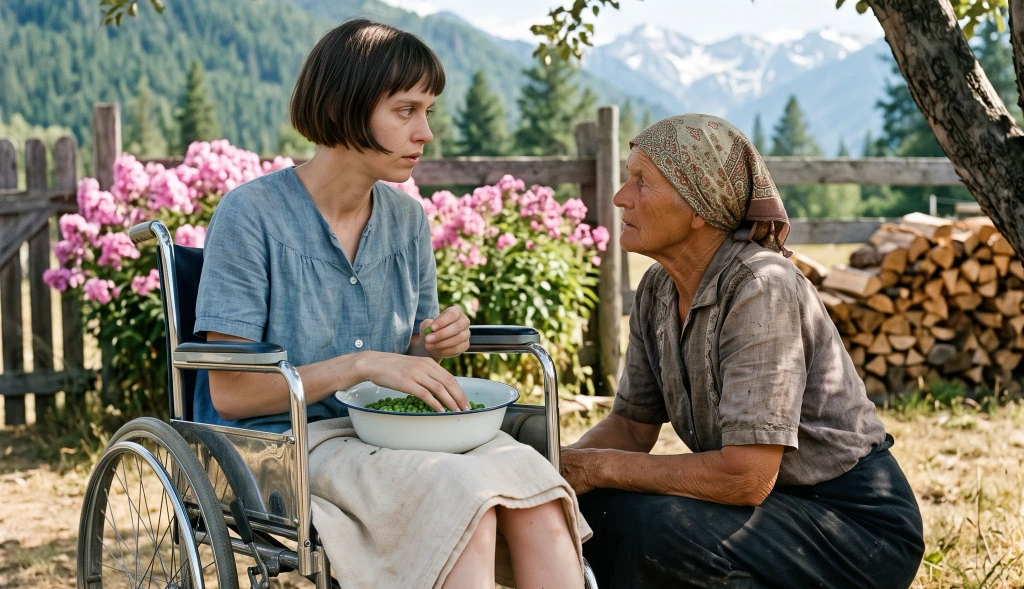
Pru set her bag on the bench and looked around the yard. Heavy pink phlox leaned along the fence, and bumblebees droned over it. Split logs were stacked against the wall, waiting for the ax. Behind the house the mountains rose. The near ones were green, with dark tongues of fir running down them. The far ones stood blue-gray, and on the farthest peaks lay snow that hadn’t melted even in August.
By the table, in a wheelchair, sat Jules.
She had been sitting there for going on three years. Travis had bought the chair used in Salt Lake. Its chrome rims were scratched, and the left wheel pulled a little to one side, so Jules corrected it with her hand without thinking, the way people don’t think about moving their feet. In summer they wheeled her out under the apple tree and left her there. She peeled potatoes, picked over berries, and shelled peas into an enamel basin. Her hands were alive. Her hands worked. Her legs didn’t.
“And that one’s here too,” Linda said without turning around. “Been sitting since morning.”
Pru looked at Jules, and she took her time about it. She didn’t look at her the way people look at the sick. There was no pity in it, none of that special soft expression that always made Jules want to turn away. Pru looked closely, the way you look at a piece of work you have to size up.
“How long have you been sitting?”
“Three years, about,” Jules said.
“All at once, or a little at a time?”
“A little at a time. First I’d get dizzy. Then my legs started giving out, like they were stuffed with cotton. I kept falling. And then it was all the way.”
“Pru, my back,” Linda called from the porch. “Come inside. I’ve got a bottle of milk set out for you, and a jar of honey.”
Pru didn’t go inside. She walked over to the wheelchair and crouched in front of it, easily, without a creak, like a young woman. She folded back the cotton throw from Jules’s knees.
The legs were thin. They had wasted so far that Jules had long ago stopped looking at them. The skin on her shins had gone smooth and white, like a dead woman’s. Along the left shinbone spread a wide purple bruise with yellow at the edges. Two days earlier she had tipped over, chair and all, at the doorsill of the cheese house, and Linda had dragged her across the ground by the arms, hurrying and angry.
Pru took the leg in her hands. Her palms were dry and hard as birch bark, and very warm. She ran her thumbs down the shin from top to bottom. She pressed under the knee, then under the ankle. Then she did something no one had done for Jules in three years. She took hold of her whole foot and squeezed it hard, the way you grip someone’s hand when you meet.
“That hurt?”
“No.”
“This?”
She pushed a finger in between the small bones of the foot. Jules flinched.
“There. Feel that?”
“A little. Sometimes I feel things, sometimes I don’t. The doctors said it’s residual.”
Pru didn’t answer. She drew her hand up the calf against the grain of the fine hair and watched the muscle move under the skin. She took Jules by the ankle and lifted the leg. It rose softly, without resistance, like a length of rope. She laid it back down, very carefully, covered it with the throw, and looked Jules in the face.
“Show me your eyes.”
“What?”
“Your eyes.”
Jules lifted her face. The sun was straight in it, and she squinted, but Pru took her chin in two fingers and turned it and held it there. She looked into Jules’s pupils for longer than was polite. The yard went very quiet. The bumblebees kept on in the phlox.
Then Pru leaned in close to her ear and spoke. She said it quietly, but the way people say a thing that can’t be misheard.
“You’re not sick, girl. They’re dosing you.”
Jules didn’t understand. At first she didn’t understand at all. The words lay down beside her without going in, like somebody else’s language.
“Dosing me?”
“Somebody’s feeding you something. A few drops at a time. Three years now.”
That was when Jules heard it. She didn’t hear it with her ears. She heard it with her whole body at once, from the roots of her hair down to her dead legs, and it was like river ice breaking up in spring: first a long low groan underfoot, and then everything starts to move. One hand came up on its own and covered her mouth. The fingers of the other hand dug into the collar of her dress at her throat.
“Pru!”
Linda was already crossing the yard. She was moving fast, forgetting the back that hadn’t straightened in three days, and her face had gone blotchy.
“What are you doing? What are you saying to her?”
Pru got up from her crouch and brushed off her skirt.
“What I see, I say.”
“What do you see? What could you possibly see? Professors in Salt Lake looked at her. They scanned her top to bottom. She has polyneuropathy. There’s a word for you. You couldn’t even pronounce it. And you come here and poison a person’s mind.”
“Polyneuropathy,” Pru repeated calmly. “Good word. Except in this house it’s been used all this time to cover up what anybody can see without a scan.”
“Get out. Get off my property, and don’t you ever set foot here again.”
Pru picked her bag up off the bench without hurrying. At the gate she turned around and spoke, loudly now, across the whole yard, so the neighbors could hear it, and the magpies on the fence post.
“Julie! That hair they cut off you, keep it safe. Hair remembers everything a body’s been given to drink.”
Then she was gone.
Jules stayed under the apple tree with her palm pressed to her mouth, looking down at the hot white dust, where the golden trail of a stranger’s bare feet was slowly settling…
To read the rest of the story – CLICK the NEXT button 👇👇👇