


The yard dust was white and hot. By noon it had settled in the spokes of Julia’s wheelchair, and bare feet stirred it into a golden haze that lingered after the woman had passed. Pearl Whitcomb had come up from the river, as she always did, through the narrow passage between the old wash shed and the woodpile instead of through the gate. Her headscarf was pulled almost to her eyebrows, her skirt tucked up out of the way. Dry stalks stuck out of the canvas bag in her hand.
“Hello in there. Anybody still breathing?”
Lydia Bennett came onto the porch, wiping her hands on her apron. Her face brightened so quickly it might have been switched on.
“Thank goodness you made it. Pearl, I haven’t been able to straighten my back for three days. Something caught when I was down in the cellar. Felt like a knife.”
“Let’s have a look.”
Pearl set her bag on the bench and glanced around. Pink phlox bowed along the fence, heavy with bloom, and bumblebees droned above it. Logs waited against the wall to be split. Behind the house, the mountains rose in layers: green slopes streaked with dark fir woods, then the blue-gray ridges beyond them, and snow on the farthest heights that would not melt even in August.
Julia sat in her wheelchair beside the table.
This was her third summer in it. Derek had bought the chair used in Spokane. The chrome rims were scratched, and the left wheel pulled a little. Julia corrected it with her hand without thinking, the way a person walking did not think about placing one foot after the other.
In summer they wheeled her under the apple tree and left her there. She peeled potatoes, sorted berries, shelled peas into an enamel basin. Her hands still worked. Her legs did not.
“She’s out here too,” Lydia said without turning. “Been sitting there since morning.”
Pearl looked at Julia. There was no pity in her face, none of that careful softness that always made Julia want to turn away. She studied her with the attention she might have given a piece of work she had been asked to judge.
“How long have you been in that thing?”
“Going on three years.”
“All at once, or a little at a time?”
“A little at a time. First I got dizzy. Then my knees started giving way. My legs felt like they were full of cotton. I kept falling. After that, I couldn’t walk at all.”
“Pearl, my back,” Lydia called from the porch. “Come inside. I’ve got a bottle of milk for you and a jar of honey.”
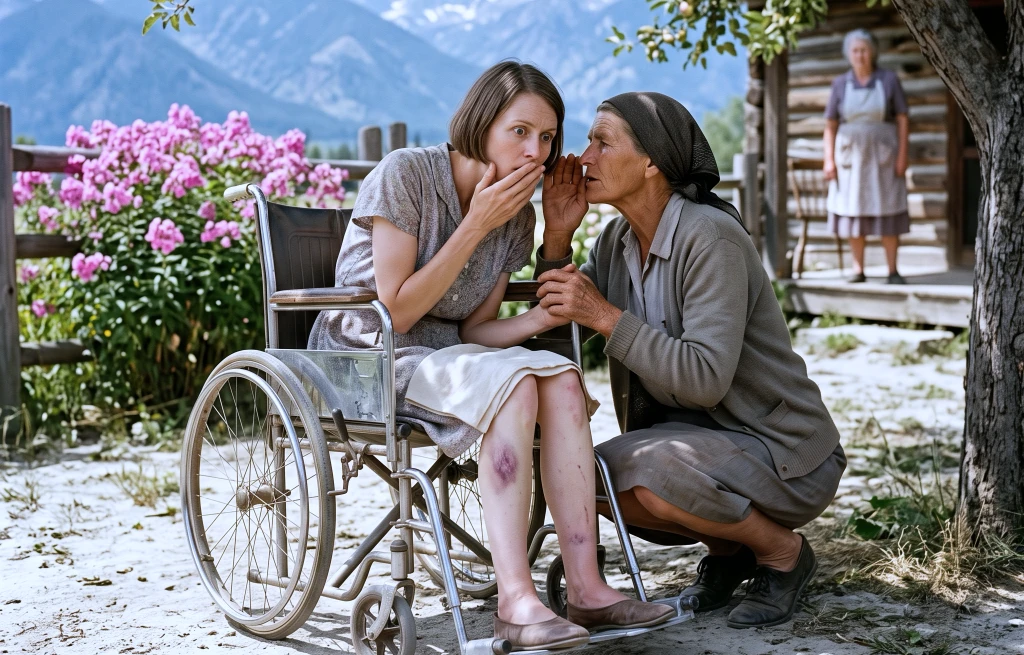
Pearl stayed where she was. She came to the chair and lowered herself into a squat, easily, without a creak, as if she were young. Then she folded back the cotton covering over Julia’s knees.
Her legs had grown so thin that Julia had stopped looking at them. The skin on her shins was smooth and pale as a dead person’s. Along the left shinbone spread a broad purple-blue bruise, yellow around the edges. Two days earlier, the wheelchair had tipped at the cheese room threshold. Lydia had dragged Julia across the ground by her arms, hurrying and angry.
Pearl cupped her leg in both hands. Her palms were dry and rough as birch bark, and very warm. She ran her thumbs down the shin, pressed beneath the knee, then below the ankle.
Next she did something no one had done for Julia in nearly three years. She closed her hand firmly around the whole foot, as if giving it a handshake.
“Hurt?”
“No.”
“How about this?”
She pressed a finger between the bones of Julia’s foot. Julia flinched.
“There. You feel that?”
“A little. Sometimes I do, sometimes I don’t. The doctors said it was some feeling left over.”
Pearl said nothing. She stroked upward along the calf, watching the muscle beneath the skin, then took Julia’s ankle and lifted the leg. It followed limply, offering no resistance, like a length of rope.
She set it down with great care, replaced the covering, and looked at Julia’s face.
“Let me see your eyes.”
“What?”
“Your eyes.”
Julia lifted her face. The sun struck it directly, making her squint. Pearl held her chin between two fingers and turned her head, studying her pupils longer than politeness allowed.
The yard had gone quiet except for the bees in the phlox.
Pearl leaned toward Julia’s ear. Her voice was low, but every word was distinct.
“This isn’t a sickness, girl. Somebody’s keeping you drugged.”
At first Julia did not understand. The words lay beside one another without becoming a sentence, as if Pearl had spoken a foreign language.
“What?”
“Something they’ve been giving you to drink. A little at a time. All these years.”
Then Julia understood, with her whole body, from her scalp to her unresponsive feet. It felt like river ice breaking in spring: first the deep rumble underfoot, then everything moving.
One hand rose to cover her mouth. The fingers of the other caught at the neckline of her dress.
“Pearl!”
Lydia was already crossing the yard. She walked fast, forgetting the back she had been unable to straighten for three days. Red blotches spread across her face.
“What do you think you’re doing? What are you telling her?”
Pearl stood and brushed off her skirt.
“What I see.”
“What could you possibly see? Specialists in Spokane examined her. They scanned everything from her head to her feet. She has polyneuropathy. You can’t even pronounce it. You come into my yard and fill a sick woman’s head with this?”
“Polyneuropathy,” Pearl repeated. “Fine word. You’ve been using it in this house for three years to cover up something a person can see without a scan.”
“Get out. Out of my yard. Don’t you ever set foot—”
Pearl picked up her bag from the bench. At the gate she turned and called loudly enough for the neighbors to hear, loudly enough for the magpie on the post.
“Julie! Keep the hair they cut off. Hair can hold a record of what you’ve been taking.”
She left.
Julia remained beneath the apple tree with her hand pressed over her mouth, staring at the hot white dust. The golden trace of someone else’s bare feet slowly settled to the ground…
To read the rest of the story – CLICK the NEXT button 👇👇👇