


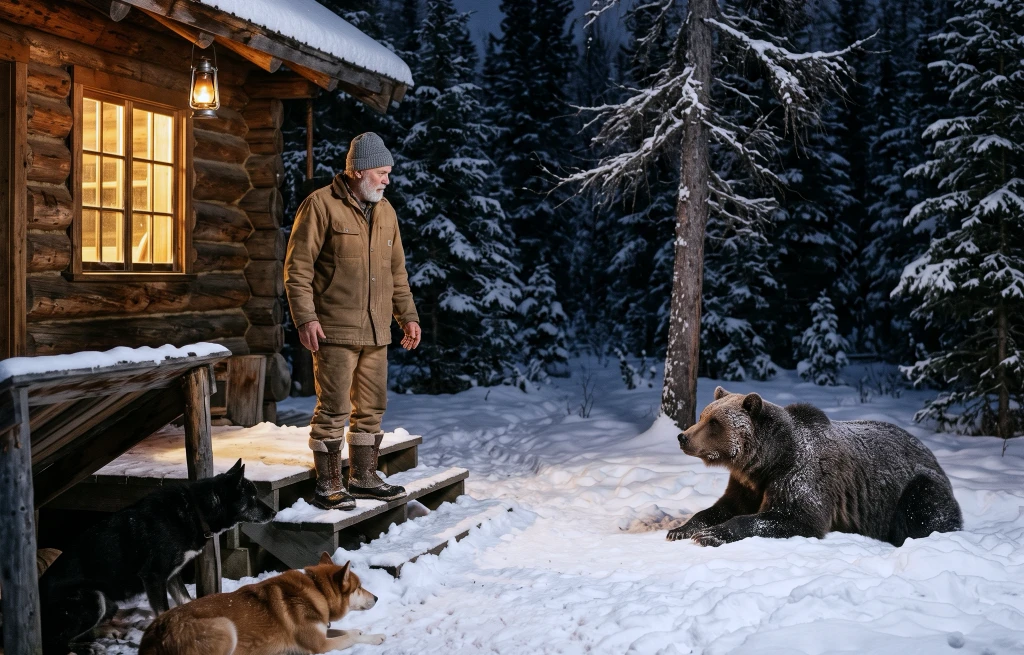
For the first time in more than thirty years, Elias Dunning saw Hump twenty paces from his own front step. The old man fired into the air. The bear didn’t run. He lifted his heavy head, looked toward the cabin, and slowly lay down in the snow, as if a man’s back were safer than wherever he had come from. Before the week was out, Elias would hear what the bear had been listening for: a dull blow from deep in the upper draw, as if someone underground had struck a huge iron door. He would come to understand that Hump’s strange behavior was only the first sign of something people hadn’t noticed yet.
That first night, what woke him was the silence.
He kept two dogs at the station, Red and Minnow. Owen had named Minnow about ten years earlier, when the pup was all body and no legs and kept shoving his nose into the fish bucket. The name stuck, though he grew into a big black brute.
At night the dogs always found something to do. They grumbled at the woods, rattled their chains, growled at nothing, or paced around their doghouses. Tonight there was nothing.
Elias opened his eyes and lay looking at the ceiling. The stove ticked. His old canvas work coat hung on a nail by the door. The clock on the wall said a quarter to three.
Without thinking, he ran his thumb along the crack in the wooden stock of his rifle. He always did that when something didn’t sit right. The crack had appeared fifteen years ago, when the rifle fell off the sled, and for all his talk of replacing the stock, he never had.
Outside, a chain clinked once. Then nothing.
Elias sat up. “Red.”
The dog didn’t answer. That was bad.
He pulled on his felt-lined boots, threw on the coat, picked up the rifle, and eased the door open. The cold grabbed his face. The sky hung low and starless, and the snow in front of the cabin looked gray.
A doghouse stood in the yellow rectangle of light, and beside it Red lay pressed belly-down against the crust. Minnow had wedged himself under the lean-to. Both were staring to the right.
Elias looked too. At first he saw only a dark patch by the larch. Then the patch moved. A huge back, round ears, a heavy head. A bear.
The fear came later. First there was bewilderment, because he had known this animal for years.
They had never gone near each other, and Elias didn’t credit the bear with human thoughts. But in the small world around the station, over a few decades, you start to recognize the regular neighbors. One bull moose had an antler that grew in crooked. A fox with a dark tail walked the old cutline every fall. Up in the high draw lived a huge old grizzly with a hump that rose sharply between his shoulders. Hump.
Elias had seen him in spring, in summer, a few times in fall. Once they had nearly met nose to nose by the creek. The bear had stood up, sniffed the air, and left first. After that Elias stopped going into the upper draw unless he had to. It wasn’t superstition. Why go poking around where you have no business?
Hump seemed to keep the same rule. In all those years he had never once come near the cabin. Until tonight.
Elias raised the rifle and fired straight up. The shot rolled between the slopes. Red flinched, snow sifted off the branches, and the bear just turned his head.
Elias was almost angry. “Hey. Go on. Get out of here.”
Hump stood a little longer, shifted his weight on his front paws, and then lay down right there in the snow.
Elias lowered the rifle, and the unease began. A bear roused early from its den would be hunting food. A sick animal might act strange. An irritated one would show it. This one did nothing. He just didn’t want to leave.
Elias didn’t go back to bed. He sat by the window until dawn, feeding the stove one log at a time and checking the yard now and then. Around four, Hump was gone. He left a deep hollow in the snow and tracks coming down from the upper draw.
In the morning Elias studied them. Wide paw, big animal. No mistaking it. He crouched and rubbed his thumb along the crack in the stock again.
He thought of his mother, of all things. He was about eight. She’d sent him to the shed for firewood one winter, and he saw strange tracks by the woodpile and came back empty-handed. She didn’t scold him. She looked out the window and said, “If you don’t understand what you saw, don’t go back in a hurry.”
He hadn’t thought of that in maybe twenty years.
Around noon he got the forestry office’s old radiophone working. On a good day it held a signal for a few minutes; on a bad one, not at all. Today the connection kept dropping, but Owen caught the important part.
“A bear by the house last night.”
The line hissed. Owen’s voice cut out for a second. “Fresh tracks?”
Elias looked at the dark prints outside the window. “From last night.”
“Maybe he got roused out of his den early?”
“A bear out of his den too early keeps away from people. This one came to me.”
“Uncle Eli, a bear doesn’t care which way he walks.”
“If he didn’t care, he’d have left after I fired.”
The line crackled. “I’m coming up.”
“No need.”
“You called me yourself, and now there’s no need?”
Elias wanted to say he hadn’t called for help, just to let him know, but he heard how dumb that would sound. Instead he grumbled, “You won’t make it before dark.”
“I’ll be there in the morning.”
The line went dead. Elias held the receiver to his ear another minute.
He had never liked people hanging around the station in winter. Not even Owen. Summer, fine. Fall, too. But winter ran on his own order. The firewood stacked just so, the kerosene in its place, the dogs fed at set hours, the shovel always to the right of the door. A man doesn’t live alone for years because he hates people. One day he just notices that without people around, things stop moving out of place.
Still, when he set the receiver down, he felt relief.
The next night Hump came again. This time Elias was waiting. The dogs warned him early with a short, low growl instead of barking.
The bear came out of the dark almost where he had the night before, but this time he moved closer to the lantern. Elias saw his side and went still. A long fresh stripe ran back from the shoulder through the fur. It wasn’t the kind of wound that would put an animal down, but it was plain even from a distance, as if a rock or a sharp branch had caught him.
Hump stood and turned his muzzle toward the upper slope. He listened. Elias listened too. Nothing.
The bear shuffled around near the larch, and a few minutes later he went off downhill along the creek. Elias watched until the dark swallowed him. In thirty years, he had never once seen Hump go down…
To read the rest of the story – CLICK the NEXT button 👇👇👇