


The Ambrose mailbox was built like a bread oven and painted the same rust red as the company trucks. Nell Varga had filled it six mornings a week for eleven years. On the second Tuesday of December she had the door open, sleet ticking on the windshield of her right-hand-drive wagon and a stack of feed invoices and holiday catalogs on her knee, when something on the far side of the fence moved wrong.
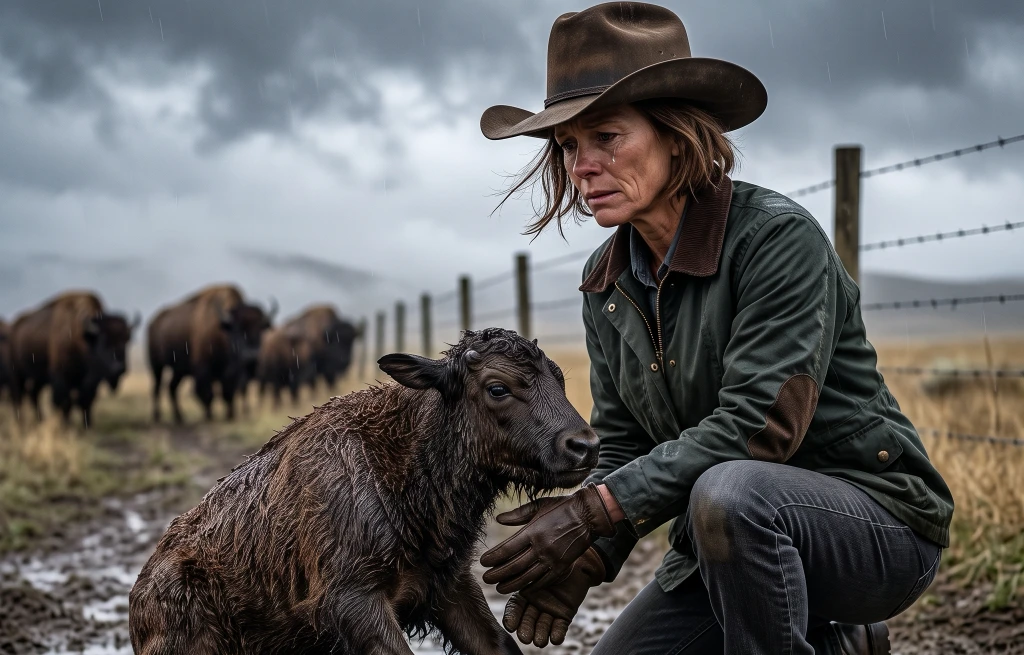
She knew how things moved out here. Deer moved like they were late. Bison drifted. Wet bluestem flattened in the wind and stood back up. This did none of those. It heaved, stopped, and heaved again, about forty yards inside the woven wire, down in the low ground where the ditch water pooled.
Nell put the wagon in park and let the hazards click. She was forty-four. She was nineteen minutes behind on a route that paid by the box, not the hour, and her father would already be sitting at the kitchen window waiting for the noon pills only she could get him to swallow. She got out anyway.
From the ditch she could see it was a bison calf, and that it had been one for a while without anyone paying attention. Sleet had frozen in the hair along his back in a gray crust. His hipbones stood up under the hide like the two ends of a sawhorse with a wet blanket thrown over it, and there was a hollow in front of each hip deep enough to set a coffee cup in. The rest of the Ambrose herd was a dark smudge a half mile up the slope, moving away.
He saw her and tried to rise. He rocked back, threw his head forward to fling his weight up after it, and got his front legs straight. His hind end shivered and stayed in the mud. He went down on his side, lay there with his ribs going like a bellows, and then rocked back and threw his head again.
Her father had bought cattle on commission across four counties for forty years, and Nell had walked a thousand pens behind him. She knew what a thin calf looked like. This was what became of a thin calf nobody had checked on in a month.
She called Annie Fogle, because Annie’s clinic was on Route 2 and Annie answered her phone. Then she stood in the ditch with the sleet going down her collar and watched the calf try four more times. Each time he went down, he lay still only long enough to gather the next try.
The Ambrose feed truck came over the rise before Annie did, a flatbed with a bale processor chained on the back, and Tucker Moody leaned out the window. He was the ranch manager, thirty-four, a decent hand who wore his company jacket zipped to the chin like it might fall off otherwise. He followed her eyes into the bottom, said a word he didn’t usually say in front of her, and got out with a scanner wand.
The calf didn’t even flinch when Tucker climbed through the wire, walked down into the bottom, and passed the wand by his ear. Tucker read the tablet, then read it again.
“Pulled at weaning,” he said. “Coded cull. He was supposed to go on the packer load the fourteenth of November.” He kept looking at the screen. “I did that sort. He must’ve ducked back through the gate.”
“And nobody counted.”
“We count by the hundred, Nell.” He said it without heat, the way a man says a thing he has already said to himself. Then he walked off a few steps and made a call.
Carter Ambrose arrived twelve minutes later in a silver crew-cab with the company logo on the door, the same bison silhouette that was on the ground-meat packages at the grocery store in Emporia. He was fifty-eight and lean, in a canvas vest that had never had a calf scour on it, and he had a way of turning his whole body toward whoever he was talking to that made people feel chosen. Nell had watched him do it at the post office counter, to Darlene, and to the man who fixed the elevator in Council Grove.
He did it to her now. “Nell. You found my orphan.”
He looked at the calf long enough to see what he needed to and no longer. The brand ran on a calendar, he told her kindly: a bull went on grass in May and came off at twenty-two months, and a calf that fell behind in the fall never caught up in the spring.
“So what happens now?” Nell said.
“Now?” Carter glanced at the sky. “Processing on him would run me more than he’d hang. Tucker’ll come back with the rifle when the sleet lets up.”
“Sell him to me.”
The words were out of her like a dish breaking in another room, finished before she knew she’d moved. Carter’s laugh was friendly, which made it worse later.
He said she delivered his mail and he knew what a contract route paid. He had seen her nine cows from the road. He wanted to know what she planned to do when a bison decided her board fence was a suggestion. He asked whether her daddy knew she was out here buying livestock in a ditch, and he smiled when he said it, because everyone knew her daddy couldn’t say much of anything anymore.
Tucker looked at his boots.
Nell didn’t argue. On a mail route you learned not to correct a man at his own box; it cost you on every road he owned. “Write it up or don’t,” she said. “Either way he’s off your books before Annie gets here.”
Carter glanced up the road toward the houses on the county line, where people had already strung their Christmas lights. Nell knew what he was picturing: a dead bison with an Ambrose tag in its ear, lying in sight of a county road in the one week of the year when everybody drove slow and looked out their windows.
Tucker had a pad of company bill-of-sale forms in the truck. Carter filled one out against the hood: one bison bull calf, the tag number, and in the description, in block capitals, CULL, NO VALUE. He paused at the price line. “Company won’t carry a gift on the books. Make it something.”
Nell went back to the wagon and dug in the cup holder where she kept change for stamps. She came back with a dollar bill gone soft as cloth and a fistful of quarters and dimes. Carter counted it on the hood with one finger, two dollars and forty cents, and wrote it in, still smiling.
“Let the record show,” he said. He signed, tore off her copy, and slid the coins to Tucker. “Lunch fund.” He had the truck door open before he remembered something. “Nell. When he dies, call Tucker before you call the rendering truck. I don’t need my tag in somebody’s phone video.”
Annie came down the road with her stock trailer just as the silver truck pulled away. She was thirty-three, two years out of school, with student loans she referred to as her other horse. She took one look over the fence and didn’t bother being gentle.
“If he were mine,” she said, “I’d let Tucker come back with the rifle.”
“He’s mine.”
Annie studied her a second, then took three pictures of the calf with her phone, the way she did for insurance cases, before she went for the calf sled. It was a slick orange plastic tub she used to drag newborns out of snowdrifts. They cut the bottom wire with Tucker’s blessing and slid the calf onto it, and the sled skated over the wet grass far more easily than it should have with an animal in it. In the trailer Annie went over him with a stethoscope and a penlight and kept whatever she thought to herself.
At home, Nell’s father was not at the kitchen window.
He was halfway down the porch ramp with his walker, in his slippers and an old feedlot jacket, sleet collecting on his bare head. Nell yelled his name. Hollis Varga paid her the same attention he had paid her since she was four. He shuffled to the trailer, set the walker against the fender, and reached through the slats.
He wrapped his good hand around the calf’s foreleg just below the knee. His thumb and fingers didn’t meet. He held on a long moment, then looked at Nell with the right side of his face, the side that still worked.
“Bin,” he said. It took him two tries. “Big. Bin.”
Annie looked at Nell.
Nell had to swallow before she could explain. When she was a girl and they’d bought thin calves cheap out of drought country, her father would grab a leg like that and say it to whoever was griping about the price. You didn’t judge a grain bin in March, when it was empty. You judged it by how many rings it had.
Annie got a tape out of her kit, wrapped it around the cannon bone, and checked the number against a chart on her phone. She frowned at the screen and wrote the figure on her glove.
“That’s heavy bone for what he weighs,” she said. “A lot heavier.” Then she turned the frown on Nell. “Which makes the next three days more dangerous, not less. You’re going to want to fill him up. I wanted to, the first one I ever had. His body’s been running on fumes so long it’s rebuilt itself to burn nothing. Pour a full tank in, and his heart and his blood chemistry can’t keep up, and you’ll lose him while he’s eating out of your hand.”
She wrote it on the back of an invoice and taped it to the barn post. A flake of grass hay the size of a paperback, every three hours. A measured cup of protein pellet, split. Electrolytes in warm water. No grain. Not a handful. Not one bite of anything sweet.
“I’ll be back at seven,” Annie said. “Call me if he goes flat.”
Wes got off the school bus at four and stood in the barn door with his backpack still on, staring. He was twelve and still built like a rake handle, and he had his grandfather’s habit of looking at an animal for a long time before he said anything about it. Nell read him the invoice on the post, twice. He nodded both times.
She fed at six and nine. The calf bawled between feedings, a cracked, airy sound that went through the walls of the house. At eleven she lay down on the couch in her clothes with the alarm set for one.
She woke at twelve-forty because it was quiet.
In the barn, by flashlight, she found Wes asleep in the straw against the pen, his coat over the calf’s shoulders. Beside his hand lay the coffee can she kept in the feed room for the old mare’s sweet feed. It was on its side, licked clean. It had been full at supper.
Wes woke up blinking into the light. “He was crying so bad,” he said. “Mom, he was so hungry. I only gave him a little…”
To read the rest of the story – CLICK the NEXT button 👇👇👇