


Sleet blew across the Ashby working pens in long gray sheets. Nora Hulett stood braced on the catwalk above the alley with a sorting flag in her right hand, and she had already noticed that one calf from the last pen hadn’t come up the alley with his bunch. She had stopped feeling her fingers somewhere around the three hundredth calf. Every October, Ashby Bison Company hired a dozen day hands to push its calves through the tub and the squeeze. Nora had been one of them for six years, because the work paid cash at the end of each day and she was better at it than most of the men on the catwalk with her.
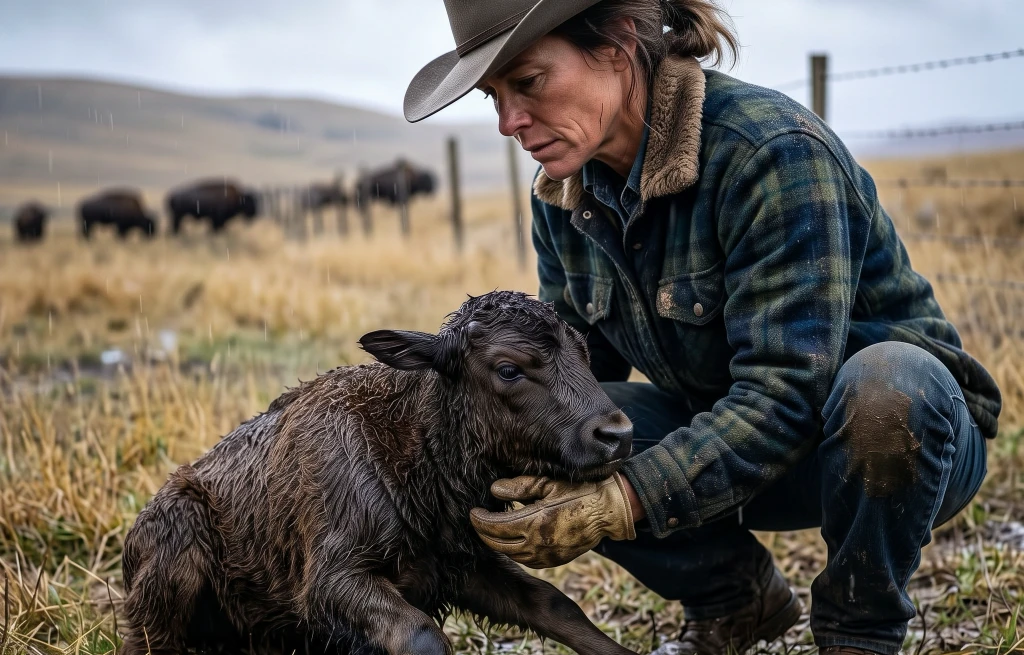
She was forty-four. She owned a hundred and forty acres on Plum Creek, eight cows, a stock trailer older than some of the hands, and an operating note at the bank in Kettle Butte that came due every October whether the year had been kind or not. She also had a ten-year-old daughter who would step off the school bus in four hours and expect supper.
Below her, the calves came up the alley in a steaming, shoving river of brown wool. Bison didn’t move like cattle. They hooked, spun, and turned back on themselves with no warning, so the hands worked from above, kept their legs out of the gaps, and let the flags do the talking. At the squeeze, Sam Delgado stood in a slicker gone black with wet, working a vaccine gun with one hand and cracking sunflower seeds in his teeth. Sam had been the county’s large-animal vet for twenty-six years and complained about every one of them. Beside him, Wade Kittredge, the ranch manager, read tags with a handheld scanner and called weights to a girl in the scale house.
The bunch thinned out, and for a moment the alley stood empty. Then the straggler came up it alone.
He walked slowly, the way an old dog crosses a kitchen. He was so narrow that the alley seemed to widen around him. When he stepped into the squeeze and Wade dropped the head catch, it closed on air, and Wade had to crank it in two notches past where it ever went before it touched his neck.
“One fifty-eight,” the girl called from the scale house.
Wade asked her to read it again. She did. The calves ahead of him had averaged better than three hundred and sixty.
Sam spat out a seed hull and laid his hand flat along the calf’s side. Nora watched the hand go still on the ribs, then move to the hip, then to the spine, where the bones stood up through the wet hair. Sam didn’t say anything, and Nora had worked enough pens with him to know that was a bad sign.
Wade frowned at his scanner. “He’s in the system,” he said. “Flagged in August. Poor doer. Mother went out on the cull truck in July.” He scrolled. “Says pull and reevaluate. Nobody pulled him.”
In July, Nora had worked a day here sorting old cows for the packing plant. The thought passed through her and kept going. There had been a lot of cows.
“Body condition one, maybe one and a half,” Sam said. “If he goes back out with the bunch, the cows’ll walk on him at the bale feeder. If he goes out alone, the coyotes won’t wait for him to finish.” He turned to Wade. “Your call, not mine.”
“It isn’t mine either,” Wade said, and got on the radio.
Preston Ashby came across the yard from the office five minutes later in a canvas coat dry enough to have been hanging by a heater all morning. He was fifty-four, tall, gray at the temples, and easy in his body in a way that made other men stand straighter. He sat on the county commission and the state bison council. He had a gift for remembering the names of everyone’s children, and Nora had watched him use it for years without once being fooled by it.
He climbed the catwalk steps, looked at the scale readout on Wade’s tablet, and only then looked down into the squeeze.
“Back trap,” he said.
“He won’t winter,” Wade said.
“That’s the point, isn’t it? We don’t put hay into the ones going out the back door.” Preston said it reasonably, like a man explaining interest rates. “He was flagged in August. He’s had his chance.”
The calf in the squeeze lifted his head as far as the catch allowed and bawled. No sound came out, only a rasp of breath and a cloud of steam.
“Sell him to me,” Nora said.
She hadn’t planned to say it. Everyone on the catwalk heard it, and two of the younger hands looked at each other.
Preston turned his whole body toward her, which was another thing he did well. “Nora. You run eight cows and day work on a hundred and forty acres. What’s your hay look like in March?” He smiled at her kindly. “A bison calf isn’t a bottle lamb. By the time he’s three he’ll outweigh your pickup, and the first fence he doesn’t care for, he’ll walk through like it’s a clothesline. I’m saying this as a friend.”
Somebody behind her snorted into his collar.
Her father had given her a rule about men like Preston once, in the parking lot of a sale barn in Belle Fourche, when she was eighteen and too angry to see straight. You don’t fight a man on his own catwalk, Nornie. You wait till there’s a scale between you. So she didn’t fight. She said she’d sign whatever paper he wanted, and that the calf could die on Plum Creek as easily as in his back trap. If he died on her place, he’d stop being Preston’s business.
She watched him think. His eyes went past the pens to the highway, where cattle pots rolled by all day, and she could see him picture it: an Ashby tag on a dead calf in the ditch grass, and a day hand with a phone.
“Wade,” he said, “print her a bill of sale.”
When it came, Preston held it against the catwalk rail and asked her what the calf was worth to her. She opened her wallet in the sleet. She had a twenty for diesel, which she couldn’t spare, and folded small behind her license, the two-dollar bill her father had carried in his own wallet for thirty years. Arlo Hulett used to say that a man with a two-dollar bill was never broke. He had died broke anyway, three years ago that spring.
She held it out. Preston looked at it, and something amused crossed his face. He wrote $2.00 on the consideration line and signed his name with a flourish.
“Lucky money?”
“It was my dad’s.”
He folded it once and slid it into the breast pocket of his vest. “I’ll keep it safe for you,” he said. “You’ll be wanting it back by February.”
He went down the steps without waiting to hear whether she had anything to say to that. She didn’t.
Wade backed her trailer to the loading chute himself, which he didn’t have to do. He tore the scale ticket off the printer, with the tag record printed under the weight, calved May 4, and folded it in with the bill of sale before he handed her the paper. Sam and Nora carried the calf out of the squeeze on a sheet of plywood, and he weighed so little that Nora’s end came up too fast and nearly tipped him off. They set him in the front compartment on clean straw. Sam crouched beside him, pressed two fingers under the jaw, and counted.
“Don’t feed him anything when you get home,” Sam said. “Water. Nothing else. I’ll come out tonight when I’m finished here.” He stood, and his knees popped. “And if he goes flat on his side in there, you stop and roll him back up on his chest. He can’t belch lying flat. He’ll bloat.”
It was forty-one miles from the Ashby gate to Plum Creek, thirty of them gravel. Nora drove at thirty miles an hour with the wipers losing to the sleet. At the Moreau road junction she stopped and looked through the trailer slats. The calf lay on his chest with his chin in the straw and his eyes open.
At the cattle guard on the county road, eleven miles from home, she stopped again.
He was flat on his side. His legs stuck out stiff and straight toward the trailer wall, and his head had fallen back at an angle that made her stomach drop. She climbed in, knelt in the wet straw, and laid her bare hand on his ribs.
Nothing moved under it…
To read the rest of the story – CLICK the NEXT button 👇👇👇