


The county had zip-tied a laminated notice to the gate of the Gaines lot, and the wind coming off the flats kept flipping it over. IMPOUNDED, then the blank back side. IMPOUNDED, then nothing. Behind it stood eighteen horses on dirt the color of a feed sack. None of them looked toward the line of trucks parked along the road, and Laurel Dunning noticed that before she noticed anything else.
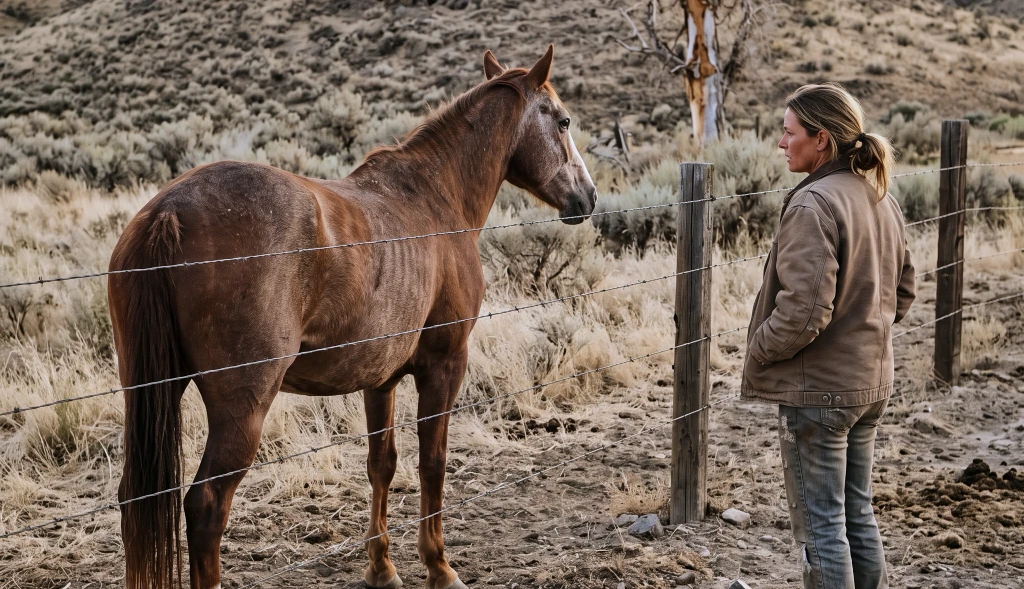
She had come for two. Maybe three if the third was small and sound and wouldn’t cost her a farrier bill the first month. She had a two-horse trailer hitched to the Ford, forty-six acres on the bench above Sage Creek, a barn built for cattle that had been gone ten years, and a checking account that could absorb one mistake if nothing else went wrong that year. Tess was eleven and had outgrown her boots twice since Christmas. Laurel kept that in front of her like a figure written on her hand.
Lyle Gaines hadn’t beaten anything or locked anything in a dark barn. Everyone along the fence agreed on that, in the low voices people use at a funeral for someone they didn’t much like. He had simply stopped being able to pay for hay and kept telling himself fall would fix it. Two falls had come and gone. The trough in the corner had a green skin on the bottom, and the three round feeders were licked down to the metal.
Laurel walked the fence with her hands in her jacket pockets. A gray gelding with a crooked blaze watched her go by without moving his ears. A paint mare stood with her hind end to the wind and her head almost touching the ground. Laurel had built fence for a living for twelve years and had walked past thousands of horses in other people’s pastures, and she had never seen a whole herd too tired to be curious.
Dr. Dale Whitcomb was working the line with a clipboard tucked under his arm and a stethoscope he barely used. He’d done her cattle when there were cattle. He didn’t say hello so much as lift his chin.
“Give it to me straight,” she said.
He did. Most of them would come back with four or five months of good feed, their teeth floated, and their feet trimmed. A couple had mouths so bad the dental work would run more than they’d bring at a sale. Two were old, and for those two, coming back meant being comfortable, not being useful. He tapped his pen toward a bay mare standing alone by the empty water tank.
She was the thinnest thing in the lot. Her back sagged like an old porch roof. Gray had crept up from her muzzle into the hollows over her eyes, and her hip bones stood up under the hide like two fists. One white sock on her left hind had gone the color of dishwater. Somebody had put a strip of masking tape on her halter and written MAGGIE on it in marker. The paperwork the county had found put her at twenty-four.
“That one,” Whitcomb said, “I’d keep warm and let go easy when it’s time. That’s my honest opinion.”
The county had hired a horse handler from Marlow for the week, a heavyset woman named Trina with a sunburned neck, and it was Trina who changed Laurel’s arithmetic. She said it walking beside her, not to persuade anyone, just thinking out loud. These horses had run together a long time, some of them most of their lives. The county would split them five or six ways by Monday, and she’d seen what that did to animals running on empty. A horse that quits eating from nerves can stand in good hay and waste away anyway.
Laurel stood by the corner post a long while. The barn was already standing. Her fences were already tight, because tight fence was the one thing she could guarantee on her own place. She had forty round bales stacked under a tarp, bought in April because the price had dropped and she had a lifelong habit of buying what was cheap whether she needed it or not. She ran the figures against the bales and the barn and the fence twice. The total pinched. It would pinch every week until spring, but it held.
She signed for all eighteen.
The county clerk at the folding table asked her twice. Whitcomb set his clipboard on the hood of somebody’s truck.
“Loading them’s the part people brag about,” he said. “Any fool with a trailer can do that. Month three is what finds out who you are. You’ll spend what you planned, and then the hay man will show you what you forgot to plan.”
“I know,” she said.
He looked at her the way he used to look at a calf he wasn’t sure about. Then he tore a corner off a feed receipt, wrote his cell number on it, and handed it over.
Garrett Ashby pulled in about twenty minutes later in a white Dodge with a flatbed that had never hauled anything muddier than a saddle. Ashby Ridge ran four hundred irrigated acres on the north side of the valley, and its quarter horses showed up in sale catalogs from Ogden to Pendleton. He’d come, he told the men by the corral, to see if either of the two young geldings had any breeding worth salvaging. He went down the fence unhurried and a little bored, the way he probably went through anything for sale.
Then he saw the county paperwork in Laurel’s hand with the number 18 written at the top.
“Laurel.” He said it pleasantly. He said everything pleasantly. “You starting a rescue or a boneyard?”
Two of the men at the corral laughed. Laurel folded the papers in half and put them in her back pocket. Men like Garrett asked questions like that so they could watch you answer, and she’d stopped giving them the show years ago.
He should have walked back to his truck. Instead he stopped beside the old bay mare by the water tank and stood there. Laurel saw it without paying it much attention, the way you notice a man rereading a sign. He looked at the mare’s face a long time. Then his eyes went down to her left shoulder, and then back along her to her hind legs, and he stayed there long enough that the mare turned her head to see what he wanted.
When he came back up the fence, he had the easy look on again.
“I’ll take that old one off your hands,” he said. “Do right by her. Five hundred dollars, and you’ve got one less mouth.”
Five hundred dollars was more than anyone would pay for a twenty-four-year-old mare with her ribs showing. The men at the corral knew it. Laurel could see them deciding it was the punch line, a rich man buying the cull out of a pity he wanted everyone to watch.
“No, thank you,” Laurel said.
She backed the trailer to the gate. It took her four trips and the whole afternoon, and she borrowed Ray Kimball’s stock trailer for the last two. She brought the old mare home last, alone, because she didn’t trust her to stay on her feet with another horse leaning on her.
The sun was nearly down when she dropped the ramp in front of her own barn. Tess was waiting on the top rail of the corral with her chin on her knees. The other seventeen were already scattered through the east pasture, some of them eating, most just standing, ears finally turning at the sounds of a new place.
Maggie came off the ramp slowly, testing each foot on the boards. She lifted her head and smelled the air. Then she walked straight past the hay Laurel had forked out for her, past the water tank, past the other horses, all the way across the pasture to the west fence, without stopping once. She stood there facing the dry hill beyond the wire, where nothing grew but cheatgrass and a dead cottonwood, and she called. It was a long, cracked whinny that rolled up the slope and came back off the rocks.
Tess climbed down from the rail. “Mom,” she said. “Why is she calling at the hill like somebody’s up there?”
To read the rest of the story – CLICK the NEXT button 👇👇👇