


The cold that morning was the kind that made the snowmachine’s engine sound thin, as if the air didn’t have enough body to carry noise. Amos Teague shut it off at the bend below Wolverine Creek, and in the quiet that rushed in after the motor died, he heard something he couldn’t name. Low and drawn out, then gone before he could turn his head toward it.
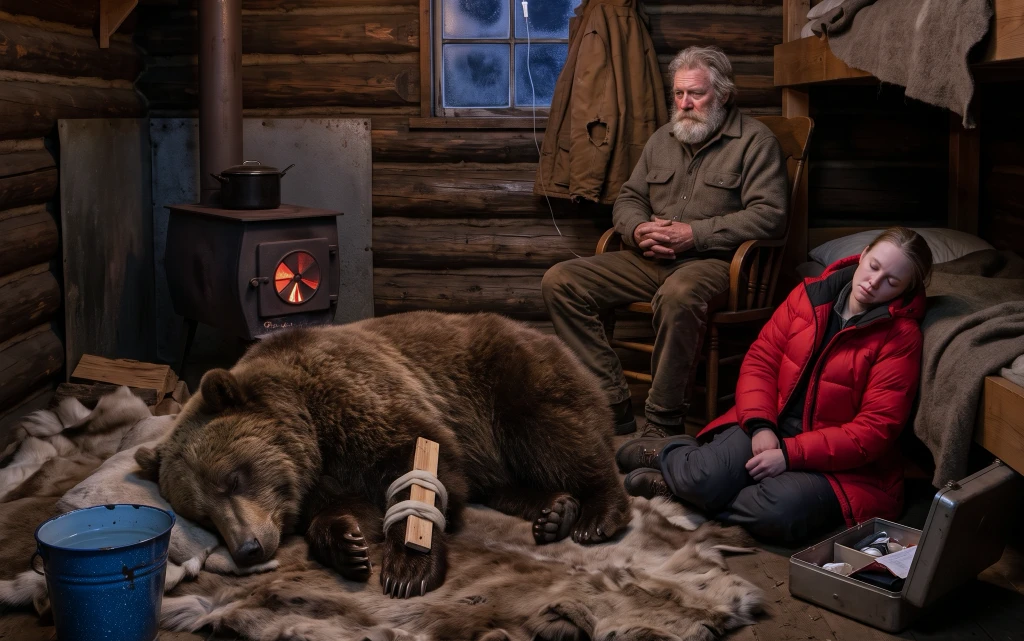
He sat still and waited. Nothing. Somewhere upslope a spruce let go of its load with a soft collapse, and the powder hung glittering in the air before it settled. Twenty-six below on the thermometer nailed to the cabin porch when he’d left, colder down here in the bottomland, where the cold pooled like water. Cold made sound carry strange. He told himself that and pulled on his snowshoes.
He had nine sets on this stretch of the line, marten mostly, a couple of lynx cubbies up where the willows thinned. Thirty-one years he’d run it. Before that his father had run most of it, and the blazes the old man had cut into the spruce had healed over into gray knots that Amos still read the way other people read street signs.
The last half mile was too tight for the machine, so he went up the creek on foot. The storm two nights back had laid down almost three feet, dry and fine as flour on top, packed hard underneath where the wind had worked it. The trees were bent with it.
He was nearly to the third set when the sound came again, and this time there was no mistaking where it came from. It rose out of the ground itself, from under the big drift where a windthrown spruce lay across the creek bank with its root plate standing up like a wall.
Amos had spent his life listening to animals in pain. Snared hares, a cow moose with a leg broken through river ice, a dog team once, tangled and screaming after a sled went over. This was something heavier than any of those. It came from deep in a big chest and went on longer than it should have, and it had a kind of exhaustion in it, as if whatever made it had been making it for a long time and had stopped expecting an answer.
He unslung the rifle and held it across his body and waited. Nothing moved. The sound came a third time, weaker.
He should have walked away. He knew that. Whatever was under there was hurt, and hurt things got dangerous in proportion to their size. But thirty-one years on a trapline makes a man unable to leave a question lying in the snow, so he leaned the rifle against the root plate, took off one snowshoe, and started digging with it.
The drift was set up hard below the powder. He chopped and scooped, breathing through his scarf, the frost building white on the wool. Ten minutes. Fifteen. His shoulders burned, and the sweat under his layers turned cold the moment he paused. Then the snowshoe scraped something that gave a little, and he dropped to his knees and dug with his mittens.
Brown fur. Frost-tipped, matted, dense as felt.
He cleared another foot and a face came up out of the drift, broad and dish-shaped, the ears small and round and rimmed with ice. An eye opened. It was dark brown, almost black at the center, and it looked at him from about two feet away.
Amos went backward so fast he sat down in the snow.
Grizzly. A young sow, he saw once his heart let him see anything, three years old at most, not a big bear by the standards of the country but still more animal than any man had business being this close to. She should have been in a den by now. Most of them were, by the middle of November.
His hand found the rifle without his telling it to. He had it up and the safety off before he was all the way back on his feet, and the front sight settled on the flat place between that eye and the ear, and his finger was inside the guard.
Eleven years. Eleven Augusts since the berry slope above the Chena road, since June’s bucket rolling down through the blueberry bushes with nobody holding it. Eleven years of stepping off the trail at every pile of bear scat and feeling the old thing climb up the back of his throat. He had shot four grizzlies in that time, every one of them legal, every one of them in defense of something, and he had never once felt sorry about it.
One round. The easiest shot he’d take all winter.
The bear didn’t move. She didn’t pop her jaws or huff or try to rise. She looked at him, and there was nothing in her face he could have called fury. Her breath came out in short gray puffs that froze on her muzzle.
He kept the rifle up and stepped sideways to see the rest of her. Her left foreleg was stretched out at an angle no leg should take, and around it, just above the wrist, a loop of steel cable had bitten so deep into the hide that the fur had grown crusted and black around it. The cable ran taut back into the snow toward the base of a spruce. He could see where she’d fought it. The bark on that tree was stripped to bare wood as high as his chest, and the ground around it, under the new snow, had been churned to frozen mud. Then the storm had come and buried her where she lay.
Three days, he figured. Maybe four.
It was a neck snare, the big kind, set low. Nobody snared bears legally in this unit. Nobody snared bears legally anywhere he’d ever trapped. He knew who did, though, or knew the shape of it. A gallbladder brought real money in certain markets. So did claws, and a clean hide off a young bear.
He lowered the rifle an inch. Then another.
He knew this feeling. He got it when he found somebody’s garbage burned in a firepit on the river: the sense that a thing had been done badly, by people who wouldn’t come back to see what they’d left.
He stood there long enough for the cold to work into his toes. Then he put the safety on, set the rifle on the root plate, and walked back down the creek to his machine.
The freight sled was eight feet of ash and plastic, built for hauling firewood and gas cans and, twice a winter, a frozen moose quarter. He brought the machine as close as the willows allowed and broke a trail the rest of the way on foot, dragging the sled behind him by its rope. He laid the rifle across the sled’s front stanchion. Then he took his cable cutters out of the trap pack.
She watched him come. Her ears went flat.
“I know,” he said. His voice sounded odd out loud, cracked from disuse. “I know it.”
He crouched at the tree end of the cable, as far from her as he could get and still reach it, and closed the cutters on the steel. It took both hands and all his weight. The cable parted with a flat snap and the free end whipped back toward the bear.
She came up out of the snow.
Not all the way. Her hindquarters were still buried and the broken leg folded under her the moment she put weight on it, but she got her chest up and her head up and she swung that broad face around toward him with her lips peeled back from her teeth, and the sound she made this time had no exhaustion in it at all.
Amos was on one knee in soft snow, six feet from her. The rifle was on the sled behind him, eight feet away, on the wrong side…
To read the rest of the story – CLICK the NEXT button 👇👇👇