


The old mare stood with her nose over the water tub and didn’t drink. Marcy Keller noticed that because noticing was her job. She had driven Rural Route 2 out of Cutler, Wyoming, for nineteen years, and the route had trained her to catch what was out of place before anything else: a flag left up on a Sunday, a box nobody had emptied in three days. On sale Wednesdays the livestock auction was her last stop before lunch. The front lot was always jammed with stock trailers, so she went around back to leave the office’s catalogs at the side door. That put her at the end of the alley, beside the pen where they kept horses nobody had called ahead about.
Seven animals stood in it. Two brown molly mules leaned shoulder to shoulder against the far rails like a pair of aunts waiting for a bus. A sorrel gelding with a scabbed hip kept snaking his head at a spotted yearling. A black mare stood crooked on a clubbed front foot, and a fat Shetland pony slept in the only strip of shade. Then there was the old one at the tub. She was a grulla, that smoky blue-gray, with a dark stripe down her spine and faint bars on her legs, and age had turned her face nearly white. Her hipbones stood up high enough to hang a hat on.
She lowered her muzzle until it almost touched the water and held it there. Then she raised her head and looked north, over the pen roofs, toward nothing Marcy could see.
“She does that,” said the kid with the sorting stick. He was maybe seventeen, with a sunburned neck and a brand inspector’s clipboard he was obviously proud to carry. The trader had bought the bunch at a cleanout up near Roundup, Montana, he said. An old man had died and his family wanted the place empty. They’d run through the ring as one lot at four o’clock. Whatever didn’t sell would go on the trader’s truck tonight, headed south.
He didn’t say what south meant. Marcy had lived in the basin all her life, and he didn’t need to.
“The mules won’t go anywhere without that old mare,” he added. “We tried to sort them this morning. The little one about went over the top rail.”
Marcy finished the route. A hundred and seventeen miles of gravel and three hundred and four boxes. The dog at the Petersen place chased her mail car the way it did every single day, as if she were new. She thought about the barn at home. Since January, when she had buried old Doc with a rented backhoe at thirty-one years of age, it had held nothing but a riding mower and the smell of him in the boards.
At three-forty she was back in her own pickup with her checkbook in her shirt pocket. She called Cody from the parking lot.
“Bring the stock trailer,” she said.
“For what?”
“I’ll tell you when you get here.”
Cody was twenty-six and had come home in March, when the oil company laid off half its crews. Since May he’d been working day wages on Russ Aldine’s hay crew, eleven miles up the Owl Fork. He said “Mom” in a way that sounded like a whole argument. He said it now. Then he said he’d be there by four-thirty.
The loose horses came in last, after the bred heifers and a pen of bawling calves. The auctioneer called them “a set of seven, folks, sold as a lot, they go together,” in a voice that didn’t expect much. The ring man pushed them in at a jog. The mules came in with their noses nearly touching the old mare’s hindquarters, and the pony trotted twice his own length to keep up.
The opening ask was five hundred, and nobody moved. Then a hand went up in the second row.
Marcy knew the hand before she knew the face. Russ Aldine sat with his hat on his knee in a shirt that someone had pressed, a long, sun-dark man of fifty-eight. For nineteen years she had put his seed catalogs, his feed invoices, and his granddaughter’s birthday cards into the welded steel box at the foot of his lane. He lifted one finger at six hundred.
Marcy said, “Seven.”
He looked across the ring at her, mildly surprised, the way he might look at a heifer that had gotten through a gate. Then he went eight. She went nine. It climbed in hundreds, then in fifties. People on the bleachers stopped talking to watch. At twenty-two hundred Russ looked down at the old grulla mare, who stood at the ring rail facing north again, and at twenty-three Marcy’s voice came out steadier than she felt. He put his hat back on his head.
“Sold,” the auctioneer said. “Twenty-three hundred, to the mail lady.”
Someone laughed, not unkindly. Marcy wrote the check at the office window with her hand nearly cramping. It was more than half of what she had.
Russ found her at the chute while she waited for Cody. Up close he smelled of saddle soap and the cinnamon gum he always chewed.
“Marcy.”
“Russ.”
“I’ll give you eighteen hundred for the grulla.” He said it easily, as if he were asking about the weather on the north end of her route. “Ava’s seven. She needs something old and slow to fall off of.”
“You just bid twenty-two on all seven.”
“I wanted the mare. Didn’t need the rest.”
“The mules won’t load without her.”
“Then I’ll take the mules too.” He smiled. “You’d still have four head you didn’t plan on.”
She looked into the pen. The old mare had her face pressed against the planks on the north side, breathing through the gap. The sorrel was trying to bite the pony. The black mare stood on three legs and watched Marcy with a patience that felt like an accusation.
“No,” Marcy said. “They go together. That’s how I bought them.”
Russ studied the old mare for longer than an offer needed. Something moved in his face, and then it was gone. “Feed her slow,” he said. “Grass hay first. You rush an old horse that thin, you’ll founder her.” He touched his hat and walked back toward the cattle pens.
Cody pulled in five minutes later. He watched Russ’s back go up the alley.
“Mom. That was my boss.”
“I know who it was.”
The kid with the clipboard was right about the mules. They wouldn’t step up until the old mare had walked into the trailer, slowly, testing the floor with each front hoof. Then they followed her so close they bumped her. The others went in after them. Cody had to lift the pony.
The Keller place sat on thirty-eight acres of bench ground above the Owl Fork, eleven miles out of town. They unloaded in the last of the light. Marcy ran the hydrant into the barn tank, and the water came out the way it always did, smelling faintly of struck matches and leaving orange rings on everything it touched. The mules drank first, and then the rest of them crowded in, the black mare last on her three good legs.
The old mare didn’t go near the tank. She walked out of the barn lot and up the long rise of the pasture to the north corner, where the fence lines met. A thicket of wild rose had grown there once, thick enough that deer bedded in it. A few dry summers back it had died, and now it was a tangle of gray canes. She walked into the middle of it and stood still.
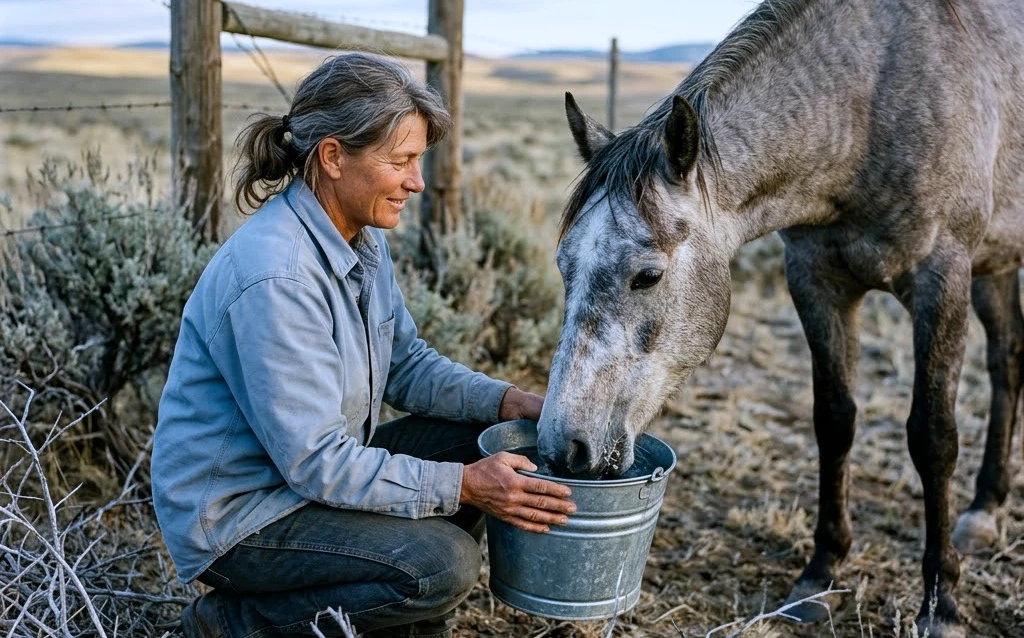
Marcy carried a bucket up there in the dark. The mare put her nose to it, blew hard enough to ripple the surface, and turned her head away.
At midnight Marcy was still at the kitchen table, not even pretending to sleep. Cody came in from his truck with his phone in his hand, looking like he’d just remembered something he should have mentioned hours ago.
“That kid at the chute,” he said. “He told me something when I was loading, and I didn’t think about it till now.” He set the phone down. “He said the old mare hasn’t had a drink since they hauled her out of Montana. That was Sunday…”
To read the rest of the story – CLICK the NEXT button 👇👇👇