


At twenty past six on the eleventh morning of the cold snap, Walt Kessler carried a coffee can of oats across the yard and found the hay barn door standing open about a foot. The air coming out of the gap smelled wrong, thick and musky, like a wet dog left too long beside a stove. He had latched that door the night before. He was as sure of it as he was of anything his hands did, because they had done it the same way for forty years.
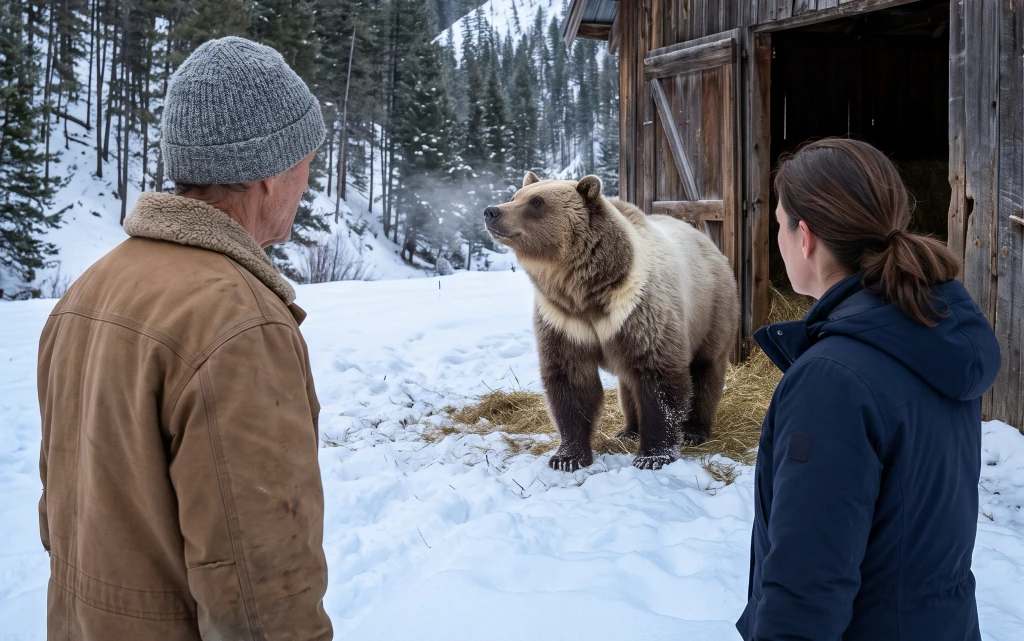
Juniper should have been at the corral gate, rattling the chain with her chin. Instead the old mare had wedged herself into the far corner of the pen, as far from the barn as the rails allowed. Frost had whitened the long hair along her spine, and her breath came out in short, hard bursts. She didn’t nicker at the oats. She didn’t look at him at all.
Walt set the can on a post and pointed his flashlight through the gap. He saw loose hay, the front tire of the tractor, and Ruth’s saddle on its rack, where it had hung untouched for almost two years. Then, in the back corner where he’d broken open three bales for bedding, he saw a hill of brown fur rising and falling.
He knew her before he saw her face. Nineteen years of watching the same bear across the gulch from a kitchen window will do that. A broad band of pale fur lay across her shoulders, nearly cream against the brown. The first spring, Ruth had studied it through the binoculars and said, “Well, that’s Grandma Agnes. She never took her shawl off either.” Since then Agnes had raised four sets of cubs on the far side of Sauer Creek and dug her dens in the old waste dumps below the Mountain Queen mine, a mile and a half up the gulch. In all those years she had never once come below the irrigation ditch.
Now she was asleep in his hay in the middle of January, when every grizzly in Montana should have been under four feet of snow.
Walt didn’t move. Behind him, Juniper blew through her nose. The bear’s head rose slowly out of the hay, and her small eyes caught the beam. She looked at him the way a neighbor might look at someone who had walked in without knocking. Then she laid her head back down.
He backed away three steps, then three more, and eased the door shut without throwing the latch. If she wanted out, he’d rather she had a way. He took the oats into the round pen on the far side of the house and whistled until Juniper came around the long way, keeping the house between herself and the barn.
In the kitchen he tapped the barometer by the door before he took his coat off. Thirty point four, high and steady, the way it had been for eleven days. Ruth had given him that barometer for their tenth anniversary, and he had tapped its glass every morning since. She used to say he’d die doing it. He hadn’t yet.
The Fish, Wildlife and Parks office in Callister didn’t open until eight, so he called Gil Ostrander’s cell. The line popped and hissed. Ice had been building on the phone wires since Christmas.
“In your barn?” Gil said. “You’re sure it’s not a black bear?”
“I know this bear, Gil. Ruth named her.”
A pause. Gil had sat two rows behind him at the funeral. He’d been in Dana’s class at Callister High, and he still called Walt Mr. Kessler when he forgot himself. “A sow coming out in January usually means something ran her out of the den. Water, a slide, some kid on a snowmachine. Is she hurt?”
“Didn’t look.”
“Don’t. I’ve got two wrecks on the interstate, a moose in the middle of town, and one truck running. Monday’s the soonest I can get up there.” Another burst of static. “Keep the mare close. And don’t shoot her unless she’s coming through your door, Mr. Kessler.”
“I wasn’t planning to shoot her.”
“I know you weren’t. That’s why I said it.”
After he hung up, Walt went out to check the pump house. Some mornings in a cold snap like this, the heat lamp over the wellhead burned out and the line froze, and he’d lose half a day with a hair dryer. The lamp was fine. The wellhead wasn’t.
A collar of ice had built up around the steel cap, thick and clear, as if water had been seeping out from underneath and freezing in layers. Walt crouched, which his right hip didn’t like, and knocked the ice away with the heel of his hand. Then he unscrewed the vent plug and fed his weighted tape down the casing.
He’d drilled this well himself in the summer of 1987. Two hundred and twenty feet. The water had always stood about sixty-one feet below the top of the pipe, and he knew it the way he knew his own blood pressure. The tape went wet at two feet.
He pulled it up and dropped it again, because the first reading made no sense. Two feet. Water didn’t climb sixty feet in a week in the dead of winter, with nothing melting anywhere and the ground frozen like iron.
He remembered the day the bit dropped. A hundred and sixty-two feet down, the rods had gone loose in his hands and the rig lurched as the bit fell three feet through nothing. An old drift from the Queen, some passage the miners had cut and left. He’d cased right through it and grouted it shut. Ruth had driven his lunch up to the rig that afternoon and eaten half of it, sitting on the tailgate, while he explained what a drift was.
He wrote the reading in the green logbook he kept in the pump house: Jan 18. SWL 2 ft. ??? He hadn’t used three question marks in a well log in his life.
At ten past nine, Dana’s hatchback came up the drive, low and dirty from the county road, and parked by the woodpile. She came every third Saturday on her days off from the emergency room in Callister, fourteen miles each way, with groceries and opinions. Today she also had a blue folder under her arm.
“You didn’t salt the steps,” she said.
“They were fine yesterday.”
She was forty-six and had her mother’s way of climbing stairs, fast and leaning forward, as if they owed her money. On the top step she reached for his wrist, which she did now whenever she got close enough, and Walt knew she was counting his pulse. He took his hand back and opened the door for her.
In the kitchen she set the groceries on the counter beside Mateo Ruiz’s drawing of Juniper, which was still taped to the refrigerator from August. The boy from the old Haugen place at the mouth of the gulch had drawn the mare purple, with a yellow mane and six legs, and labeled her JUNIPR in letters of different heights. Dana straightened it with one finger.
“There’s a bear in the barn,” Walt said.
She turned around. “A what?”
“Agnes. Your mother’s bear. She’s asleep in the bedding hay.”
Dana looked at him for a long moment, then at the window, then down at the blue folder in her hand. She set it on the table between them and laid her palm flat on top of it. Behind her, the faucet he’d left dripping against the freeze coughed twice and ran a thin stream the color of rust.
“Then I guess I’m glad I didn’t wait,” she said. “The Hallorans made an offer on the place, Dad. Cash. I told them yes. They’re driving up Monday to walk it…”
To read the rest of the story – CLICK the NEXT button 👇👇👇