


“Is your bay supposed to be loose?” Bev Okerlund asked it before Nora Haskell had finished saying hello. Nora was leaning across her passenger seat at the time, phone pinned to her shoulder, sliding a seed catalog into the Gundersons’ box. Nobody else called Nora on the route. People flagged her down instead, or clipped a note under the flag, or left a jar of chokecherry jelly on the post with her name on masking tape. Bev did all three. Every October she also asked whether Nora might come to the Grange supper, and every October Nora said she’d see. Three Octobers ago she’d had a reason to say no: her father in the back bedroom, asking for her mother, who had been dead nineteen years. Now she said it out of habit.
Nora shut the box with two fingers. “Loose where?”
“He just trotted across in front of me at the Juniper Spur turnoff. No halter. Didn’t even look at the truck. Going like somebody’d sent for him.”
Nora looked at the trays behind her seat. She had ninety-one boxes left on the north loop, a pharmacy package for Walt Foster that couldn’t wait another day, and Glenda back at the post office in town. Glenda kept track of when every carrier came in, in a notebook nobody was supposed to know about.
“Which way?”
“Up the spur,” Bev said. “Toward the old Pruitt place.”
For three weeks Rook had been standing at the north corner of his pasture in the evenings, head high, ears fixed on nothing Nora could find. She had taken it for weather. Out here you could watch a front come down off the rim for an hour before it reached you, and a horse with any sense paid attention. She had never thought about which direction the Pruitt place lay. She hadn’t thought about the Pruitt place at all, except once a day, when she drove past its box.
“Thanks, Bev.”
“You want me to—”
“I’ve got it.”
She delivered Walt Foster’s package first, because his daughter had called the post office twice about it and because Nora knew what was in it. Then she locked the trays in the back and drove north faster than the gravel liked, or than a wagon with two hundred and forty thousand miles on it ought to go. She had almost enough put by for a new one. Another year, maybe.
Juniper Spur ran nine miles off the county road and ended at a box nobody had opened in years. It still had a number on Nora’s route list, with VACANT typed beside it, and she still slowed there every day out of habit. The flag had rusted in the down position. Somebody had used the box for target practice a long time ago, and the holes had gone brown at the edges.
A mile before that she passed Arlo Gentry’s box, the one shaped like a little red barn. Its door wouldn’t close anymore. She had been folding his electric bill and his farm paper into it for a week and a half, and last Saturday she’d left an orange notice saying the box was full and his mail would be held in town. Glenda said Arlo’s daughter lived in Boise and he’d probably gone to see her. Nora had let that be the answer.
She found Rook’s tracks where the spur crossed a dry wash, pressed deep into the sand. The ruts got worse after that. She drove them at a walking pace with the window down, listening to sage brush the doors, a hawk somewhere, the tick of the engine.
Then, from over the rise, a horse calling.
It wasn’t a sound she knew from him. Rook was a quiet animal. In seven years she’d heard him whinny maybe a dozen times, mostly at feeding time in deep snow, mostly to complain. This was higher, and it didn’t stop.
Something answered it.
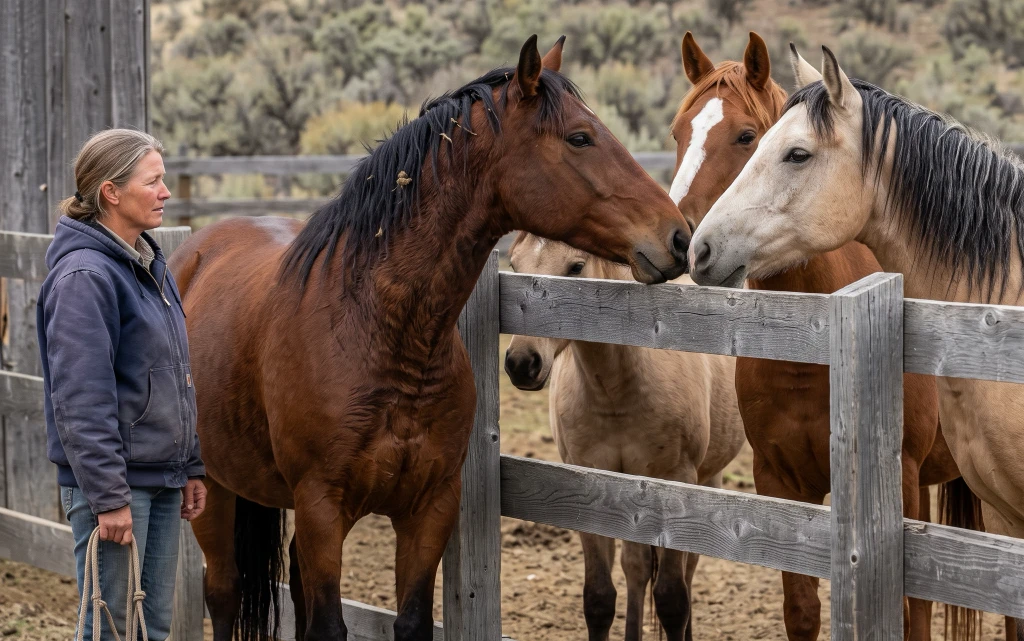
The Pruitt place sat in a fold of the hills, with a stand of willows around a spring. The house had plywood over its windows. The barn had held up better, its tin roof patched with sheets that didn’t match. A board-fenced pen ran sixty feet off the barn’s south wall. Rook stood against that fence with his chest pressed to the top rail, and on the other side three horses stood with their noses almost touching his.
Nora stopped the car and got out slowly.
Rook swung his head toward her. She watched him take in the car, then her, then the halter she’d grabbed from the back seat. Then he turned back to the fence.
“Hey, bud.” She walked down with the halter held low against her leg. “Look at you. You came a long way.”
He let her get within reach. He let her run a hand down his neck, which was dark with sweat and stuck with burrs. When she lifted the halter, he sidestepped it without leaving her and put his nose back over the fence.
Nora lowered her hand. She’d spent most of a year learning what that sidestep meant, back when he wouldn’t eat until she’d walked to the far side of the corral and couldn’t stand to see a rope swing anywhere near him. She didn’t argue with it now.
She looked over the fence.
The old mare was a buckskin faded nearly white with age, her black mane gone grizzled, the hollows above her eyes sunk deep. She stood in front of the other two. Behind her was a sorrel gelding with a crooked blaze and a long healed gash down one foreleg. Behind him, half hidden, was a little dun mare who couldn’t have been more than three or four. The dun was the worst. Nora could count her ribs from where she stood, and her hipbones jutted under the hide like the ends of a sawhorse.
The pen was bare dirt. A feeder made from a cut-down stock tank held a few gray stems. The water trough at the far end had a green skin on the bottom and nothing above it.
“Oh, you poor things,” Nora said.
The gate was fastened with a chain and a snap, no lock. She stood with her hand on the snap and made herself think about it for five full seconds. These were not her horses. This was not her land. Then she looked at the dun’s hips again and unhooked it.
She went for the trough first. A black pipe came down from the willows and fed it through a float valve, and when she pushed the float down she got nothing but a dry gurgle. She could hear water somewhere up the line, though, a thin ticking. She unscrewed the valve housing, found it packed with silt and a drowned grasshopper, and dug it clean with the small blade of her pocketknife. The pipe coughed, spat brown, and ran.
It ran slowly. She brought the two gallon jugs she kept in the car for summer days on the route, poured them into the cut-down tank, and stepped back.
The buckskin let the sorrel drink first, then the dun. Only when the little mare lifted her dripping muzzle did the old one lower her own head, and even then she kept one eye on Nora.
Rook had followed Nora through the open gate. He didn’t drink. He stood beside the dun with his head lowered next to hers, close enough that their breath mixed, and Nora had to look somewhere else for a minute.
The barn door rolled when she leaned on it. Inside, the stalls were clean, which surprised her. Somebody had forked them out and spread sawdust, and a wheelbarrow stood upended against the wall to drain. In the tack room, on a nail by the door, hung a clipboard with a pencil tied to it by baling twine.
The pages were ruled into columns by hand: date, hay, water, notes. The handwriting was large and careful, the writing of someone who didn’t write much and didn’t want to be misread. Every other day, as far back as the pages went, the same short entries. 2 bales. Tank full. Hazel stiff in the cold. Tink lame LF, better. Junie ate good.
The last entry was dated October 9.
2 bales. Tank low, check line Sat. Shut pen, hunters on ridge.
Under it were two initials. A.G.
Nora stood in the tack room holding the clipboard in both hands. Deer season had opened on the twelfth. He’d shut them in so nobody would mistake a horse for a buck at dusk, and he’d meant to come back Saturday and look at the water line.
She had driven past his mailbox every day since then and decided he was in Boise…
To read the rest of the story – CLICK the NEXT button 👇👇👇