


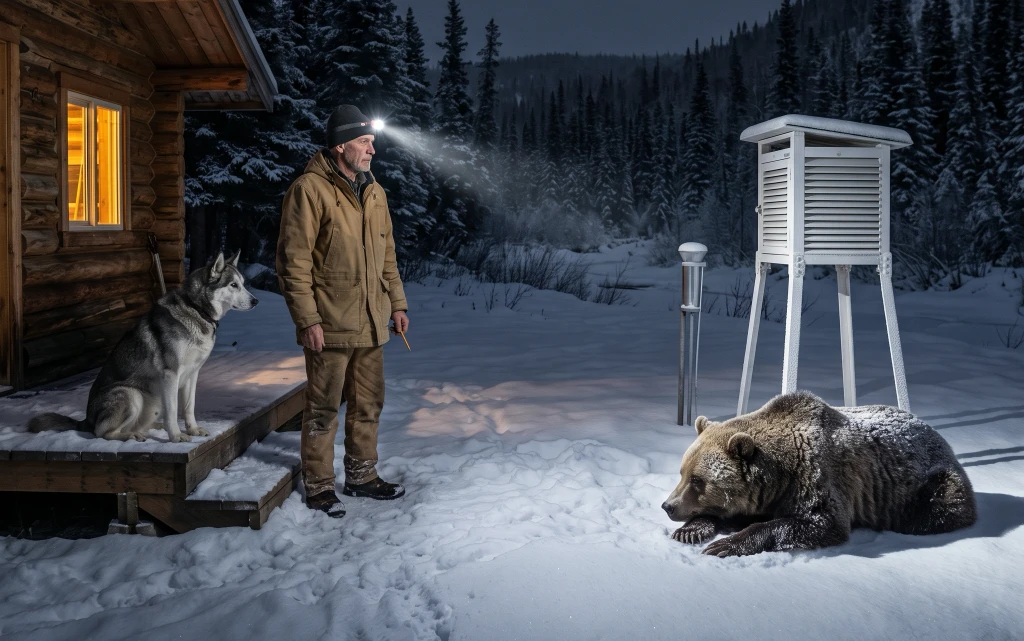
The minimum thermometer read thirty-one below. Lyle Brandvold had his headlamp clamped in his teeth so he could write the number down when he noticed that Sadie hadn’t followed him off the porch. She always followed him to the shelter. She was eleven, half retired sled dog and half whatever had climbed the fence of a Nenana dog yard one spring night, and she treated the five o’clock reading as her job as much as his. Tonight she sat on the top step with her tail curled over her feet. She was staring past the rain gauge, toward the far end of the clearing where the willows ran down to the creek.
Lyle took the light out of his mouth and turned it that way.
The beam crossed the willows, then the frosted cap of the gauge, then a dark heap beside it that looked like a load of firewood dumped in the wrong place. The heap lifted its head, and snow slid off its neck. The light caught one ear, round and whole, and then the other, which was split down the middle and hung in two pieces. It had hung that way for at least fifteen years.
“Well,” Lyle said. “Bishop.”
His breath froze and hung in front of his face. A second later the cold got past his scarf and into his chest. He was forty feet from a grizzly, in January, holding a pencil.
Ruth had named the bear during their third summer at the station. They had watched him from the porch as he walked the gravel bar, slow and solemn, swinging his big gray-tipped head from side to side as though he were blessing the river rocks. “Look at him,” she’d said. “Bishop of Tenderfoot Creek.” The name stuck the way her names always did. Bishop belonged to the upper valley, to the berry slopes below Gilchrist’s old mining dam. In thirty-one years Lyle had seen him perhaps a hundred times, always at a distance the two of them seemed to have agreed on without discussing it.
Bishop had never come into the yard, and in winter he shouldn’t have been anywhere except under the ground.
Lyle backed toward the porch without turning around. Sadie pressed against his shins as he came up the steps. He reached inside the door for the pen launcher on its nail, screwed a banger cartridge onto the end by feel, cocked it, and fired over the clearing. The banger burst beyond the willows with a flat crack and a white flash that lit the snow for a quarter of a second.
The bear stood up and shook himself. Then he took three slow steps toward the cabin, and Lyle’s hand closed hard on the launcher. Bishop stopped beside the instrument shelter, turned around once, and lay down again with his chin on his paws, facing up the valley. He looked like a man who had been shown a chair and had decided to take it.
Lyle went inside and shut the door. He took the rifle down, loaded it, and set it across his knees in the chair by the window. Sadie crawled under the table and stayed there.
A bear out of its den in January was a hungry bear or a sick one, and Lyle knew what each of those looked like. A hungry bear would have been at the meat cache or tearing open the dog-food barrel. A sick one would have been ragged, with its ribs showing and its feet dragging. Bishop was neither. He lay with his back to the cache and the barrel, his nose pointed at the dark upper end of the valley, and he didn’t move.
The ledger lay open on the table where Lyle had left it. It was green and clothbound, ruled by hand into columns in Ruth’s square printing, the way she’d laid them out in the first one. Date. Max. Min. At Obs. Snowfall. Depth. Then the wide last column on the right, which she had labeled Remarks and had filled for nineteen years with whatever came into her head. Juncos back. L. swears the stove is fine. Bishop on the bar, fat as a sofa.
In the four winters since she’d died, Lyle had mostly left the remarks column empty, or written clear in it.
He wrote -31 in the minimum column. Then, in the remarks, Bishop in yard 4:55. Banger. No effect. It was the most he had written there in a month.
He didn’t sleep. Every half hour he leaned toward the glass. The bear stayed a dark hummock by the shelter, and frost grew on the fur along his back.
At ten past three, Bishop lifted his head.
Lyle saw it happen. The heavy head came up off the paws and the torn ear swung forward. A breath later, maybe two, a sound came down the valley. It was a long hollow crack that ended in a thud, like a dozer blade dropped onto frozen rock somewhere far off. The windowpane hummed against Lyle’s knuckles. Under the table, Sadie whined.
Bishop got to his feet and faced upvalley. He stood like that for a long minute, his breath smoking. Then he lay back down.
Lyle found the pencil. 3:10 boom upvalley, he wrote. He looked at that, and then added, B. heard it first.
When the light came at half past nine, the bear was gone. His tracks led down along the creek, away from the upper valley. Lyle took Sadie and the rifle and walked out to the shelter to see where Bishop had lain.
The bed was a shallow oval melted into the snow. Scattered in the bottom of it were small gray lumps, like gravel. Lyle had seen ice balls before. Dogs packed them between their toes and horses carried them in their feathers. He picked one up, worked it in his gloved fingers, then pulled the glove off and held the lump in his bare palm until it softened.
It was clay. It was gray and slick and wet, and there was only one place in forty miles of frozen country where he had ever seen clay that color…
To read the rest of the story – CLICK the NEXT button 👇👇👇