


The rescue’s night line rang at 4:02, and by 4:20 Jo Pruitt was on the county road in the dark with Walt Kessler’s dog eating her back seat. Becca Ordway didn’t call at four unless something was dying, and this week only one animal at Tallgrass Wildlife Rescue was.
The seatbelt went with a soft rip somewhere past the Diamond Springs turnoff. In the dome light, Boone lay across the back seat with the shoulder strap pinned under one paw, working through the nylon the same way he had worked through her laundry room door on Saturday night. He was patient about it and didn’t apologize. The strap was simply between him and wherever he meant to be.
“That’s two hundred dollars, Boone,” she said, and kept driving.
She couldn’t leave him at home. In the eight days since the funeral home had carried Walt out of his own bedroom, Boone had dug under her yard fence twice. The second time a county deputy found him two miles up the gravel road, limping east toward the Kessler place eleven miles away, toward a house where nobody lived now.
He was ten years old, a Great Pyrenees with something heavier mixed in, a hundred and twenty pounds of white coat that had gone the color of old piano keys along his belly. One ear had been torn by a coyote years ago and healed folded. He had spent his whole life outdoors with Walt’s cattle and a dozen goats, and he had never set foot in the house until Walt’s last week. Walt had made Jo carry the dog’s bed in from the barn, because his own hands were past it. Put it by the door, he’d said. He’ll want to see who’s coming.
Dale, Walt’s son, had said after the service that he would sort out the dog once he’d caught his breath, and Jo had driven home before the lawyer sat the family down at the kitchen table. She’d said she would keep Boone until then. He ate when she set the bowl down and left the room, and only then.
Sleet ticked against the windshield the whole way to the rescue. The barn had been a dairy barn once, long and low, with a concrete aisle and a hayloft where the swallows nested in summer. Jo parked by the side door and walked Boone into the feed room, which stayed warm off the water heater, and dropped the hook latch behind him. He lay down facing the door before she’d taken her hand off it.
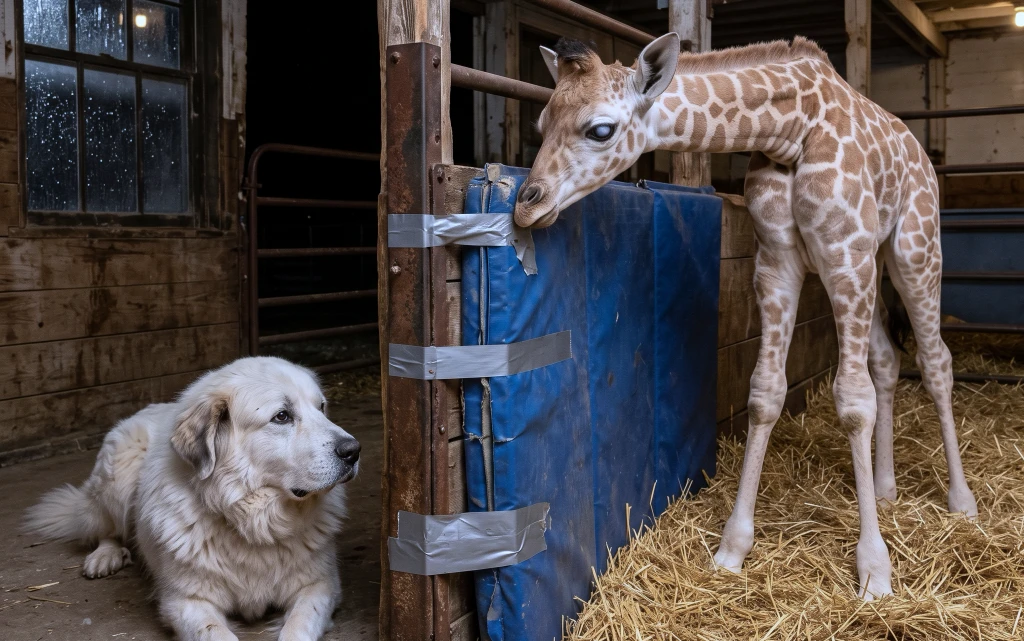
Becca was kneeling in the straw of the old bull pen, where the panels had been padded with gym mats and duct tape. The calf lay flat on her side against her.
Wren was nine days old. On her feet she stood a head taller than Jo, who was five foot four. She weighed a hundred and twenty pounds when she should have been closer to a hundred and fifty, and both her eyes were filled with a milky film that had been there since birth. The ophthalmologist from the vet school in Manhattan had looked once and said that surgery on eyes that small might buy her shadows, at a price nobody had.
She had been born at a drive-through animal park outside Coldwater the week the bank took the place. Her mother was a first-time cow, and a blind calf doesn’t find an udder; she finds legs, and bumps them, and keeps bumping them. The cow had kicked her away twice before the state’s people could get a rope on anything. The mother had gone to a zoo in Oklahoma. The calf had come here, because Tallgrass was the closest place with a barn tall enough and a vet who’d once raised a moose.
“She went lateral around three-thirty,” Becca said. Her voice still had the Hill Country in it from two years of hoofstock work outside San Antonio. “I propped her twice. She keeps rolling back off.”
Jo knelt and put her stethoscope on the calf’s chest. The heart was quick and thin. The gums were pale and tacky under her thumb. A calf lying flat on her side was a calf whose stomach was pressing on everything, and whose body had stopped bothering to argue.
“Tube at eleven?” Jo asked.
“Eleven and three. She didn’t fight it at three.”
Jo didn’t like that. A calf who fought the tube still had opinions.
On Friday Jo had stood in this aisle, set a line out loud, and written it at the bottom of the whiteboard so that she would have to keep it. If Wren hadn’t taken a full bottle on her own by Wednesday, they would let her go. She had made rules like that ever since a pronghorn fawn, years back, that she’d kept on fluids for eleven days because she couldn’t stand to be the one. The fawn had paid for every one of those days, and Jo had paid for them since.
Today was Monday.
They rolled Wren onto her chest together and wedged her with rolled horse blankets. Becca had a bottle in the warmer by the gate. She offered it and Wren turned her face away, slowly, as though even refusing were work.
The hook latch rattled down the aisle.
Becca looked up first. “Jo. Your dog.”
“He’s not my dog.”
Boone came down the concrete at his stiff evening walk, head low, the folded ear swinging. He didn’t hurry and he didn’t look at either woman. He stopped at the bull pen gate, lowered his nose to the gap under the bottom rail, and breathed in for a long time.
Then he lay down across the gateway on the aisle side of the panel, the way he’d lain across Walt’s bedroom door, and let out the deep, put-upon groan of a big dog settling his hips.
Jo was already moving to get a hand in his collar. A livestock guardian lying against the pen of a prey animal was one bad second from becoming something else.
“Wait,” Becca said. “Look at her ear.”
Wren’s left ear had come around toward the gate.
Boone sighed again, through his nose, a sound like air let out of a tire. The calf’s head lifted an inch off the blanket.
Jo didn’t know she was humming until she heard it. It was the old hymn Walt had hummed all his life, under his breath, at the gate, in the truck, at his kitchen table with the hospice nurse checking his feet. “Shall We Gather at the River,” though he’d never once sung the words. Jo couldn’t carry a tune in a bucket, and she was carrying this one badly. Boone’s tail lifted and dropped once on the concrete.
Wren tried to get her legs under her. She folded on the first try. On the second, she came up front end first, swaying, her hocks trembling, and stood.
Becca didn’t breathe. Jo didn’t either.
The calf took one step toward the gate and found the padded panel with her shoulder. She followed it with her muzzle, searching along the rails, lips working at the bars like a newborn working along her mother’s side for the place where milk comes from. When she reached the spot where Boone’s breath came through, she stopped and stood there.
“Bottle,” Jo said quietly.
Becca slid it out of the warmer and came in along the far side, slow, as they’d practiced. Boone’s head came up off his paws. He watched her, but he didn’t rise.
Becca touched the nipple to Wren’s lip. The calf’s mouth closed on it. She swallowed, and swallowed again, and kept going, her tail giving a short weak switch against her hocks.
She took half the bottle before her legs began to shake, and Becca eased her down into the straw. Wren lay with her head turned toward the gate.
Jo’s phone buzzed in her coat. She thought it would be Gil, who would have seen the overnight log. It was Dale Kessler.
Doc Haskins in Emporia can take Boone Wednesday at 10. I’ll pick him up from you that morning. Thanks for keeping him, Jo. Dad would’ve appreciated it…
To read the rest of the story – CLICK the NEXT button 👇👇👇