


At a quarter to seven, the cry came up from the gully while Dale Whitcomb was on his knees in the well house, pouring water from a milk jug into a pump that had lost its prime again. He stopped pouring. The motor coughed twice, caught, and settled into the lopsided hum that meant he had bought himself another day, but he was no longer listening to it.
His phone buzzed against the pressure tank. Off at 7. Bringing biscuits. Do NOT touch that pump without me.
He didn’t answer. The cry came again, thin and sawing, climbing at the end and breaking off. He knew the screech owls on the ridge and the gray fox that barked in February. He had spent thirty-one years walking power line right-of-way for the electric cooperative, and the woods had very few sounds left that he couldn’t place. This one he could place. He had been listening for it, in a way, for three weeks.
He left the jug on the floor and walked out past the barn to the lip of the gully.
The mother bobcat was on the far bank, under the roots of the white oak that had blown down two winters ago. Most mornings since early June, Dale had climbed to the hayloft with his coffee and watched her through the loft door: the female sunning on the root mat, and lately four kittens tumbling out of the hollow beneath it. He hadn’t told anybody. He hadn’t known how to make it sound like more than an old man sitting in a barn.
This morning she wasn’t sunning. She stood stiff-legged at the edge of the washout, staring down, and the cry came again from below her.
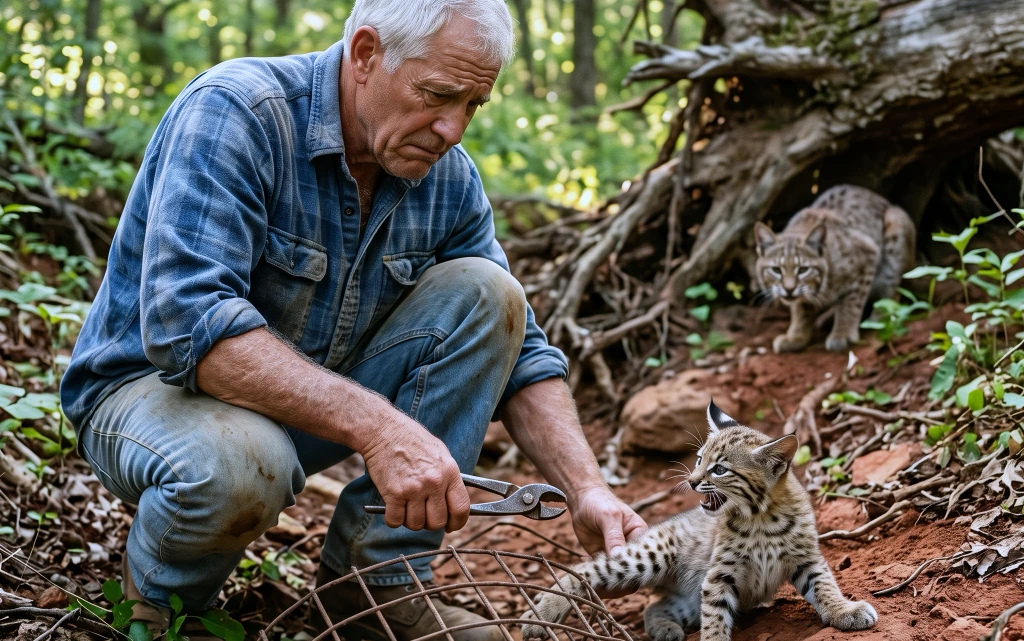
The kitten was in the wire.
Twelve years ago Dale had rolled a length of rusted woven fence into the gully head to slow the washout. Every spring for the last three springs of her life, Carol had asked him to haul it to the scrap yard, and every spring he’d said the bank needed it. Now a spotted kitten hung half inside the coil, its front feet scrabbling at the clay, one hind leg twisted through the mesh at an angle that made Dale’s stomach turn over.
He started down the bank. The mother dropped low and made a sound like canvas tearing, and he stopped with one boot on a root and the other sliding.
“Okay,” he said, and backed up. “Okay. I hear you.”
His side cutters were still on his belt. He’d worn them so long that Carol used to say he’d be buried with them. He could see exactly how the kitten had wound itself in, three turns through the mesh, every pull drawing the wire tighter. It was the kind of tangle he’d spent a career taking apart. It was also wrapped around a living leg, with a twenty-pound mother standing guard over it.
He called the conservation department and got a recording, then a person, then a number. The woman who answered the number said her name was Marisol Vega and asked four questions before she said anything else. How old did the kitten look. Was it still pulling. Where was the mother. Had he touched it.
“Forty minutes,” she said. “Don’t go down there. Not to calm it, not for a better look.”
He went back to the barn and climbed to the loft, because it was the only place he could see the gully without being in it.
Dana’s car came up the drive at a quarter past seven. He watched her carry a paper sack into the house, come out again without it, and walk to the well house. She stood in the doorway long enough to find the milk jug. Then she followed the path to the barn, and he heard her on the ladder.
“You primed it,” she said, coming up through the hatch.
“It needed priming.”
She was still in her dispatch-center fleece, her hair flattened on one side from the headset. She sat down beside him on a bale and followed where he was looking. Eleven years at a dispatch console had taught Dana to find out where before she asked what.
When she found the kitten, her breath went out of her. “Dad. Is that the fence Mom wanted gone?”
He didn’t answer. She didn’t make him.
Marisol Vega drove a farm truck with a dog crate strapped in the bed and a sheet of plywood leaning against it. She was somewhere past sixty, with a gray braid and forearms covered in old white scratches, and she pulled on a pair of welding gloves before she looked at anything. She studied the gully from the barn for a long minute.
“Who knows that wire?” she asked.
“I put it there.”
“Then you’re cutting it. She’s going to fight the blanket, so you’ll get one look. Tell me which strands before we go.”
He told her. Two cuts on the upper loop, then the strand around the leg itself, then the one beneath it, cut away from the foot so nothing pulled. She made him say it twice.
Dana carried the plywood. She stood it on the upslope side of the coil and leaned her shoulder into it, a wall between them and the oak roots. The mother paced behind the root mat, coughing and growling, then slipped back out of sight. Dale heard the other kittens go with her through the dead leaves.
Marisol dropped the blanket over the kitten and pinned it with both gloved hands. The kitten screamed. He made the first cut without deciding to, the way he’d made it on a thousand wet poles. The second wire was tighter than it had looked from the loft. He had to rotate the cutters and come at it from below, and he could feel the small body bucking under the blanket an inch from his knuckles.
“Next one,” Marisol said, her eyes on the blanket.
The fourth strand parted. She lifted the leg free instead of pulling it, and the kitten went limp all at once.
“Crate,” she said. Dana already had the door open.
Inside the crate the kitten found its feet and hissed so hard it sneezed. Dale crouched to look. The eyes were furious and fine. The left hind foot was not. Two of the toes were wrong, swollen dark and turned against each other.
“Vet,” Marisol said. “Today. That toe may have to come off. Possibly two.”
“And her mother?”
“Her mother’s the hard part. I’ll call you tonight.”
When the truck had gone, Dana stood with him at the top of the gully, both of them looking at the cut wire.
“How long have you been watching them?” she asked.
“Three weeks. From the loft.”
“I was here Sunday. We ate supper on the porch.”
He started to say there hadn’t seemed to be anything worth bringing up over supper. Then the mother came back.
She came down the far side of the oak, quick and low, and went into the hollow under the roots. When she came out, a kitten swung from her jaws by the scruff. She crossed the creek on the stones and climbed the other bank, straight for the logging landing where Curtis Ahern’s crew had been cutting white oak on the upper ridge all week. At the edge of the cleared ground stood a slash pile taller than the barn door, a tangle of tops and limbs. She disappeared into it.
She came back for the second kitten, and then the third.
“Curtis is working this Monday,” Dana said slowly. “You told me Sunday. They’re pushing that pile so the trucks can turn.”
“Six a.m. With the dozer.”
“Pushing it where?”
Dale watched the mother come out of the pile with nothing in her mouth and sit at its edge, looking back toward the gully where her fourth kitten had been.
“Into the gully head,” he said. “To hold the bank.”
Dana turned and looked at him. “Whose idea was that?”
“Mine…”
To read the rest of the story – CLICK the NEXT button 👇👇👇