


Sleet had glazed the windshield twice since Caleb Voss pulled into his own driveway. Twice he had run the wipers and watched the ice come back. The truck idled, the heater pushed warm air at his boots, and through the front window of the house Banjo stood with his forepaws on the sill and something yellow in his mouth. His breath made two small clouds on the glass that spread and shrank, spread and shrank.
Caleb had told Jenna he’d be back in forty minutes. He had already spent twenty-five of them right here, hands on the wheel at ten and two like a kid waiting for permission to pull out.
He knew what was in the dog’s mouth. Jenna’s mother had started that hat the fall she got sick, four rows of ribbed yellow wool on a little circular needle, and then she had stopped. Two years later Jenna taught herself to knit from videos on her phone so she could finish it. You could see exactly where one woman’s hands quit and the other’s began. Four rows up, the stitches turned tight and slightly anxious, the way Jenna parallel-parked.
“The hat, Cal,” she’d said from the stretcher that morning. “It’s on the dryer.”
He had told her he had it. He hadn’t had anything.
At ten to eight that morning he’d been eating cereal standing up, still in the thermal shirt from a sixteen-hour shift chasing a windstorm through the townships north of Duluth with Ray Kettunen’s crew. Jenna was in the mudroom fighting her boots. She had three more days of teaching fifth-grade music before her leave started, and she meant to get every one of them.
“Your dog’s having a moment,” she called.
“Before eight he’s your dog.”
“Cal. Come look.”
Banjo was lying across both her boots. He was eighty-five pounds of black shepherd mix with one ear that had never learned to stand up, and he was not playing. When Jenna worked a boot free, he rose and put himself between her and the garage door, legs set wide, head low, eyes on her stomach. He didn’t growl or whine. He simply would not move, and when she tried to step around him he stepped with her, like a dance partner who had decided to lead.
“He did this in the bathroom,” Jenna said. “Sat on the mat and stared at me the whole time I brushed my teeth.”
“He likes the mat.”
“Not like this.” She laughed, but it was the thin laugh she’d had since Clara, the one that seemed to check whether laughing was still allowed.
They had lost their daughter at twenty-three weeks, two winters ago. Four months later Caleb brought home a shelter dog with kennel cough who leaned his whole weight on Jenna for the entire drive, and by Easter she was buying him a raincoat he refused to wear.
Now she bent to tug at the boot, straightened, and stopped with one hand flat on the wall.
“Jen?”
She looked at him puzzled more than frightened, as if she’d heard a wrong note from the back row and couldn’t find who’d played it. Then the pain folded her in half. There was blood on the mudroom tile before he reached her. Banjo barked once, a deep sound Caleb had never heard from him, then went silent and pressed his body against her back while Caleb got her down to the floor and dialed with a thumb that kept missing the numbers.
After that, the day came in pieces with the order knocked out of them. Paramedics’ boots on the kitchen floor. Jenna asking for the hat. The doors of an operating suite at Lakehead Medical swinging shut. A chaplain with snowmelt on her shoulders who said nothing he could remember.
Then Dr. Lise Haugen from pediatrics, tall and gray-eyed, sitting on the edge of a coffee table so her face was level with his. “Your son was born at 9:02. He had no heartbeat. We worked on him for twenty-two minutes. I’m so sorry. We couldn’t bring him back.”
Wesley. Jenna had picked it in October, and Caleb had pretended to argue for a month for the pleasure of losing.
They brought Wes to Jenna when she woke from the anesthesia, a little before ten-thirty. She put him under her gown against her skin and held him there as though the hospital might be wrong about temperature. A nurse named Bev Odegaard came in to do his footprints for the memory card. She pressed each foot to the ink pad, then wiped it clean with a warm cloth, taking her time over every toe.
“He’s holding on to the heat you’re giving him, Mom,” Bev said quietly. Jenna nodded without looking up.
When Bev left, Jenna spoke to the top of Wes’s head. “You forgot the hat.”
“I’ll go get it.”
“Don’t.”
“It’s fifteen minutes.”
“Cal. I’m asking you. Don’t go.”
He went. In the elevator he told himself it was for her. By the parking ramp he’d stopped pretending. The room had a lamp with a pleated shade, a framed print of a loon on open water, and a quiet so thick he couldn’t find air in it, and the whole time he’d stood there his body had been leaning toward the door the way it leaned toward a call-out on a bad night. After Clara he had worked every storm for two months. Jenna had never once asked him to stay home.
Today she had.
Caleb turned off the engine.
Banjo met him in the entry with the hat in his teeth and did not give it up. He carried it to the coat hooks, set it on the floor between his front feet, then reached up and pulled his leash off its hook, as he did every afternoon at five sharp. He dropped that too and looked at Caleb.
“No,” Caleb said. “Not today, buddy.”
He picked up the hat, and Banjo let him. When he went back out into the sleet, the dog came along, not pushing past him but walking at his side, as if the decision had been made somewhere else and they were both just carrying it out. At the truck Banjo planted himself by the passenger door. Caleb took his collar and pulled. Banjo dropped flat on the ice, the whole long weight of him, a trick he’d been using at the vet’s office for two years.
“I can’t take you there,” Caleb said. “They won’t let you in.”
Banjo looked up at him with sleet collecting in the fur between his shoulders.
Caleb thought about Jenna’s voice. He thought about the dog in the mudroom with his legs braced, an hour before anyone in the house knew anything was wrong. Then he went back inside, picked the leash up off the floor, and clipped it to Banjo’s collar himself. When he opened the truck door, Banjo climbed in and sat upright on the passenger seat as if he’d been assigned it.
The birth center was on the fourth floor, behind locked doors with a speaker box. Caleb pressed the button with the leash wrapped twice around his fist and slush dripping off both of them.
“Birth center.”
“Caleb Voss. My wife’s in 4112.” He heard the next part come out before he’d decided to say it. “I’ve got my service dog with me.”
The lock buzzed.
The unit clerk, a young man in a cardigan, stood up so fast his chair rolled into the wall behind him. “Sir. I’m sorry, is that a—”
“Tyler, sit down.” Bev Odegaard came around the nurses’ station with a chart against her chest. She was sixty-one, rangy, with reading glasses pushed up into short gray hair and the flat vowels of someone raised two hours north. She looked at Banjo dripping on her floor, then at the yellow hat in Caleb’s hand.
“That’s not a service dog.”
“No, ma’am.”
“You lied to Tyler.”
“Yes.”
Bev studied the hat a long moment. Caleb watched her decide; it happened in her jaw.
“Leash short,” she said. “He stays on the floor. He doesn’t put his mouth on anything. If Jenna says no, he’s gone and so are you, and you don’t argue with me in the hallway.”
“Bev,” Tyler said, “Colleen’s going to—”
“Colleen knows where I sit.” She turned and walked, and Caleb followed with Banjo’s nails ticking on the tile.
Room 4112 was at the end of the hall. Someone had taped a small card printed with a falling leaf to the door, and everyone who worked on that floor knew how to read it. Bev knocked once. “Jenna, it’s Bev. Your husband’s back. He brought someone with him. You can say no.”
Silence. Then Jenna’s voice, scraped thin. “Who?”
Caleb pushed the door open himself.
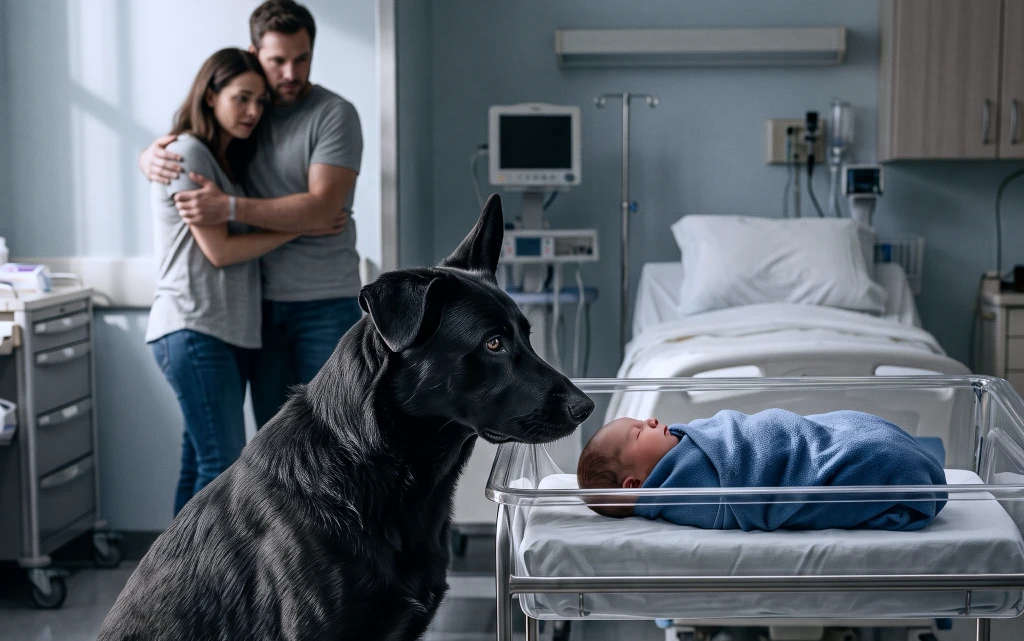
Jenna sat propped up in the bed with Wes against her chest under the open front of her gown and a white blanket over them both. The pink-and-blue striped hospital hat sat crooked on his head. She looked at Caleb, then down at the dog, and something crossed her face too fast for him to read.
“You brought Banjo.”
“He wouldn’t stay.”
Banjo didn’t pull. He crossed the room at the pace a dog uses when someone in the house is sleeping, and raised his nose toward the blanket until it was an inch from the small bare foot that had slipped out at the bottom. He breathed in.
Then he went completely still. His legs spread. His head dropped. His eyes fixed on the baby against Jenna’s chest and stayed there.
Jenna’s lips parted. “Cal,” she whispered. “That’s what he did this morning.”
Bev had come in behind them. Caleb felt her stop.
Jenna wasn’t looking at the dog anymore. She was staring down at her son, and her free hand had gone rigid on the blanket. – “His hand,” she said. “Bev. I didn’t fold his hand like that…”
To read the rest of the story – CLICK the NEXT button 👇👇👇