


Martin Kessler was explaining for the third time why the drain valve under the station sink had to be opened last when Owen turned the laptop around on the kitchen table.
“Hold that thought,” Owen said. “You’re going to want to see this one before you finish the plumbing lecture.”
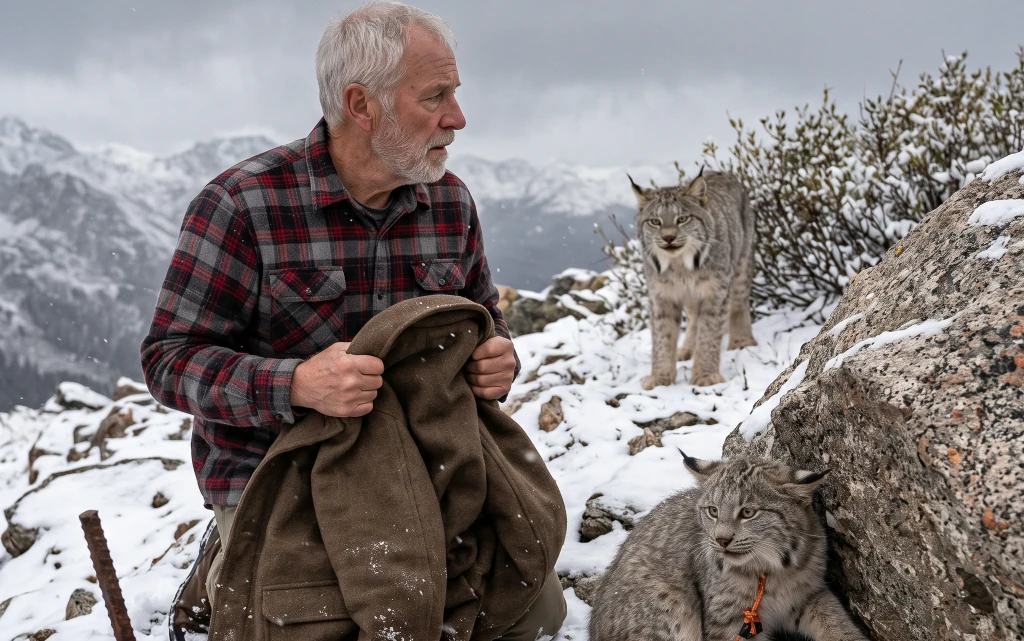
It was the second week of October at Cinder Basin Field Station, at ten thousand eight hundred feet in the mountains above Lake City, Colorado. In three days Martin would hand Owen Pruitt the keys, the generator log, and the job of keeping the place alive until May. He had been the winter caretaker for six seasons. That afternoon his daughter was landing in Montrose to drive him to Ohio on Saturday, and he had already packed four boxes he couldn’t remember filling. He had expected this last week to feel like a retirement. Instead it felt like being walked to a car.
The laptop held the memory card from one of the state wildlife agency’s lynx cameras. The station hosted six of them in exchange for a share of the data, and pulling the cards each month was one of the chores Martin liked best. Most of the clips were wind, ravens, and an elk cow who seemed to enjoy setting off the sensor.
This clip was night footage, gray and grainy, stamped two nights earlier at 1:12 a.m. A female lynx walked out of the willows on the bench below the old plot area, all legs and enormous padded feet. One kitten followed her, round-faced and tufted, close enough to touch her tail. Then a second kitten came into the frame on three legs.
It held its left front paw up against its chest. Behind it, a line ran back into the willows, and when the kitten tried to follow its mother, the line drew tight and stopped it like a dog at the end of a chain. The kitten spun, fell, got up, and lunged again. The mother came back, sniffed the paw, and lay down in the snow beside it.
Owen tapped the screen. “What is that? Wire?”
Martin did not need to lean closer, but he did. The camera turned everything gray except that one thread, which caught the infrared and glowed almost white. He knew its thickness and its sheen. He had ordered six hundred feet of it from a marine supply house the year flagging tape kept shredding in the wind, and he had argued with the station director about the cost.
“It’s braided polyester,” he said. “Orange, in daylight.”
Owen looked at him. “That’s the plot line. The old ones on the upper bench.”
“Plot fourteen. Maybe fifteen. They’re forty yards apart.” Martin heard how even his voice was and disliked it. “I pulled ten of the twelve. I left two.”
He had left them the last week of July, seven summers ago, on a morning when the phone had rung at the station and his daughter had said four words he could still hear in the bones of his ears. Dad. You need to come. Ruth had spent June at the station with him that year, sitting on a foam pad beside his plots with a thermos and a crossword, before she flew home to Ohio to start a treatment her oncologist had called routine. Finish your season, she had told him at the airport. He had.
Owen was already scrolling to the next clip. There were four more from the same night and two from the following evening. In every one, the second kitten was in the same place, fixed to the same point, and in the last one the mother was gone and the healthy kitten was gone and the small anchored animal lay curled in the snow alone.
“Forty hours,” Martin said. “At least.”
“Is that bad?”
“For the leg, it’s very bad.” He stood up too quickly and had to put one hand on the back of the chair. Owen pretended not to notice, which Martin appreciated, and also resented, because it meant Owen had been told what to watch for.
Outside, the sky over Uncompahgre Peak had gone the color of dishwater. The forecast called for eighteen inches by morning. Owen was supposed to drive down to town at three to fill the fuel cans and buy groceries before the road closed, then come back up behind the plow. Martin had insisted. He had wintered here six times. He could manage one night.
He called Dr. Mai Tran from the station phone. She was the state’s wildlife veterinarian for the southwest region, thirty-six years old, and she picked up on the second ring sounding like someone who had been interrupted halfway through a procedure, which she probably had.
He told her what was on the card. She asked him to send the clips, and he heard her breathing change as she watched them.
“Okay,” she said. “That kitten’s at the plot right now?”
“As of yesterday evening.”
“I can’t get over Slumgullion tonight. Nobody can. They’re closing the pass at four.” A pause. “Martin, if the mother’s still around, she’ll be close to it. I don’t want you going up there.”
“The kitten won’t last the night in eighteen inches of snow tied to a stake.”
“It might. They’re tougher than you’d think. And if you’re up there at dark with a storm coming and your heart doing whatever it does—” She stopped. “You told me about your heart when we signed the camera agreement. You told me so I’d say this.”
“I told everyone. It was a condition of staying.”
“Then you know why I’m saying it.”
He waited. She was not someone who filled silence. Finally she exhaled.
“If you go, you take something rigid to put it in. You cut the line away from the leg, not at the leg. Leave the loop for me. Throw a coat over its head before you touch it. If the mother’s there, you back off and you come home. You don’t negotiate with her.”
“Understood.”
“I’m going to call Owen.”
“Owen is driving to town.”
“Then I’m going to call Owen while he drives to town,” she said, and hung up.
Martin took the director’s old dog crate from the storage room, the plastic kind with a wire door, and a canvas tarp to cover it. He took the folding knife he used for cutting specimen labels, a headlamp, his heavy wool coat, and the satellite messenger that sent his position to the station’s account every ten minutes, a condition of his employment that he had considered insulting the year it was imposed. He swallowed one of the pills from the bottle in his shirt pocket. He did not write a note. Owen would know.
The trail to the upper bench climbed seven hundred feet in a little under a mile and a half. In seven years he had walked every other route in the basin, some of them dozens of times. He had botanized the talus below Cinder Point and counted columbine in the avalanche chutes and led summer students on wildflower walks up the creek. He had never once taken the forty-minute climb to the bench where he and Ruth had spent her last June.
The snow started as he crossed the first switchback, small and dry, ticking against the hood of his coat. His breath came hard but even. At the second switchback he stopped to let a gust pass and saw that the willows on the bench above were already blurring.
He knew the bench by its plants. Ruth had liked to say he couldn’t find his own car in a parking lot but could find a single cushion of moss campion in a square mile of rock. The campion was why he had put his plots up here: dense green mounds no bigger than dinner plates, some of them older than the state of Colorado, flowering pink for two weeks in July if the snow let them. He had been measuring how fast they grew. The answer, over twelve years, was very slowly.
Plot fourteen was on the east edge of the bench where the dwarf willow came up against a field of broken rock. He saw the stake first. Rebar, rust-orange, with 14 still faintly white on the cap where he had painted it. The braided line ran from the stake across the rock in a long diagonal and disappeared behind a boulder the size of a stove.
He went around the boulder slowly.
The kitten was wedged into the angle between the rock and the ground, curled tight, its back to the wind. Snow had begun to collect on its fur. It was larger than he had expected, perhaps eight or nine pounds, with the absurd adult feet of its kind already on a body that hadn’t caught up to them. The line went taut from the stake to its left foreleg, where it disappeared into a mass of swollen, matted fur twice the width it should have been.
It lifted its head and looked at him. Its eyes were pale gold and the black tufts on its ears were flattened back. It opened its mouth and made a sound like tearing cloth.
“I know,” Martin said. “I know. I’m the one who did it.”
He set the crate down and opened the door. He took off his coat, and the cold went through his shirt at once. He knelt on the rock and opened the knife.
The willows on the far side of the boulder moved, and not with the wind.
The mother lynx stepped out of them and stopped, no farther away than the length of the station kitchen. She was bigger than she had looked on the camera, gray-brown and long-legged, her face ringed in a ruff of pale fur. Her ears were flat. Her eyes were fixed on his hands, and the low sound coming out of her rose and fell like an engine.
Behind Martin’s breastbone, his heart missed, caught, and broke into the fast, stumbling gallop he had promised three different people would never happen up here again.
To read the rest of the story – CLICK the NEXT button 👇👇👇